
Fortune 500 companies have known something about India’s software development market for decades that most SMEs and mid-market businesses are still discovering: the talent is not just cheaper. At the senior end of the market, it is deep, experienced, and capable of handling the complexity that enterprise software development demands — system integrations that span decades of technical debt, security requirements that span multiple regulatory jurisdictions, performance requirements that span millions of concurrent users.
Google runs its Maps infrastructure team from Hyderabad. Microsoft’s Azure global product teams are anchored in Bangalore. Amazon’s advertising platform has significant engineering leadership based in India. These are not support centres or maintenance teams. They are core product engineering operations, staffed by the same calibre of talent that is available through Indian software development partnerships to businesses that cannot afford FAANG-level salary structures.
This blog covers what enterprise software development in India involves in 2026 — the specific capabilities, the realistic cost picture, and the architectural considerations that determine whether an enterprise software engagement succeeds or creates new technical debt on top of the existing kind.
What Enterprise Software Development in India Actually Means
Enterprise software development is distinct from standard application development in several important ways. The systems are larger, longer-lived, and more tightly integrated with other systems than consumer or startup applications. A poorly architected startup app can be rebuilt in three months when it hits its limits. A poorly architected enterprise system can take three years to untangle, during which the business operates on a foundation that restricts rather than enables its growth.
The categories of enterprise software that Indian development teams build for global clients in 2026:
|
Enterprise Software Category |
Key Technical Requirements |
India Cost Range |
|---|---|---|
|
ERP modules and customisation |
SAP/Oracle integration, workflow automation, multi-entity accounting |
$60,000 – $200,000+ |
|
CRM development and customisation |
Salesforce/Dynamics extensions, pipeline automation, reporting |
$30,000 – $120,000+ |
|
Business Intelligence platforms |
Data warehouse, ETL pipelines, real-time dashboard, executive reporting |
$40,000 – $150,000+ |
|
Workflow automation systems |
BPMN process design, approval chains, SLA monitoring, audit trails |
$35,000 – $130,000+ |
|
Supply chain management systems |
Inventory, procurement, vendor management, multi-location logistics |
$60,000 – $180,000+ |
|
Enterprise SaaS platforms |
Multi-tenant architecture, role-based access, SSO, API-first design |
$50,000 – $200,000+ |
|
Legacy system modernisation |
Code migration, architecture refactoring, API gateway layers |
$40,000 – $160,000+ |
Why Enterprise Software Is Harder Than It Looks
Integration Complexity
Enterprise software does not exist in isolation. It connects to — and depends on — every other system in the organisation’s technology landscape. ERP systems connect to HR, finance, procurement, and logistics. CRM systems connect to marketing automation, support desk, email platforms, and billing systems. BI platforms connect to every data source the business generates.
Each integration is a potential failure point. Data format mismatches, authentication incompatibilities, rate limiting on third-party APIs, webhook reliability under load — these are the engineering challenges that experienced enterprise software developers solve in architecture design rather than in production incidents. Indian teams that have built and maintained enterprise integrations across multiple industries have pattern libraries for these failure modes. Teams encountering them for the first time in your project do not.
Security and Compliance Architecture
Enterprise software handles sensitive business data — employee records, financial transactions, customer information, intellectual property. The security architecture requirements for this data go beyond the standard OWASP Top 10 vulnerability list that most web application developers are familiar with.
Role-based access control (RBAC) at the data level, not just the UI level. Audit logging that is tamper-evident and regulatory-compliant. Encryption at rest and in transit with key rotation policies. SSO integration with enterprise identity providers (Okta, Azure AD, Google Workspace). API security beyond bearer token authentication — mutual TLS, rate limiting, payload signing. Penetration testing against a real threat model before any production deployment.
Indian development companies with genuine enterprise security experience build these requirements into architecture from the beginning. Companies with consumer app experience and no enterprise track record discover them during security review — which is a significantly more expensive place to discover them.
Scalability That Matters at Enterprise Load
Consumer apps scale on two dimensions: user count and request volume. Enterprise software scales on more complex dimensions: concurrent users within scheduled business hours (often a much sharper peak than consumer traffic), transaction volume during period-end close processes, reporting query load on databases that contain years of historical data, and background job processing that runs against the full data set.
The architectural patterns that handle enterprise-scale load — read replicas, query caching strategies, background job queues, database partitioning, connection pooling at the right tier — are decisions that experienced enterprise architects make in sprint one. They are expensive to retrofit onto a system that was not designed with them from the beginning.
The Engagement Model for Enterprise Software Projects
Enterprise software engagements are structured differently from startup app builds. The discovery phase is longer and more detailed — typically four to eight weeks for a complex enterprise system. The development timeline is longer — six to twelve months for mid-to-large enterprise projects. The QA scope is broader — including security penetration testing, performance testing under enterprise load, integration testing across all connected systems, and user acceptance testing with actual business stakeholders.
|
Phase |
Duration |
Deliverables |
India Cost |
|---|---|---|---|
|
Discovery and architecture |
4–8 weeks |
Functional spec, technical architecture, data model, integration map |
$8,000 – $20,000 |
|
UI/UX design |
4–8 weeks |
Enterprise design system, wireframes, prototype |
$8,000 – $25,000 |
|
Core development (sprints) |
16–36 weeks |
Working software increments, sprint demos, integrated modules |
$50,000 – $160,000+ |
|
Integration development |
Parallel or sequential |
All third-party connections, data migration, API layer |
$15,000 – $60,000+ |
|
Security and performance QA |
3–6 weeks |
Penetration test report, load test results, UAT sign-off |
$8,000 – $25,000 |
|
Deployment and handover |
2–3 weeks |
Production deployment, documentation, team training |
$5,000 – $15,000 |
Selecting an Indian Development Partner for Enterprise Software
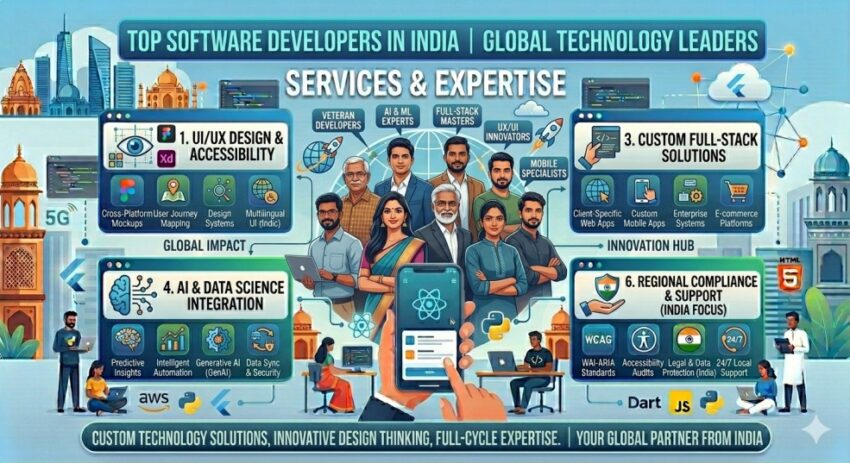
SpaceToTech’s top software developers in India page describes their enterprise capability directly: ‘Extensive experience in various industries such as healthcare, finance, education, e-commerce, and manufacturing. Industry-specific software that caters to each sector’s unique needs. Healthcare software designed to manage patient records and streamline workflow automation, while financial software prioritises data security and regulatory compliance.’ That industry depth — built through repeated production delivery in regulated, high-stakes verticals — is the evaluation signal that matters most when choosing an enterprise software partner.
The questions that reveal genuine enterprise capability: How many enterprise systems have you built that are currently in production with 500+ concurrent users? What is your approach to database performance at 10 million+ records? How do you handle integration failures gracefully — what happens to data integrity when a connected system goes offline? What is your security testing process for systems handling sensitive business data?
Companies that answer these with specifics have earned the capability. Companies that describe their process at a generic level have not.
Conclusion
Enterprise software development in India in 2026 delivers access to the engineering depth, integration experience, security expertise, and scalability architecture knowledge that enterprise-grade systems require — at a cost structure that makes previously unaffordable investments commercially viable. The cost advantage over US or UK development is 65 to 70 percent at the senior level. The quality ceiling, for the right partner, is not a compromise. It is the reason Fortune 500 companies have been building engineering functions in India for two decades. The framework above identifies what that quality looks like in practice and how to verify it before committing to an engagement.