
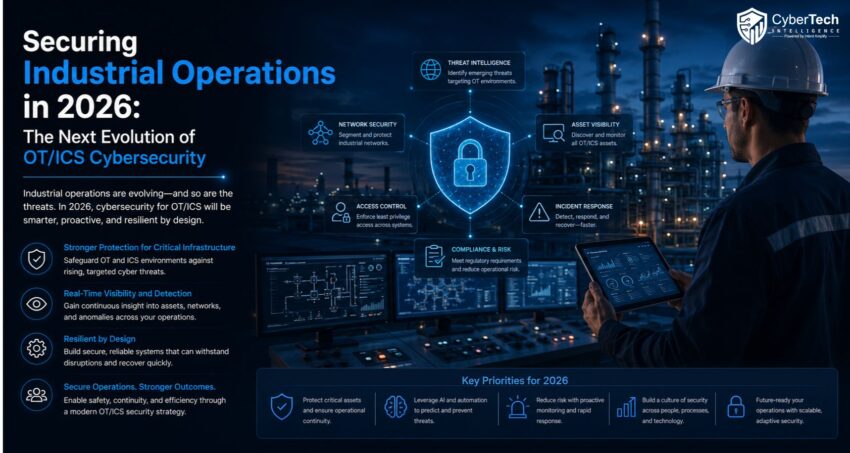
Operational Technology (OT) was once designed with a single objective: keep industrial processes running safely and reliably. Whether controlling power generation, manufacturing equipment, water treatment facilities, transportation systems, or energy distribution networks, these environments were traditionally isolated from corporate IT systems and the public internet. Cybersecurity was rarely considered because physical separation provided a natural layer of protection.
That reality has changed.
In 2026, industrial environments are becoming more connected than ever. Organizations are integrating operational technology with cloud platforms, enterprise applications, predictive maintenance systems, Industrial Internet of Things (IIoT) devices, AI-driven analytics, and remote operations to improve efficiency and business performance. While these innovations deliver measurable operational benefits, they also expose industrial systems to previously unimaginable cyber risks.
Modern attackers no longer distinguish between IT and OT environments. Ransomware groups, state-sponsored actors, and financially motivated cybercriminals increasingly target industrial control systems because disrupting physical operations often creates greater business impact than stealing data alone.
Protecting operational technology today requires more than isolating industrial networks. Organizations must build security strategies that preserve safety, ensure operational continuity, and improve visibility across increasingly interconnected industrial environments without interrupting critical processes.
Why Traditional OT Security Approaches Are No Longer Sufficient
For many years, industrial environments relied on the principle of isolation.
Control systems operated within closed networks, engineering workstations remained on-site, and production equipment rarely communicated with external systems.
Today’s industrial operations are fundamentally different.
Organizations now depend on:
- Industrial Internet of Things (IIoT) devices
- Remote engineering access
- Cloud-connected operational platforms
- AI-powered predictive maintenance
- Enterprise resource planning (ERP) integration
- Third-party maintenance providers
These connections improve productivity but also create additional pathways for cyber threats to reach operational environments.
Traditional perimeter defenses alone cannot provide adequate protection when industrial assets continuously exchange information with business applications, cloud services, and external vendors.
Modern OT/ICS security focuses on understanding operational risks while securing communications across both IT and OT environments.
The Core Principles of OT/ICS Security
Effective OT security requires balancing cybersecurity with operational reliability.
Unlike traditional IT environments, industrial systems cannot simply be restarted or patched without considering production schedules, safety requirements, and operational continuity.
Build Complete Visibility Across Industrial Assets
Many organizations still lack a complete inventory of connected industrial assets.
Security teams should continuously identify:
- Industrial controllers
- Human-machine interfaces (HMIs)
- Engineering workstations
- IIoT devices
- Industrial servers
- Network communication paths
Comprehensive visibility helps organizations understand what exists in operational environments and identify assets that require additional protection.
Secure Communications Between IT and OT
Business systems and industrial environments increasingly exchange operational data.
While this connectivity improves efficiency, it also increases cyber risk if communication pathways are not properly secured.
Organizations should carefully manage interactions between enterprise networks and industrial control systems to reduce unnecessary exposure while supporting operational requirements.
Strengthen Remote Access Security
Remote maintenance has become an essential component of industrial operations.
Equipment manufacturers, engineering teams, and service providers frequently require access to production systems for diagnostics and maintenance.
Strong authentication, session monitoring, and controlled access policies help organizations reduce risks associated with third-party connectivity while maintaining operational flexibility.
Continuously Monitor Industrial Activity
Industrial cyberattacks rarely begin with immediate operational disruption.
Subtle changes in network communications, controller behavior, or engineering activity often provide early indicators of compromise.
Continuous monitoring enables organizations to identify unusual activity before attackers affect production processes or critical infrastructure.
Industry Spotlight: Energy & Utilities
Energy providers operate some of the world’s most critical infrastructure, including power generation facilities, substations, transmission networks, and renewable energy assets.
As smart grid technologies, remote operations, and cloud-connected monitoring continue expanding, protecting operational technology has become essential for maintaining service reliability.
Modern OT/ICS security enables energy organizations to improve visibility across industrial environments, strengthen remote access controls, and detect suspicious operational activity before it impacts critical infrastructure or public services.
By securing operational resilience, energy providers also strengthen national infrastructure protection.
Industry Spotlight: Manufacturing
Manufacturing facilities continue adopting industrial automation, robotics, AI-assisted production planning, and connected factory technologies to improve efficiency and product quality.
These innovations depend on seamless communication between operational technology and enterprise business systems.
OT/ICS security helps manufacturers monitor industrial communications, protect production equipment, reduce operational disruptions, and strengthen resilience against cyber threats targeting intellectual property and manufacturing operations.
As Industry 4.0 initiatives mature, cybersecurity becomes a critical component of production reliability rather than simply an IT function.
Why OT/ICS Security Supports Operational Resilience
OT security has evolved far beyond protecting industrial networks.
Organizations implementing mature OT/ICS security programs often achieve:
- Improved visibility across industrial environments
- Reduced operational cyber risk
- Better protection for critical infrastructure
- Stronger IT and OT collaboration
- Faster identification of abnormal operational behavior
- Enhanced regulatory compliance
- Greater confidence in industrial modernization initiatives
Rather than slowing innovation, effective OT security enables organizations to modernize industrial operations while maintaining safety, reliability, and business continuity.
Building a Successful OT/ICS Security Strategy
Strengthening industrial cybersecurity requires collaboration between operations, engineering, cybersecurity, and executive leadership.
Organizations should prioritize:
- Maintaining a complete inventory of operational assets
- Segmenting industrial and enterprise networks appropriately
- Securing remote vendor and engineering access
- Continuously monitoring industrial communications.
- Incorporating threat intelligence into operational security
- Developing incident response plans specifically for OT environments
- Regularly assessing cyber risks affecting critical operations.
Security investments should support operational objectives while minimizing disruption to industrial processes that organizations depend on every day.
Organizations looking to strengthen their OT/ICS Security strategy can improve operational resilience by implementing continuous industrial visibility, secure remote access, network segmentation, and intelligent monitoring across critical operational environments.
The Future of OT/ICS Security
Industrial cybersecurity will continue evolving alongside automation, artificial intelligence, and connected infrastructure.
Future capabilities are expected to include:
- AI-assisted industrial anomaly detection
- Predictive operational risk analysis
- Autonomous monitoring of industrial networks
- Continuous asset discovery across OT environments
- Integrated visibility between IT and OT security operations
- Digital twin technologies supporting cyber resilience planning
Organizations adopting these capabilities early will improve operational reliability while strengthening their ability to defend increasingly connected industrial environments.
Final Thoughts
Industrial organizations are entering a new era where operational efficiency and cybersecurity are inseparable.
As operational technology becomes more connected through cloud services, AI-driven analytics, and digital transformation initiatives, protecting industrial environments requires continuous visibility, collaboration, and security strategies designed specifically for operational systems.
Organizations that invest in OT/ICS security today will be better prepared to safeguard critical infrastructure, maintain operational continuity, and support the secure modernization of industrial operations throughout 2026 and beyond.