
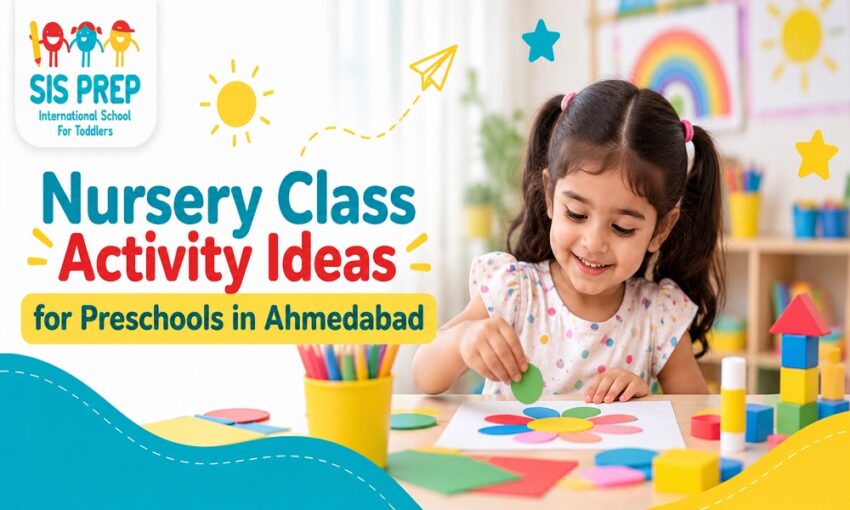
Early childhood is a time when children naturally explore, question, experiment, and learn through everyday experiences. For this reason, a well-planned nursery class activity can be much more than a way to keep young learners engaged. Activities can help children develop communication, creativity, coordination, confidence, problem-solving abilities, and social skills while making learning enjoyable.
For preschools in Ahmedabad, activity-based learning can create meaningful opportunities for children to learn through seeing, hearing, touching, moving, and doing. SIS PREP Ahmedabad follows this kind of interactive approach in its Nursery programme, where activities are regularly varied to maintain children’s interest while supporting focus and concentration.
Why Nursery Class Activities Matter
Young children learn differently from older students. Instead of relying primarily on lectures or memorisation, nursery learners benefit from hands-on experiences that allow them to participate actively. A thoughtfully designed nursery class activity can introduce concepts naturally while encouraging children to investigate their surroundings.
At SIS PREP, the Nursery programme focuses on creativity, communication, confidence, critical thinking, and collaboration. Children are encouraged to participate actively and respond to their teachers and learning materials. The programme also recognises that every child develops physically, intellectually, socially, and emotionally at an individual pace.
1. Colour Sorting Activity
Colour sorting is a simple activity that introduces children to colours while developing observation and classification skills. Teachers can provide safe objects in different colours and ask children to place similar colours together.
The activity can be adapted according to the children’s abilities. Younger learners can begin with two or three colours, while children who are ready for greater challenges can identify additional shades or patterns.
2. Shape and Number Games
Early numeracy does not have to begin with worksheets. A nursery class activity involving blocks, cards, puzzles, or everyday objects can introduce numbers, shapes, counting, matching, and basic reasoning.
Children can count objects, identify circles and squares, arrange items according to size, or match corresponding shapes. These activities make mathematical concepts tangible and encourage children to discover relationships independently.
SIS PREP’s Nursery curriculum includes problem solving, reasoning and numeracy, making activities involving numbers and shapes relevant to its broader learning approach.
3. Storytelling and Picture Talk
Storytelling provides an excellent opportunity to develop language and communication. Teachers can use picture books, puppets, objects, or simple story cards to encourage children to listen and respond.
After telling a short story, teachers can ask questions such as, “What happened next?” or “Which character did you like?” Children can also describe pictures in their own words.
This type of nursery class activity supports vocabulary, listening, imagination, confidence, and early literacy. Communication and English, languages and literacy are among the learning areas identified in SIS PREP’s Nursery programme.
4. Music, Rhythm and Movement
Music allows young children to learn through sound and movement. Simple songs, clapping patterns, action rhymes, and movement games can make classroom sessions energetic while supporting coordination and listening.
Teachers can introduce different rhythms and invite children to copy them. Children may also move according to a song or create their own simple movements.
SIS PREP specifically includes rhythm and rhyme and music appreciation within its Nursery learning areas, supporting opportunities for children to experience music as part of early learning.
5. Art and Creative Expression
Art activities allow children to communicate ideas without depending entirely on spoken language. Drawing, painting, collage, clay modelling, and printing can encourage imagination and experimentation.
Rather than expecting every child to produce an identical finished product, teachers can provide suitable materials and allow children to explore different ways of using them. This approach supports creativity and self-expression.
SIS PREP’s broader educational philosophy is inspired by the Reggio Emilia approach and recognises multiple forms of expression, including words, movement, art, play, imagination, music, stories, discovery, nature, and collaboration.
6. Sensory Exploration
Sensory activities can introduce children to different textures, sounds, shapes, colours, and materials. A supervised sensory tray, for example, can contain age-appropriate objects that children can observe and explore.
Teachers can encourage children to describe whether something feels soft, rough, smooth, heavy, or light. Such activities can promote vocabulary while encouraging curiosity and observation.
The key is to keep materials safe, age-appropriate, hygienic, and closely supervised.
7. Nature Discovery
Nature can become an extension of the classroom. A short, supervised observation activity can encourage children to notice leaves, flowers, insects, textures, colours, or sounds around them.
Teachers can ask open-ended questions rather than providing every answer immediately. “What do you notice?” and “Why do you think this happened?” can encourage children to observe and think.
SIS PREP’s philosophy includes nature and discovery among the ways children can express themselves and learn about their world.
8. Pretend Play and Role Play
Role play allows children to recreate familiar experiences such as shopping, visiting a doctor, preparing food, or travelling. It can encourage imagination while giving children opportunities to communicate and cooperate with classmates.
Pretend play can also help teachers understand children’s interests and provide opportunities for children to express ideas in their own ways.
Choosing Activities for Nursery Children
A successful nursery class activity should be age-appropriate, flexible, safe, and connected to a meaningful learning objective. Teachers should consider each child’s interests, developmental stage, comfort level, and preferred way of participating.
SIS PREP Nursery is structured for children from approximately 30 to 48 months, with Nursery 1 designed for 30–42 months and Nursery 2 for 42–48 months. The programme uses a three-hour, five-day-a-week structure, with programme duration varying between Nursery 1 and Nursery 2.
Activity-Based Learning at SIS PREP Ahmedabad
SIS PREP Ahmedabad describes itself as a Reggio-Emilia-approach preschool with campuses at Gulbai Tekra and S.P. Ring Road. Its curriculum combines play-based activities, collaborative group work, and a multisensory approach intended to support holistic development.
For parents exploring preschools in Ahmedabad, looking at the types of activities offered can provide useful insight into how children experience learning each day. The most meaningful activities are not necessarily the most complicated ones. Simple opportunities to create, move, communicate, discover, solve problems, and collaborate can help young learners build a strong foundation for their educational journey.
Ultimately, a thoughtfully planned nursery class activity should make children curious enough to ask questions, confident enough to participate, and comfortable enough to learn at their own pace. This combination of play, exploration, creativity, and purposeful learning can make the nursery years joyful and meaningful.