
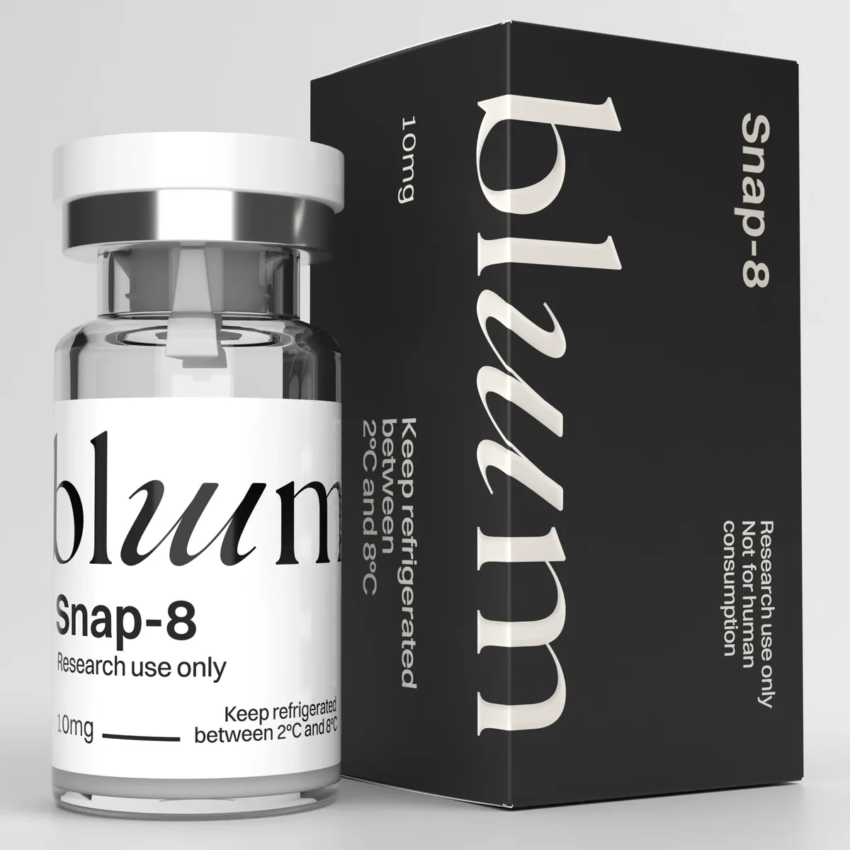
The neuromuscular junction (NMJ) is a critical chemical synapse where motor neuron signals transition into mechanical muscular contraction. Central to this process is vesicle-mediated neurotransmitter release: acetylcholine ($text{ACh}$) stored in presynaptic vesicles must fuse with the terminal axon membrane to enter the synaptic cleft.
This vesicular fusion process is driven by the Soluble $N$-Ethylmaleimide-Sensitive Factor Attachment Protein Receptor (SNARE) complex. Disrupting or modulating this protein scaffold provides a targeted mechanism for controlling localized muscle contractions, hyper-functional facial lines, and peripheral neuromuscular signaling.
While irreversible enzymatic toxins (such as botulinum neurotoxins) permanently cleave SNARE proteins, synthetic peptide mimetics offer a safer, non-cytotoxic alternative. At the forefront of competitive SNARE inhibition is the SNAP 8 peptide sequence (acetyl-octapeptide-3).
By mimicking the N-terminal end of SNAP-25, this octapeptide reversibly competes for assembly within the SNARE complex, attenuating neurotransmitter exocytosis without causing cell damage.
1. Biomechanics of the SNARE Core Complex at the Synaptic Cleft
To understand how neurotransmission is modulated at the NMJ, it is necessary to examine the assembly mechanics of the SNARE core complex:
The functional SNARE complex consists of a stable four-helix bundle formed by three core proteins:
-
Synaptobrevin / VAMP: A vesicle-membrane protein (v-SNARE).
-
Syntaxin-1: A target-membrane protein (t-SNARE).
-
SNAP-25: A target-membrane protein that contributes two $alpha$-helices to the four-helix bundle.
When an action potential arrives at the nerve terminal, voltage-gated calcium channels ($text{Ca}^{2+}$) open, triggering the SNARE complex to pull the vesicle membrane against the presynaptic membrane. This fusion forms a pore that releases acetylcholine into the synaptic cleft, where it binds to postsynaptic nicotinic receptors to trigger muscle contraction.
2. Competitive Inhibition via the SNAP 8 Peptide Sequence
The SNAP 8 peptide sequence (Ac-Glu-Glu-Met-Gln-Arg-Arg-Ala-Asp-$text{NH}_2$) acts as an N-terminal structural analogue of native SNAP-25. Rather than enzymatically degrading the SNARE complex, it functions via competitive biochemical inhibition:
-
Competitive Displacement: The octapeptide competes directly with native SNAP-25 for binding positions alongside Syntaxin-1 and Synaptobrevin.
-
Scaffold Destabilization: When the SNAP-8 sequence incorporates into the developing four-helix bundle, it creates a structurally incomplete scaffold that cannot generate the mechanical force required for full membrane fusion.
-
Attenuated Acetylcholine Exocytosis: Unfused or destabilized vesicles remain within the presynaptic terminal, significantly reducing the volume of acetylcholine released into the synaptic cleft.
-
Reversible Recovery: Because the interaction is non-enzymatic, the peptide slowly dissociates over time, restoring baseline SNARE assembly and normal synaptic transmission without causing long-term nerve terminal dysfunction.
3. Comparative Profile: Irreversible Toxins vs. Reversible Octapeptides
Comparing irreversible enzymatic cleavage against competitive octapeptide inhibition highlights the advantages of non-cytotoxic neuromuscular modulation:
| Parameter / Mechanism | Botulinum Neurotoxin Type A (BoNT/A) | SNAP 8 Peptide Sequence | Biological & Experimental Impact |
| Mode of Action | Irreversible enzymatic cleavage of SNAP-25 | Reversible competitive displacement of SNAP-25 | Prevents permanent nerve terminal damage or synaptic loss. |
| Duration of Effect | Months ($90 – 120text{ days}$) | Controlled, dose-dependent, and fully reversible | Allows fine control over duration of action in pre-clinical assays. |
| Cytotoxicity Risk | High systemic toxicity risk | Non-cytotoxic, high biocompatibility profile | Ideal for cell-based cosmetic and topical research. |
| Receptor Selectivity | Requires polysialoganglioside binding | Direct competitive peptide scaffold assembly | Bypasses complex receptor-mediated cell entry requirements. |
| Formulation Stability | Highly labile, temperature-sensitive protein | Stable synthetic octapeptide sequence | Resists rapid enzymatic degradation when properly stored. |
4. Analytical Quality Metrics for Research Procurement
Because synthetic octapeptides are susceptible to incomplete sequence assembly or deletion fragments during solid-phase peptide synthesis (SPPS), strict quality control procedures are essential.
5. Summary and Strategic Takeaways
Attenuating neuromuscular junction signaling via SNARE complex modulation provides a precise method for regulating synaptic exocytosis. Unlike permanent enzymatic neurotoxins, the SNAP 8 peptide sequence provides controlled, reversible competitive inhibition by mimicking native SNAP-25 helices and destabilizing the presynaptic fusion machinery.
For research laboratories evaluating neuromuscular modulation, cell-based exocytosis assays, or topical anti-wrinkle formulations, sourcing high-purity, analytically verified peptide lots ensures reproducible experimental results and publication-grade data.