
Software-as-a-Service (SaaS) has fundamentally transformed how modern enterprises operate. From collaboration platforms and customer relationship management systems to human resources, finance, marketing, and development tools, SaaS applications now support nearly every business function. Their flexibility and scalability have accelerated digital transformation, enabling organizations to innovate faster and adapt more quickly to changing business needs.
However, the rapid adoption of SaaS has also introduced a new cybersecurity challenge. As organizations deploy dozens – or even hundreds – of cloud applications across departments, maintaining visibility into configurations, user access, third-party integrations, and sensitive data becomes increasingly difficult. In many cases, security teams are unaware of misconfigurations, excessive permissions, or dormant accounts until an incident occurs.
Unlike traditional infrastructure, SaaS environments operate beyond the direct control of enterprise IT teams. Responsibility for securing these platforms is shared between service providers and customers, making configuration management, identity governance, and continuous monitoring essential components of enterprise security.
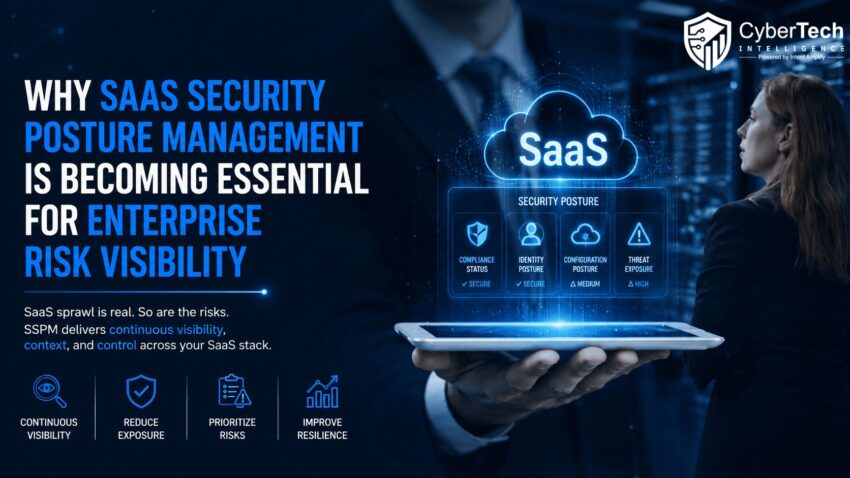
This evolving landscape has elevated SaaS Security Posture Management (SSPM) from a niche capability to a strategic security function. Rather than relying on assumptions that cloud services are secure by default, organizations are using SSPM to gain evidence-based visibility into SaaS risks, strengthen governance, and improve cyber resilience across increasingly complex cloud ecosystems.
Why Traditional SaaS Security Approaches Are No Longer Enough
Many organizations initially approached SaaS security with the assumption that cloud providers were responsible for protecting their environments.
While providers secure the underlying infrastructure, customers remain responsible for configuring applications, managing user identities, protecting sensitive data, and controlling access.
As SaaS adoption continues to grow, organizations now manage:
- Business collaboration platforms
- Customer relationship management (CRM) systems
- Human resources applications
- Financial and accounting platforms
- Marketing automation tools
- Development and productivity applications
Each platform introduces unique security settings, permission structures, third-party integrations, and compliance requirements.
Without centralized visibility, security teams often struggle to identify configuration drift, unnecessary administrative privileges, inactive accounts, or risky application connections that increase enterprise exposure.
SSPM addresses these challenges by continuously assessing SaaS environments and identifying security risks before they become business incidents.
The Core Principles of SaaS Security Posture Management
Effective SSPM focuses on continuously improving the security posture of enterprise SaaS environments rather than reacting to incidents after they occur.
Maintain Continuous Configuration Visibility
Misconfigurations remain one of the most common causes of SaaS-related security incidents.
SSPM continuously evaluates application configurations against security best practices, helping organizations identify settings that increase exposure or violate internal security policies.
Continuous visibility enables security teams to correct issues before attackers exploit them.
Strengthen Identity and Access Governance
Identity remains the primary gateway into SaaS environments.
SSPM helps organizations identify excessive permissions, inactive accounts, privileged users, and authentication weaknesses across multiple applications.
Strengthening identity governance reduces unauthorized access while supporting Zero Trust principles across cloud environments.
Monitor Third-Party Integrations
Many SaaS platforms rely on connected applications, APIs, and external integrations to improve functionality.
While these integrations enhance productivity, they can also introduce additional security risks if permissions are overly broad or insufficiently monitored.
SSPM provides visibility into connected applications, helping organizations evaluate whether integrations align with security and compliance requirements.
Improve Compliance Readiness
Organizations operating in regulated industries must demonstrate consistent governance across cloud environments.
SSPM simplifies compliance efforts by continuously monitoring security configurations, documenting posture improvements, and providing evidence that supports internal audits and regulatory assessments.
This proactive approach reduces compliance gaps while improving overall security maturity.
Industry Spotlight: Technology & Telecommunications
Technology and telecommunications organizations depend heavily on SaaS platforms to support software development, customer engagement, cloud operations, collaboration, and service delivery.
The growing number of cloud applications increases the complexity of managing identities, configurations, and third-party integrations across distributed environments.
SSPM enables these organizations to strengthen visibility, reduce configuration risk, and maintain consistent security policies while supporting rapid business innovation.
Industry Spotlight: Business Services
Business services organizations routinely manage sensitive client information, financial records, contracts, and operational data across numerous SaaS platforms.
As employees adopt new cloud applications to improve productivity, maintaining consistent governance becomes increasingly challenging.
SSPM helps organizations monitor their SaaS security posture, reduce exposure from excessive permissions or configuration weaknesses, and strengthen client trust through improved cloud security governance.
Why SSPM Supports Business Resilience
SaaS Security Posture Management is no longer simply a cloud security tool – it is a business resilience capability.
Organizations implementing mature SSPM strategies often achieve:
- Greater visibility across SaaS environments
- Improved identity and access governance
- Reduced configuration-related security risks
- Better compliance readiness
- Stronger third-party application oversight
- Faster identification of security posture gaps
- Increased confidence in cloud adoption
Rather than responding to cloud security incidents after they occur, organizations strengthen their ability to prevent misconfigurations from becoming operational risks.
Building a Successful SSPM Strategy
Developing an effective SSPM program requires collaboration between cybersecurity, IT operations, cloud administrators, governance teams, and business stakeholders.
Organizations should prioritize:
- Maintaining a complete inventory of enterprise SaaS applications
- Continuously monitoring security configurations.
- Strengthening identity and access governance
- Reviewing third-party integrations regularly
- Automating posture assessments where possible
- Aligning SaaS security with compliance requirements
- Continuously measuring security posture improvements.
Security leaders should treat SSPM as an ongoing governance capability that evolves alongside enterprise cloud adoption rather than as a one-time implementation project.
Organizations looking to strengthen their SaaS Security Posture Management (SSPM) strategy can improve enterprise risk visibility by implementing continuous configuration monitoring, identity governance, third-party integration oversight, and proactive security posture assessments across their SaaS ecosystem.
The Future of SaaS Security Posture Management
As organizations continue expanding their SaaS ecosystems, SSPM will become increasingly intelligent, automated, and risk-aware.
Future capabilities are expected to include:
- AI-assisted posture analysis
- Automated configuration remediation
- Continuous identity risk scoring
- Intelligent third-party integration monitoring
- Predictive SaaS exposure analytics
- Unified cloud security posture reporting.
These advancements will help organizations move from reactive cloud security management to continuous risk optimization across increasingly complex SaaS environments.
Final Thoughts
SaaS applications have become indispensable to modern business operations, but they have also introduced new security challenges that extend beyond traditional infrastructure management.
SaaS Security Posture Management provides organizations with the visibility, governance, and continuous monitoring needed to secure rapidly growing cloud environments. By identifying configuration weaknesses, strengthening identity controls, and improving oversight of third-party integrations, SSPM enables enterprises to make informed security decisions based on evidence rather than assumptions.
Organizations that invest in SSPM today will be better positioned to reduce cloud risk, strengthen cyber resilience, and support secure digital transformation as SaaS adoption continues to accelerate.