
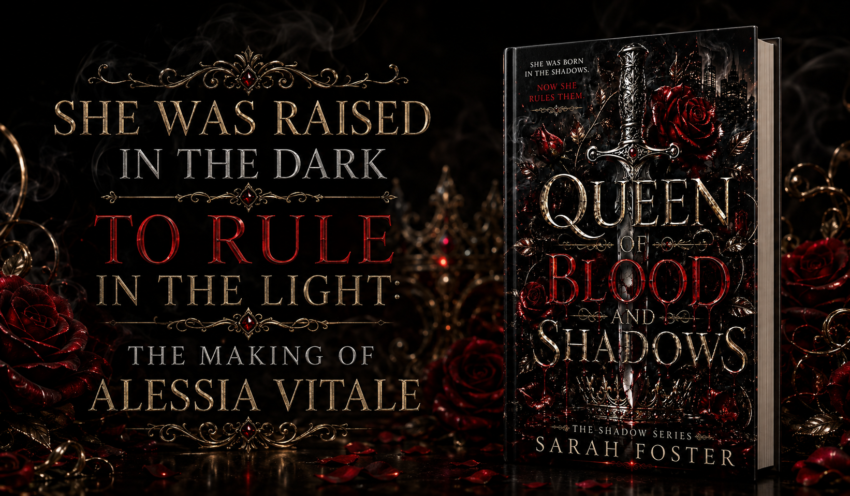
A throne arrives before the grief is finished, as Queen of Blood and Shadows does not introduce Alessia Vitale with a victory. It introduces her beside her dying father. Lorenzo Vitale, the man whose name has held an empire together through loyalty, fear, and blood, is gone, and Alessia has barely had time to understand the loss before the title waiting for her becomes real. She is not allowed the ordinary privacy of grief. Powerful men are already preparing to judge the successor, and most of them assume that successor will be Raffaele Moretti.
That opening matters because Alessia’s rise is never presented as a simple power fantasy. The crown has weight. It arrives with an empty chair at the breakfast table, a father’s watch on her wrist, a mother’s ring on her hand, and a younger brother who still needs her to be his sister. Alessia becomes compelling because the story lets all those identities exist at once.
She can order men into battle and still miss her father. She can terrify a room and later need quiet. Power does not erase her humanity. It exposes it.
The Woman Everyone Underestimated
For years, the underworld believes Lorenzo has hidden his daughter away behind private schools, travel, and protection. The truth is far more interesting. Alessia has spent more than a decade learning combat, weapons, strategy, discipline, and control. She has not been sheltered from the machinery of the Vitale empire. She has been studying it from behind the curtain.
The men around the table are expecting a familiar transfer of power. Instead, Alessia enters in a sharply tailored suit and calmly takes the place they thought belonged to someone else. Her authority does not come from shouting. It comes from preparation. She knows the organization. She knows the men. More importantly, she knows what they do not know about her.
Her femininity is not treated as something she must surrender to become formidable. Alessia wears designer clothes, heels, jewelry, makeup, and carefully styled hair. Some of those heels also conceal blades. The image is almost a thesis statement for the character: elegance and danger are not competing identities.
When men object to a woman leading them, Alessia does not spend the novel begging for validation. She demonstrates competence, remembers details, asks intelligent questions, makes decisions, and, when necessary, reminds people that disrespect has consequences. By the time skeptical family heads begin leaving meetings impressed or nervous, she has done something more satisfying than proving she can imitate Lorenzo. She has established her own method of rule.
The Shadow Behind the Queen
The title Queen of Blood and Shadows becomes most meaningful when the novel reveals that Alessia is not only an underworld leader but also a protector of the innocent. She is also one of the Vitale Shadows, the covert group built beneath the estate and trained to move with speed, secrecy, and lethal precision.
The hidden compound gives physical form to Alessia’s double life. Above ground are meetings, suits, family politics, legal documents, and ceremonial authority. Below ground are armories, tunnels, a dojo, surveillance rooms, weapons training, and the people who know what she can really do.
Her connection to the Shadows also ties her to her mother, Serafina. Serafina was not simply a glamorous memory from childhood. She was a feared assassin who hunted traffickers, war criminals, and predators beyond the reach of ordinary justice. Alessia eventually understands that her father’s relentless preparation was not an attempt to remake her solely in his image. He was preserving the strengths of both parents: Lorenzo’s command and Serafina’s deadly precision.
That realization changes the emotional meaning of Alessia’s training. Her skill is not just spectacle. It is inheritance.
Grief Is the First Enemy She Cannot Shoot
The novel gives Alessia plenty of external enemies, from traitors who reject her authority to attackers, kidnappers, and ghosts from the Vitale family’s past. Yet one of the most effective conflicts is the one she cannot solve with a weapon.
Grief keeps interrupting her.
It appears in her hesitation before sitting in Lorenzo’s chair. It appears in the cathedral when memories of her mother return. It appears when Nico disappears, and Alessia’s identity as Capo collapses beneath the fear of a sister who thinks she has failed the promise she made to her father.
Those moments prevent her from becoming a polished symbol of invulnerability. Alessia can command hundreds of armed people, but she cannot command loss to stop hurting. She can lead a rescue operation, but she cannot make herself immune to fear. She can rule an empire, but there are still moments when someone she trusts has to help carry the weight.
Leadership Without Becoming a Copy
Lorenzo’s reputation hangs over nearly every early decision. People compare her to him, remember him, fear what his death means, and wonder whether she can keep his world intact. Alessia herself feels the pressure. But the story gradually shifts the question from “Can she replace Lorenzo?” to “What will the empire become under Alessia?”
Her leadership draws on observation as much as intimidation. She listens before speaking. She values information. She relies on Nico’s technological instincts, Raff’s experience, the Shadows’ expertise, and the loyalty of allied families. She accepts that power is not the same thing as isolation.
Even her relationship with Damian Donati develops alongside that lesson. His instinct is to protect her with almost frightening intensity, but Alessia repeatedly makes one point clear: she is not a fragile prize waiting behind him. The relationship works best when protection becomes partnership, when he learns the woman he wants to guard is also capable of walking into the darkness beside him.
A Queen Who Chooses What Inheritance Means
The proposed union between the Vitale and Donati families initially feels like one more decision made for her by men, including men she loved. Alessia’s anger is understandable because she has spent years training to stand on her own. The crucial shift comes when the marriage stops being merely an arrangement inherited from the dead and becomes something she chooses for herself.
She does not reject inheritance. She claims the right to interpret it.
She keeps the Vitale name. She brings Damian into the world of the Shadows. She helps turn two powerful families into one empire without disappearing inside the merger. She carries Lorenzo’s lessons and Serafina’s legacy, but neither parent gets the final word on who Alessia becomes.
Why Alessia Vitale Stays With the Reader
Dark romance is full of dangerous men, inherited empires, family wars, and women pulled into violent worlds. Queen of Blood and Shadows changes the center of gravity. Alessia is not being introduced to danger. Danger has been part of her education.
She begins as the woman who would rather remain behind the curtain. Circumstance forces her into the room, enemies test whether she belongs there, and grief repeatedly threatens to pull the ground from beneath her. Still, she stays.
Because every time the story gives her another reason to disappear into the shadows, Alessia learns how to step out of them without losing the part of herself that was forged there.