
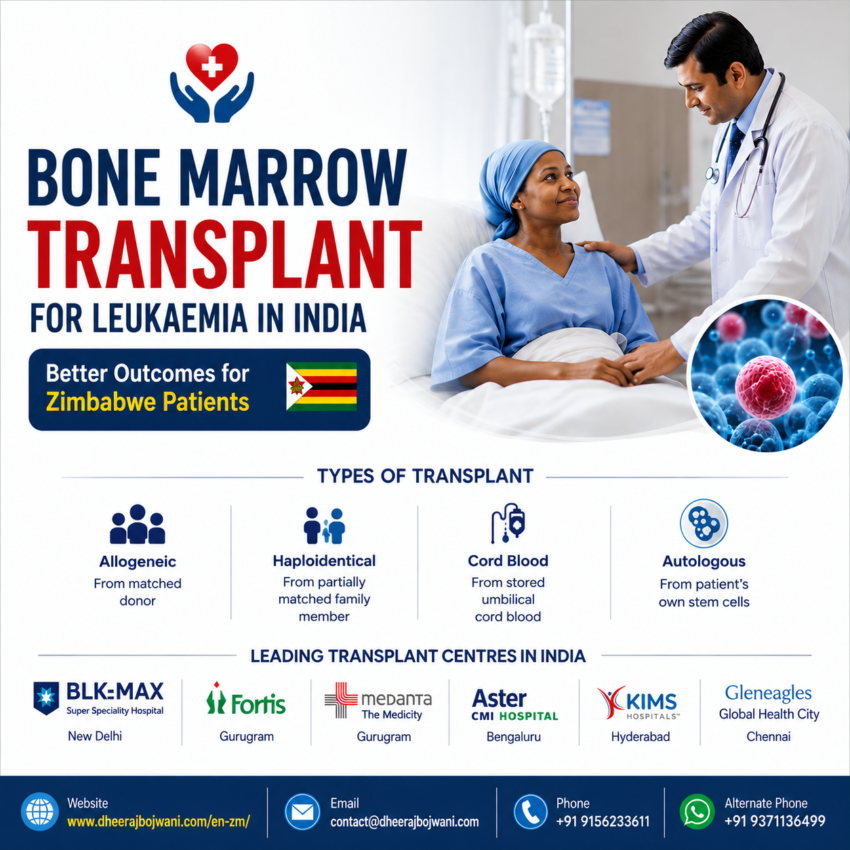
Bone marrow transplant, medically known as haematopoietic stem cell transplantation, can be an important treatment for selected patients with leukaemia. It replaces unhealthy or damaged blood-forming cells with healthy stem cells, allowing the bone marrow to begin producing normal blood cells again.
For patients travelling from Zimbabwe, India offers specialised transplant centres with experienced haematologists, advanced HLA-matching laboratories, infection-controlled transplant units and multidisciplinary follow-up. However, transplant is not suitable for every person with leukaemia. The decision depends on the exact disease type, genetic risk, treatment response, donor availability, age and general health.
Also Read :-Bone Marrow Transplant Treatment for Zambians Patients
When Is a Transplant Considered?
A transplant may be recommended for selected patients with:
- Acute myeloid leukaemia
- Acute lymphoblastic leukaemia
- Chronic myeloid leukaemia that does not respond adequately to medicines
- High-risk or relapsed leukaemia
- Leukaemia with unfavourable genetic or molecular findings
- Persistent measurable residual disease after chemotherapy
India’s National Cancer Grid guidelines include stem cell transplantation within the treatment pathway for selected high-risk, persistent or relapsed haematological cancers.
Types of Bone Marrow Transplant
|
Transplant type |
How it works |
|
Allogeneic transplant |
Stem cells are collected from a matched family or unrelated donor |
|
Haploidentical transplant |
Uses a partially matched family donor, such as a parent, child or sibling |
|
Umbilical cord blood transplant |
Uses stem cells collected from stored umbilical cord blood |
|
Autologous transplant |
Uses the patient’s own stem cells; less commonly used for most leukaemias |
Allogeneic transplantation is the approach most frequently considered for high-risk leukaemia because donor immune cells may help recognise and attack remaining cancer cells. AIIMS reports performing matched, autologous and haploidentical haematopoietic transplants for conditions including leukaemia.
What Determines Transplant Outcomes?
There is no single success rate that applies to every patient. Outcomes vary considerably according to:
|
Outcome factor |
Why it matters |
|
Disease status |
Outcomes are generally better when leukaemia is in remission |
|
Leukaemia subtype |
Each form of leukaemia responds differently |
|
Genetic risk |
Molecular abnormalities influence relapse risk |
|
Donor match |
Close HLA compatibility can reduce complications |
|
Patient age and fitness |
Healthier patients may tolerate treatment better |
|
Infection control |
Essential during periods of very low immunity |
|
Measurable residual disease |
Remaining cancer cells may increase relapse risk |
|
Transplant-centre experience |
Experienced teams can identify complications earlier |
A successful transplant may achieve long-term disease control or cure in appropriately selected patients, but relapse and transplant-related complications remain possible. Families should request an individualised outcome estimate from the treating transplant physician rather than relying on a general percentage.
The Transplant Process
- Medical evaluation
Before transplantation, the patient undergoes:
- Bone marrow examination
- Flow cytometry and molecular testing
- HLA tissue typing
- Heart, lung, liver and kidney assessments
- Infection screening
- Dental and nutritional evaluation
- Review of previous chemotherapy and response
India’s national transplantation guidelines provide standards for patient selection, donor evaluation, stem-cell collection, transplant-centre practices and long-term monitoring.
- Donor selection
Doctors first search for a fully matched sibling. When one is unavailable, options may include a matched unrelated donor, a partially matched family member or cord blood.
- Conditioning treatment
High-dose chemotherapy, sometimes combined with radiation, is given to destroy leukaemia cells and prepare the bone marrow for donor stem cells.
- Stem-cell infusion
The donated stem cells are infused through a vein, similarly to a blood transfusion. They then travel to the bone marrow and begin producing new blood cells.
- Engraftment and monitoring
Patients remain in a protected transplant unit while doctors monitor blood-cell recovery, infection, organ function and treatment-related complications.
Recovery Timeline
|
Stage |
What patients may expect |
|
First 2–4 weeks |
Protected admission, transfusions and infection monitoring |
|
First 100 days |
Frequent blood tests and close assessment for complications |
|
Three to six months |
Gradual immune recovery and increasing daily activity |
|
Six to twelve months |
Continued vaccination planning and long-term follow-up |
Recovery varies widely. Some patients require additional hospital care because of infection, delayed engraftment or immune complications.
Possible Risks
Important risks include:
- Serious bacterial, viral or fungal infections
- Graft-versus-host disease
- Bleeding or anaemia
- Liver, kidney, lung or heart complications
- Failure of donor cells to engraft
- Infertility or hormonal changes
- Cataracts or bone weakness later
- Recurrence of leukaemia
Graft-versus-host disease occurs when donor immune cells attack the patient’s tissues. Preventive medicines and close monitoring help reduce its severity, but it may affect the skin, liver, digestive system or other organs.
Leading Indian Transplant Centres
|
Hospital |
Relevant strengths |
|
BLK-Max Super Speciality Hospital, New Delhi |
Adult and paediatric blood-cancer transplantation |
|
Fortis Memorial Research Institute, Gurugram |
Haematology, transplant intensive care and international services |
|
Medanta – The Medicity, Gurugram |
Complex allogeneic and haploidentical transplantation |
|
Aster CMI Hospital, Bengaluru |
Haematology, donor assessment and transplant care |
|
KIMS Hospitals, Hyderabad |
Comprehensive blood-cancer and post-transplant services |
|
Gleneagles Global Health City, Chennai |
Multidisciplinary transplantation and critical care |
The hospital should be chosen according to the patient’s leukaemia subtype, donor option, age and need for adult or paediatric expertise.
Preparing to Travel from Zimbabwe
Patients should send:
- Bone marrow biopsy and aspiration reports
- Flow cytometry and genetic test results
- Complete chemotherapy records
- Recent blood counts
- Imaging reports
- Infection-screening results
- Current medicines
- Details of potential family donors
Potential donors may also need passports, blood tests and HLA-matching investigations. Patients should plan for a prolonged stay in India because early recovery requires frequent monitoring.
Follow-Up After Returning Home
After discharge, patients need regular:
- Blood counts and bone marrow assessments
- Chimerism or measurable residual disease testing
- Infection monitoring
- Medication adjustments
- Graft-versus-host disease evaluation
- Vaccination planning
- Online consultations with the Indian transplant team
Coordination between the Indian transplant centre and a haematologist in Zimbabwe is essential for safe long-term care.
Official Indian Government References
Indian Council of Medical Research – National Guidelines for Haematopoietic Cell Transplantation
https://www.icmr.gov.in/icmrobject/custom_data/pdf/resource-guidelines/Nat_Guide_HCT.pdf
Provides national standards for transplant-centre practices, donor selection, patient care and follow-up.
National Cancer Grid – Adult Haematolymphoid Malignancy Guidelines
https://www.ncgindia.org/assets/ncg-guidelines-2019/ncg-guidelines-for-adult-hematolymphoid-2019.pdf
Provides evidence-based guidance for treating adult leukaemia and selecting patients for stem cell transplantation.
Learn More :-Zambian Patients’ Recovery Experiences
Our Commitment to Patients
Our mission is to place patients at the centre of every healthcare decision by providing trustworthy, evidence-based, and unbiased medical information. We believe that informed patients make better decisions. Backed by personalised guidance from our experienced advisory team, we help patients understand their treatment options, compare them objectively, and confidently choose the path that best suits their medical needs and personal circumstances.
Dr. Dheeraj Bojwani
Medical Travel Advisor for International Patients Seeking Treatment in India
📍 New Delhi, India
🏆 24+ Years of Experience | Assisted 5,000+ International Patients
🌐 Website: www.dheerajbojwani.com/en-zm/
📧 Primary Email: contact@dheerajbojwani.com
📞 Phone: +91 9156233611
📞 Alternate Phone: +91 9371136499
Disclaimer
This article is intended for educational and informational purposes only and should not be considered medical, legal, or visa advice. Medical recommendations, treatment plans, and procedures may vary from one patient to another based on individual health conditions and circumstances. Readers are strongly advised to consult qualified healthcare professionals before making any medical-related decisions.