
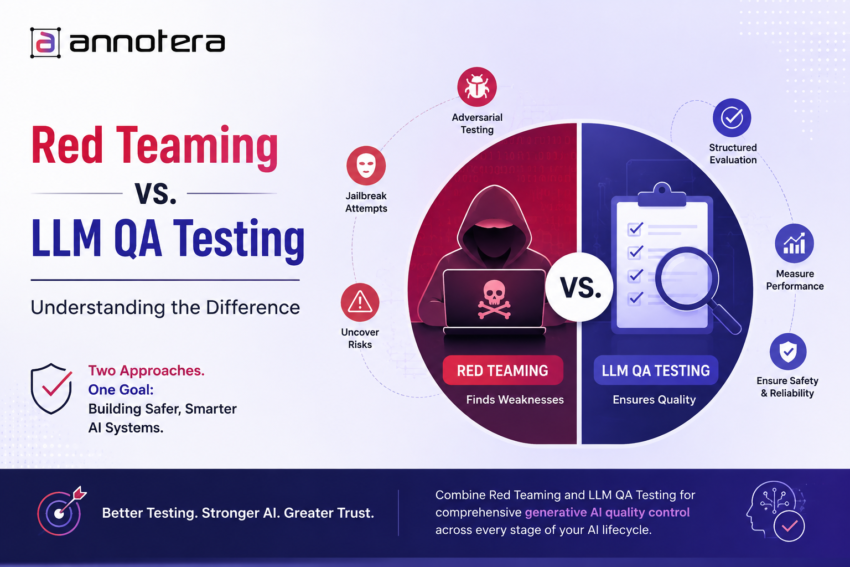
Large language models (LLMs) are increasingly powering chatbots, copilots, search systems, customer-service platforms, content applications, and enterprise workflows. As these systems move into production, organizations need more than a basic accuracy check. They must understand whether an LLM follows instructions, produces reliable responses, resists harmful inputs, and behaves consistently across real-world scenarios.
Two approaches frequently appear in this context: LLM red teaming and LLM QA testing. Although they overlap in some areas, they serve different purposes. Understanding the distinction helps organizations build a more comprehensive generative AI quality control strategy.
What Is LLM QA Testing?
LLM QA testing is a structured quality-assurance process designed to determine whether an LLM application performs according to predefined requirements.
QA teams evaluate the model using planned test cases, datasets, prompts, expected behaviors, and measurable criteria. Testing can cover both functional and non-functional aspects of an LLM-powered application.
Typical LLM QA testing areas include:
-
Instruction following and prompt adherence
-
Factual accuracy and response relevance
-
Consistency across similar prompts
-
Hallucination detection
-
Context retention
-
Output formatting
-
Language and multilingual performance
-
Response latency and reliability
-
Safety and policy compliance
-
Robustness against variations in user input
For example, if an enterprise chatbot is designed to answer questions exclusively from an internal knowledge base, QA testing can determine whether it retrieves relevant information, follows response guidelines, avoids unsupported claims, and maintains consistent behavior.
The objective is generally verification: does the system meet its intended quality and performance requirements?
What Is LLM Red Teaming?
Red teaming takes a more adversarial approach.
Instead of primarily asking whether the model performs as expected, red teamers actively attempt to make it fail. They deliberately construct difficult, unexpected, or malicious inputs that could expose vulnerabilities in the model or its surrounding application.
Red team testing may investigate areas such as:
-
Prompt injection
-
Jailbreak attempts
-
Toxic or harmful outputs
-
Bias and discriminatory behavior
-
Sensitive information leakage
-
Instruction hierarchy manipulation
-
Unsafe recommendations
-
Data-extraction attempts
-
Unexpected behavior under adversarial prompts
-
Abuse of connected tools or application functions
For instance, a red team might attempt to manipulate an AI assistant into ignoring its system instructions, revealing restricted information, or producing content that violates the application’s safety policies.
The goal is discovery under attack: identify weaknesses before real users, malicious actors, or unusual circumstances expose them.
Red Teaming vs. LLM QA Testing: The Key Difference
The simplest distinction is structured verification versus adversarial exploration.
LLM QA testing starts with defined requirements and asks:
“Does the system behave correctly?”
Red teaming asks:
“How can we make the system behave incorrectly?”
These approaches are complementary rather than interchangeable.
| Aspect | LLM QA Testing | LLM Red Teaming |
|---|---|---|
| Primary goal | Validate quality and requirements | Discover vulnerabilities |
| Testing style | Structured and systematic | Adversarial and exploratory |
| Inputs | Planned test cases and datasets | Challenging, manipulated, unexpected inputs |
| Main focus | Accuracy, consistency, functionality, reliability | Security, safety, abuse, and failure modes |
| Success criterion | Requirements are satisfied | Previously unknown weaknesses are uncovered |
| Typical outcome | Quality metrics and defect reports | Vulnerability findings and mitigation recommendations |
A mature AI quality program should use both.
Why LLM QA Testing Is Essential
LLMs are probabilistic systems, meaning the same application can sometimes produce different responses to similar inputs. Traditional software testing alone may therefore be insufficient.
A strong QA process establishes repeatable evaluation criteria. Organizations can create benchmark datasets, develop test suites, compare model versions, and track changes in performance over time.
This is particularly valuable when an organization modifies prompts, retrieval systems, fine-tuning configurations, guardrails, or model providers.
Professional LLM QA testing services can support these processes by combining human evaluation with systematic test design. Human reviewers can assess nuanced qualities such as relevance, reasoning quality, tone, factuality, and adherence to task-specific requirements that automated metrics may not fully capture.
Why Red Teaming Matters for Generative AI
A model can perform exceptionally well on standard benchmarks while still exhibiting serious vulnerabilities.
For example, an LLM might correctly answer thousands of routine customer questions but fail when a user deliberately attempts prompt injection. Similarly, a model may demonstrate high factual accuracy while generating inappropriate responses under carefully constructed adversarial prompts.
Red teaming helps uncover these less obvious failure modes.
It is especially important for applications handling sensitive information, executing actions through external tools, generating regulated content, or interacting directly with customers. Findings from red team exercises can inform stronger system prompts, access controls, guardrails, monitoring mechanisms, and human-review workflows.
How QA and Red Teaming Work Together
The strongest approach is not to choose one method over the other. Instead, organizations should integrate both into the AI development lifecycle.
A practical workflow can look like this:
1. Define quality requirements: Establish what the LLM should and should not do.
2. Build evaluation datasets: Create representative test cases covering common, complex, and edge-case scenarios.
3. Conduct structured QA: Evaluate accuracy, relevance, consistency, instruction following, safety, and other defined metrics.
4. Perform adversarial testing: Red teamers challenge the system with jailbreaks, prompt manipulation, unsafe requests, and unexpected inputs.
5. Analyze failures: Categorize defects and vulnerabilities according to severity, frequency, and potential business impact.
6. Remediate and retest: Improve prompts, data, guardrails, workflows, or application controls and evaluate the updated system again.
This creates a continuous generative AI quality control loop rather than a one-time model assessment.
Choosing the Right Approach
Organizations should consider their immediate objective when deciding where to focus.
If the priority is measuring whether an AI application meets its functional requirements, LLM QA testing should be the foundation. If the primary concern is discovering security, safety, or abuse-related weaknesses, red teaming deserves greater emphasis.
For production-grade AI, however, the better question is not “red teaming or QA?” but “how can we use both effectively?”
QA provides structured evidence that the system performs as intended. Red teaming provides adversarial evidence about how it can fail. Together, they provide a broader understanding of model behavior.
Building More Trustworthy LLM Applications
As generative AI becomes embedded in business-critical workflows, quality cannot be measured by accuracy alone. Organizations need visibility into reliability, safety, robustness, consistency, and resistance to manipulation.
LLM QA testing and red teaming address different layers of this challenge. QA establishes whether the system satisfies its expected behavior, while red teaming probes the boundaries of that behavior to expose weaknesses.
At Annotera, our data and AI quality expertise can help organizations build structured evaluation workflows, human-in-the-loop review processes, and high-quality datasets for testing modern AI systems. With the right combination of systematic evaluation and adversarial testing, businesses can identify problems earlier and build greater confidence in their generative AI applications.
The goal is not simply to build an LLM that works—it is to build one that continues to work reliably when real users push it beyond the expected path.