
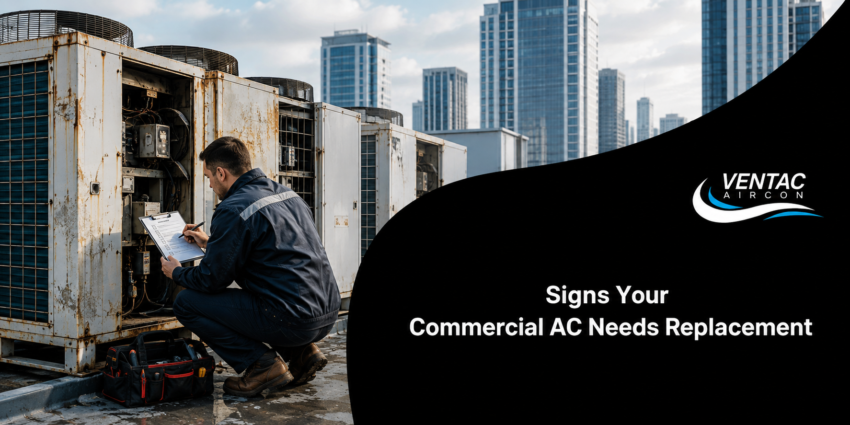
Signs Your Commercial AC Needs Replacement
A commercial air conditioning system is not something most businesses can afford to ignore. When cooling performance starts declining, the problem may initially look like a routine maintenance issue. But repeated breakdowns, rising electricity bills, uneven temperatures, poor airflow, and frequent component failures can indicate that the system is approaching the end of its useful service life.
This becomes even more important in offices, hotels, hospitals, factories, warehouses, and other large facilities where HVAC performance directly affects employees, customers, equipment, and daily operations.
In some cases, replacing the complete AC system may not be necessary. A component repair, controls upgrade, duct modification, or maintenance program could solve the problem. In other situations, continuing to repair an outdated system simply delays a replacement that the building will eventually need.
The challenge is knowing which situation applies to your facility.
This guide explains the major warning signs that your commercial AC may need replacement, what to evaluate before making the decision, and how ventilation and ductwork can influence the performance of a new HVAC system. For businesses planning a long-term upgrade, understanding these factors can prevent unnecessary expenses and avoid unexpected downtime.
Table of Contents
Why Commercial AC Replacement Requires Careful Evaluation
Sign 1: Your Energy Bills Keep Increasing
Sign 2: The System Requires Frequent Repairs
Sign 3: Cooling Has Become Uneven
Sign 4: Airflow Problems Keep Returning
Sign 5: Your HVAC System Is Outdated
Sign 6: Ductwork Is Damaged or Inefficient
Sign 7: Indoor Air Quality and Ventilation Are Poor
Sign 8: The AC Cannot Handle Your Current Building Load
Repair or Replace: How Should You Decide?
What to Check Before Replacing a Commercial AC
FAQs
Conclusion
Why Commercial AC Replacement Requires Careful Evaluation
Replacing a commercial HVAC system is a significant investment, so the decision should not be based on the age of the equipment alone.
A relatively old system can continue operating reliably if it has been properly maintained and still meets the building’s cooling requirements. On the other hand, a newer system can create problems if it was incorrectly sized, poorly installed, or subjected to demanding operating conditions.
The better approach is to evaluate the system’s overall performance.
Consider the relationship between energy consumption, repair costs, cooling comfort, maintenance requirements, indoor air quality, equipment availability, and the building’s future needs. If several of these areas are deteriorating at the same time, replacement may provide better long-term value than continuing with repeated repairs.
Ventac Aircon works across commercial and industrial HVAC applications, including design, installation, commissioning, maintenance, and repair. Its project portfolio includes offices, hotels, factories, corporate buildings, and other large facilities.
Sign 1: Your Energy Bills Keep Increasing
One of the clearest warning signs is a steady increase in HVAC-related electricity consumption without a corresponding increase in building usage.
Older compressors, motors, fans, controls, and heat-transfer components can gradually lose efficiency. Dirty coils, restricted airflow, refrigerant problems, poor insulation, and deteriorating ductwork can make the system work harder to deliver the same amount of cooling.
For example, if an office has maintained similar occupancy and operating hours for several years but its summer electricity bills continue rising, the HVAC system deserves closer investigation.
However, an increased electricity bill does not automatically mean the entire AC should be replaced. A professional inspection should first determine whether maintenance, airflow correction, controls optimization, or another repair can restore performance.
If the system is already old and several efficiency-related problems are appearing together, replacement may become the more practical option.
Sign 2: The System Requires Frequent Repairs
Every commercial AC requires maintenance. The problem begins when repairs become a regular operating expense rather than an occasional requirement.
Repeated compressor failures, motor problems, refrigerant leaks, control-board issues, fan failures, and electrical faults can indicate that the equipment is becoming unreliable.
There is also an indirect cost to consider. A breakdown in a commercial building can disrupt employees, affect customers, damage temperature-sensitive processes, and create emergency service expenses.
Suppose a hotel’s cooling system requires multiple emergency interventions during peak summer months. Even if each individual repair appears affordable, the combined cost of repairs, downtime, temporary cooling, and operational disruption may make replacement financially sensible.
The important question is not simply, “Can we repair it?” It is, “Does continuing to repair it make business sense?”
Sign 3: Cooling Has Become Uneven
Uneven cooling is another common warning sign.
If some rooms are comfortable while others remain hot despite the thermostat showing the correct setting, the underlying issue could involve the AC equipment, airflow distribution, ductwork, controls, insulation, or building load.
A modern commercial HVAC system should be evaluated as a complete system rather than as an isolated outdoor or indoor unit.
For example, a meeting room with large windows and high occupancy may require more cooling than a small internal office. If the original system was designed without accurately accounting for these differences, certain zones may consistently struggle.
Before replacing equipment, engineers should investigate whether the problem originates from capacity, airflow, zoning, duct design, controls, or the building envelope. Replacing the AC without correcting an underlying distribution problem may simply reproduce the same complaint.
Sign 4: Airflow Problems Keep Returning
Poor airflow can make an otherwise functioning AC system feel ineffective.
Employees may report that air is weak from certain diffusers, some rooms take too long to cool, or particular areas never receive enough conditioned air. These problems can result from clogged filters, dirty coils, blocked ducts, poorly balanced air distribution, damaged dampers, or inadequate fan performance.
In larger facilities, the condition of the duct system is especially important. A new air conditioner connected to poorly designed or damaged ductwork may not deliver the expected performance.
This is why businesses planning an HVAC upgrade should evaluate the complete air distribution system rather than focusing exclusively on the cooling equipment.
Sign 5: Your HVAC System Is Outdated
Age alone does not determine whether an AC system needs replacement, but it becomes increasingly relevant as equipment approaches the end of its expected service life.
Older systems may have outdated controls, lower efficiency, obsolete components, limited monitoring capabilities, or parts that are becoming difficult to source.
The issue can become particularly challenging when the system uses an older design that no longer matches how the building operates.
For example, an office may have changed from a traditional fixed-layout workspace to a flexible environment with meeting rooms, higher occupancy in certain zones, and different operating schedules. The original HVAC design may no longer be appropriate even if the equipment technically still works.
A replacement can therefore be an opportunity to redesign the HVAC system around the building’s current requirements instead of simply replacing equipment with an identical configuration.
Sign 6: Ductwork Is Damaged or Inefficient
Commercial AC performance depends heavily on how conditioned air moves through the building.
Damaged insulation, leaking joints, crushed sections, poor connections, incorrectly sized ducts, and inadequate balancing can waste cooling capacity before the air reaches occupied spaces.
This is why an HVAC assessment should include ductwork when evaluating an aging system. In some facilities, replacing the cooling equipment while retaining severely deteriorated ductwork may not deliver the expected improvement.
When major duct modifications are required, businesses may need experienced hvac ductwork installation contractors who can assess the existing distribution network, calculate airflow requirements, and coordinate new ductwork with the replacement HVAC equipment.
For organizations comparing replacement options, this is also an important budgeting consideration. The true project cost may include equipment, ductwork, electrical upgrades, controls, insulation, installation, testing, and commissioning—not just the AC machine itself.
Sign 7: Indoor Air Quality and Ventilation Are Poor
Commercial HVAC is about more than temperature.
If occupants frequently complain about stuffy rooms, unpleasant odours, excessive humidity, or inadequate fresh air, the facility may have a ventilation problem in addition to an air-conditioning problem.
This is particularly important in hospitals, factories, laboratories, kitchens, basements, hotels, and densely occupied offices where ventilation requirements can differ significantly from those of a typical commercial workspace.
An industrial ventilation system, for example, may need to address heat, fumes, dust, process air, or other site-specific conditions rather than simply lowering indoor temperature.
A replacement project is therefore a good opportunity to assess fresh-air requirements, exhaust systems, filtration, humidity control, and air distribution together.
In some cases, the right solution may involve upgrading ventilation rather than replacing the entire cooling system.
Sign 8: The AC Cannot Handle Your Current Building Load
Buildings change over time.
A factory may add machinery. An office may increase its workforce. A hotel may renovate additional rooms. A hospital may expand clinical areas. A warehouse may introduce temperature-sensitive operations.
These changes can increase the building’s cooling load beyond what the original HVAC system was designed to handle.
The result may be longer operating hours, frequent compressor cycling, insufficient cooling during peak conditions, and increasing maintenance requirements.
Before selecting a replacement system, engineers should perform a fresh cooling-load assessment rather than simply matching the capacity of the old equipment.
This is particularly important because the existing system may have been oversized or undersized from the beginning. A new installation provides an opportunity to correct those design issues and improve overall system performance.
Repair or Replace: How Should You Decide?
The decision should be based on the condition and economics of the complete HVAC system.
Repairing may make sense when the equipment is generally reliable, the problem is isolated, replacement parts are available, and the repair can restore acceptable performance.
Replacement becomes more attractive when several major components are failing, energy consumption is increasing, comfort complaints are persistent, and repair expenses are becoming difficult to justify.
A useful evaluation should consider:
Current repair and maintenance costs
Energy consumption and operating expenses
Equipment condition and remaining service life
Cooling capacity and current building requirements
Availability of replacement components
For a large facility, it can also be useful to compare the projected five- to ten-year cost of continued operation against the expected cost and benefits of a new system.
What to Check Before Replacing a Commercial AC
A commercial AC replacement should begin with a site assessment rather than an equipment quotation.
Engineers should inspect the existing cooling equipment, electrical infrastructure, ductwork, controls, insulation, airflow, operating conditions, and available installation space. The building’s current and future cooling load should then be evaluated.
Ventilation requirements should also be considered. If the facility needs a new fresh-air or exhaust arrangement, the project may require coordination with mechanical ventilation contractors rather than treating air conditioning as a standalone installation.
The replacement design should also account for maintenance access. Equipment that performs well but is difficult to access can create unnecessary maintenance challenges later.
Businesses searching online for air duct installation near me should similarly avoid choosing a contractor based only on proximity or the lowest quotation. Commercial ductwork affects airflow, energy performance, hygiene, acoustic comfort, and system reliability, so technical capability and project experience matter.
Ventac’s published service information describes site inspection, HVAC system design, installation, maintenance, and project execution as part of its commercial HVAC work. The company also reports more than three decades of experience and projects across Delhi NCR and other regions.
Frequently Asked Questions
1. How do I know if my commercial AC needs replacement?
Frequent breakdowns, increasing energy consumption, uneven cooling, poor airflow, outdated components, recurring refrigerant problems, and difficulty finding replacement parts can all indicate that replacement should be considered.
2. Should I repair or replace an old commercial AC?
It depends on the system’s condition and the cost of continued operation. If repairs are isolated and affordable, repair may be sensible. If major components repeatedly fail and operating costs continue rising, replacement may offer better long-term value.
3. Can poor ductwork make a new AC perform badly?
Yes. Leaking, damaged, undersized, oversized, or poorly balanced ductwork can reduce airflow and cooling performance even when the new AC equipment is working correctly.
4. Does a commercial AC replacement include ductwork?
Not necessarily. Some projects replace only the cooling equipment, while others require duct modifications or complete duct replacement. The scope should be determined after inspecting the existing system.
5. Why is ventilation important when replacing commercial AC?
Air conditioning controls temperature, while ventilation helps manage fresh-air supply, exhaust, air quality, and certain indoor contaminants. Depending on the facility, both systems may need to be evaluated together.
6. How often should commercial HVAC systems be inspected?
Inspection frequency depends on equipment type, operating hours, environmental conditions, and the consequences of failure. Facilities with critical cooling requirements may need more frequent professional inspections and preventive maintenance.
7. Is replacing an inefficient AC better than continuing maintenance?
Not always. Maintenance can restore performance when the underlying equipment remains in good condition. Replacement becomes more attractive when inefficiency is combined with age, frequent failures, poor reliability, or major component deterioration.
8. What should I ask an HVAC contractor before replacing my system?
Ask about the cooling-load calculation, equipment selection, energy efficiency, ductwork condition, ventilation requirements, installation scope, commissioning, warranty, maintenance support, and expected operating costs.
Conclusion
Knowing the signs your commercial AC needs replacement can help facility managers and business owners avoid costly breakdowns and rushed decisions. Rising energy bills, frequent repairs, uneven cooling, poor airflow, outdated equipment, deteriorating ductwork, and inadequate ventilation should all trigger a professional evaluation.
Replacement should not automatically mean installing a larger or newer AC unit. The better approach is to assess the entire HVAC system, including cooling capacity, ductwork, ventilation, controls, electrical requirements, and the building’s current operating conditions.
For a growing commercial or industrial facility, the replacement process can also be an opportunity to improve energy performance, indoor comfort, airflow, and long-term maintainability.
Ventac Aircon provides HVAC design, installation, commissioning, maintenance, and repair services for commercial and industrial applications. Its published project information includes large-scale work for offices, factories, hotels, corporate buildings, and other facilities.
If your existing system is becoming unreliable, a professional site assessment can help determine whether repair, retrofit, or complete replacement is the most practical next step.