
Artificial intelligence is moving rapidly from experimentation into everyday business operations. AI systems now support recruitment, healthcare, education, financial services, public administration, and many other areas where automated or AI-assisted decisions can have meaningful consequences.
As adoption grows, businesses face a question that goes beyond whether an AI system performs well:
Can the organization demonstrate that the system is properly governed, documented, monitored, and managed throughout its lifecycle?
This is where the Annex III EU AI Act becomes particularly important.
Annex III identifies categories of AI systems that may be classified as high-risk under the EU AI Act. Organizations operating in these areas may need to establish stronger governance processes, risk management practices, documentation, transparency measures, human oversight, and monitoring capabilities.
For AI startups, SaaS companies, CTOs, compliance teams, AI product leaders, and enterprise AI vendors, understanding Annex III is therefore not simply a legal exercise. It is becoming part of building scalable and trustworthy AI operations.
What Is Annex III of the EU AI Act?
The EU AI Act uses a risk-based approach to regulate artificial intelligence. Different AI systems can face different obligations depending on their intended purpose, use case, and potential impact.
Annex III EU AI Act sets out categories of AI systems considered high-risk.
These categories include areas such as:
- Biometrics
- Critical infrastructure
- Education and vocational training
- Employment and worker management
- Access to essential private and public services
- Law enforcement
- Migration, asylum, and border control
- Administration of justice and democratic processes
For organizations operating AI systems in these areas, identifying the relevant category is only the starting point.
The next challenge is operational: how does the organization consistently manage the governance, documentation, risk, oversight, and monitoring activities associated with the system?
That is where many AI companies encounter practical difficulties.
Why Annex III Matters for AI Startups and SaaS Companies
It is easy to assume that AI regulation primarily affects large technology companies.
However, startups and SaaS businesses can also develop or provide AI systems used in regulated or sensitive environments.
For example, an AI company may develop a recruitment platform that helps organizations evaluate candidates. Another SaaS provider may offer an AI solution used within education or financial services.
As these products enter enterprise markets, compliance and governance can become part of the sales process.
Enterprise buyers may want to understand:
- How AI systems are classified
- Who owns the system
- How risks are identified
- How AI documentation is maintained
- What human oversight exists
- How changes are tracked
- How compliance evidence is managed
This means EU AI Act readiness can influence more than regulatory relationships. It can affect customer trust, procurement, partnerships, and the ability to scale into larger markets.
The Operational Compliance Challenge
The biggest challenge is often not understanding the regulation itself.
It is turning regulatory expectations into repeatable business processes.
In a growing AI organization, information may be distributed across several teams.
Engineering may maintain technical documentation. Legal teams may interpret regulatory requirements. Compliance teams may maintain policies and assessments. Product teams may track system changes. Security teams may monitor infrastructure.
Each function may be doing its job, but the information can remain fragmented.
This creates several practical problems:
- Difficulty maintaining a complete AI inventory
- Unclear ownership of AI systems
- Inconsistent risk assessments
- Scattered AI documentation
- Manual approval processes
- Limited visibility into governance activities
- Difficulty maintaining compliance evidence
- Challenges preparing for regulatory or customer reviews
The result is a governance gap between what an organization knows internally and what it can actually demonstrate externally.
Compliance Is More Than Documentation
Documentation is an important part of EU AI Act readiness. For applicable high-risk AI systems, organizations may need to maintain technical documentation and other evidence required by the regulation.
However, documentation alone does not demonstrate that AI risks are actively managed.
A strong compliance operation should connect documentation with real governance activities.
For example, organizations need processes to:
- Identify AI systems and their intended purposes
- Assess relevant risks
- Assign ownership
- Track governance decisions
- Maintain appropriate human oversight
- Monitor AI systems
- Update documentation when systems change
- Preserve evidence of compliance activities
- Prepare for audits and assessments
This is why modern AI compliance is increasingly becoming an operational discipline.
Organizations are moving away from the idea that compliance happens once before deployment.
Instead, governance needs to continue throughout the AI lifecycle.
Building an Effective AI Governance Framework
A scalable AI Governance strategy should connect people, processes, documentation, and technology.
Establish Clear Ownership
Every AI system should have clearly defined ownership.
Teams should understand who is responsible for the system, who manages compliance activities, who conducts risk assessments, and who is accountable for governance decisions.
Without clear ownership, compliance tasks can easily become everyone’s responsibility—and therefore no one’s responsibility.
Create Standardized Governance Workflows
Governance should not depend entirely on individual employees remembering what needs to be done.
Standardized workflows can help organizations manage:
- AI inventory
- Risk classification
- Compliance reviews
- Approval processes
- Documentation updates
- Monitoring activities
- Governance decisions
Repeatable workflows are particularly valuable as organizations move from managing a handful of AI systems to managing an expanding portfolio.
Centralize AI Documentation
AI-related information often exists across engineering repositories, cloud storage, spreadsheets, internal wikis, and project management platforms.
Centralizing AI Documentation can make it easier for teams to understand the status of each AI system and locate relevant information when needed.
This can also improve collaboration between engineering, compliance, legal, security, and product teams.
AI Risk Management Should Be Continuous
One of the most important principles of AI governance is that risk does not remain static.
AI systems can change over time.
Models may be updated. Data sources may change. New integrations may be introduced. The intended use of a system may expand.
Therefore, AI risk management should be treated as a continuous process.
Organizations should consider processes for:
- Identifying potential risks before deployment
- Assessing the impact of significant changes
- Tracking mitigation measures
- Monitoring system performance
- Recording governance decisions
- Reviewing risks periodically
- Maintaining evidence for future assessments
This approach makes governance more resilient because it recognizes that an AI system’s risk profile can evolve after deployment.
Transparency and Human Oversight
Trustworthy AI requires more than technical performance.
Organizations also need to understand how AI systems are used and who remains accountable for important decisions.
Transparency practices can help teams document information about:
- Intended purpose
- System capabilities
- Limitations
- Relevant risks
- Governance decisions
- Monitoring activities
Human oversight is equally important.
Where appropriate, organizations need to define when human intervention is required, who is responsible for reviewing AI outputs, and how oversight activities are recorded.
For businesses, this is not simply a compliance requirement. Clear accountability can also improve internal decision-making and increase confidence among customers and employees.
Preparing for Enterprise Procurement
Enterprise procurement is increasingly asking questions about AI governance.
A prospective customer may not only want to know whether an AI product works. They may also want evidence that the provider has responsible processes around the product.
Questions can include:
- Is the AI system classified according to risk?
- Who owns the AI system?
- How are risks managed?
- How is documentation maintained?
- What controls support human oversight?
- How are changes monitored?
- Can compliance evidence be provided?
For AI startups and SaaS companies, these questions can arrive before a formal regulatory review.
That makes governance maturity a potential commercial advantage.
Organizations that can respond efficiently to customer due diligence may reduce friction during enterprise sales and demonstrate a stronger commitment to trustworthy AI.
Preparing for an EU AI Act Audit
Many organizations approach audit preparation reactively.
They begin collecting documentation after receiving a customer questionnaire, regulatory request, or internal review.
A more effective model is continuous audit readiness.
This means governance evidence is maintained as part of normal operations.
Organizations can maintain records relating to:
- Risk assessments
- Governance decisions
- Approval histories
- Documentation updates
- Monitoring activities
- Compliance workflows
- Ownership and accountability
When this information is maintained continuously, an EU AI Act audit does not require teams to reconstruct months of governance activity from scattered records.
Instead, the organization already has an operational record of what has been done.
Connecting AI Compliance With Broader Data Governance
AI governance does not exist in isolation.
AI systems frequently interact with organizational data, customer information, employee information, and other sensitive business resources.
As a result, organizations may need to consider AI governance alongside other compliance and governance programs, including GDPR compliance where applicable.
The important point is to avoid creating completely separate governance silos.
A mature compliance operation should help relevant teams understand how different obligations intersect with AI development and deployment.
How AnnexOps Helps Operationalize AI Compliance
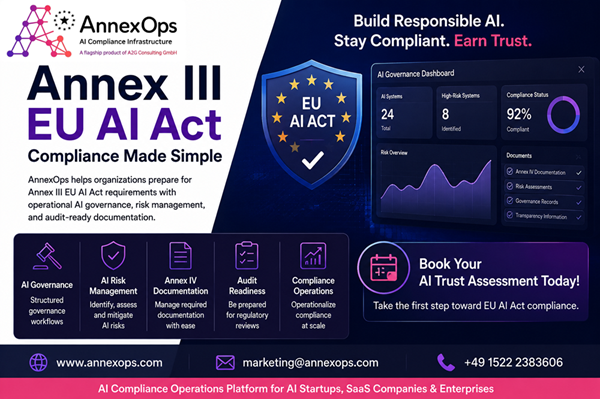
As AI portfolios expand, spreadsheets and disconnected documents can become increasingly difficult to manage. AnnexOps provides operational infrastructure designed to help organizations manage AI compliance through structured workflows, centralized documentation, governance tracking, AI risk management, and audit readiness.
The platform supports organizations with AI Governance through structured governance workflows, helping teams organize and manage compliance activities across AI projects. It also supports AI Risk Management by helping organizations track and manage AI-related risks throughout the AI lifecycle.
For organizations managing large amounts of compliance information, AnnexOps provides centralized AI Documentation capabilities. This can help teams organize relevant documentation and improve visibility across engineering, compliance, legal, security, and product functions.
AnnexOps also supports Annex IV documentation management for applicable high-risk AI systems, along with governance tracking and audit readiness. By maintaining governance activities and compliance evidence in a structured environment, organizations can be better prepared for enterprise assessments and regulatory reviews.
The broader goal is to support AI compliance operations without relying entirely on fragmented spreadsheets, scattered documents, and manual processes. Instead, organizations can establish repeatable governance workflows that scale alongside their AI systems.
This approach helps turn compliance from a reactive activity into an ongoing operational capability, giving AI-driven organizations a more structured way to manage governance, risk, documentation, and audit readiness.
Turning Compliance Into a Business Capability
The Annex III EU AI Act should not be viewed solely as a regulatory challenge.
For forward-looking AI companies, it can also be an opportunity to strengthen the way AI is developed and managed.
Organizations that establish governance capabilities early can be better positioned to:
- Respond to enterprise procurement requirements
- Demonstrate responsible AI practices
- Manage AI risks more consistently
- Maintain documentation
- Prepare for regulatory reviews
- Scale AI products more confidently
- Build stronger customer trust
Compliance becomes more valuable when it is integrated into the operating model of the business.
Instead of creating a compliance process that sits outside product development, organizations can embed governance into the AI lifecycle.
Practical Steps for AI Companies
Organizations beginning their Annex III preparation can start with a few practical questions:
- Do we have visibility into every AI system?
Create and maintain an AI inventory that identifies systems, owners, purposes, and status.
- Have we assessed potential risk?
Establish a consistent process for risk classification and ongoing risk management.
- Is our documentation centralized?
Make relevant technical and compliance documentation easier to locate and maintain.
- Are governance responsibilities clear?
Define ownership across product, engineering, compliance, legal, and other relevant teams.
- Can we demonstrate what has been done?
Maintain evidence of reviews, approvals, risk assessments, monitoring, and governance decisions.
- Are we continuously monitoring our AI portfolio?
Don’t assume that compliance remains unchanged after deployment. Review systems as they evolve.
These steps can provide a practical foundation for building scalable AI compliance operations.
Ready to Strengthen Your EU AI Act Readiness?
If your organization develops or deploys AI systems that may fall within the categories covered by Annex III EU AI Act, preparing early can make compliance easier to manage as your AI portfolio grows.
AnnexOps helps AI-driven organizations operationalize compliance through structured workflows, centralized AI documentation, governance tracking, AI risk management, Annex IV documentation management, and audit-ready processes.
Learn how AnnexOps helps AI-driven companies prepare for the EU AI Act with clarity and confidence.
📧 marketing@annexops.com
📞 +49 1522 2383606
Final Thoughts
The Annex III EU AI Act represents an important development in how organizations approach high-risk artificial intelligence.
For businesses developing or deploying AI systems in regulated areas, technical performance is only one part of the equation.
Organizations also need structured governance, effective risk management, appropriate human oversight, reliable documentation, transparency, continuous monitoring, and the ability to demonstrate compliance through evidence.
The organizations that prepare early can turn these requirements into operational capabilities rather than last-minute compliance projects.
Ultimately, the goal is bigger than passing an audit.
It is about building AI systems that customers, employees, partners, and regulators can trust.
For AI companies looking to scale responsibly, AI governance should become part of the operating model, not an activity added after the product is already built.