
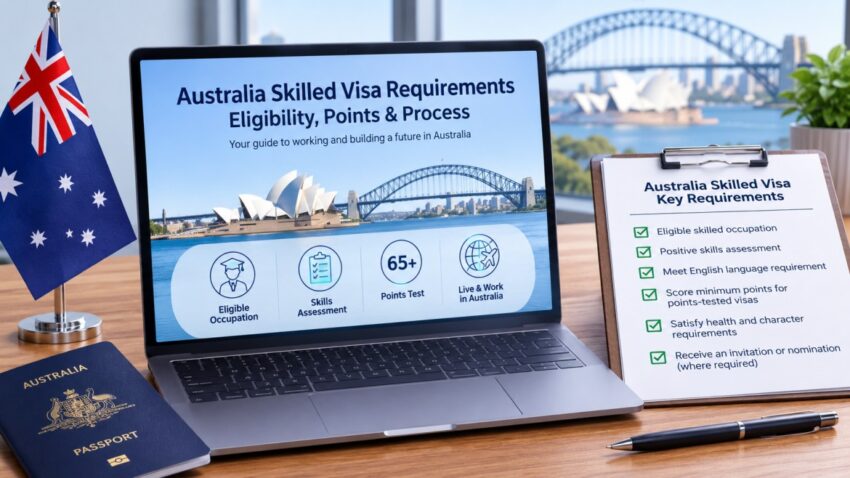
Understanding Australia skilled visa requirements is an important first step for professionals planning to work and potentially settle in Australia. Skilled migration is designed to attract people with qualifications, work experience, and skills that are needed in the Australian economy. However, there is no single “skilled visa” with one set of requirements. Eligibility depends on the specific visa subclass, occupation, skills assessment, points score and other factors.
Australia’s skilled migration system includes points-tested pathways such as subclasses 189, 190 and 491, as well as employer-sponsored visas for workers who have an Australian employer willing to sponsor them. The subclass 482 Skills in Demand visa, for example, follows a different eligibility framework from points-tested skilled visas.
What Are the Australia Skilled Visa Requirements?
The exact requirements depend on the visa you are applying for, but skilled migration applicants may need to meet several core criteria, including:
- Having an eligible skilled occupation
- Obtaining a suitable skills assessment
- Meeting the relevant age requirement
- Demonstrating competent English or a higher level where required
- Meeting the applicable points threshold for points-tested visas
- Having relevant qualifications and work experience
- Meeting health and character requirements
- Receiving an invitation or nomination where required
- Satisfying the specific requirements of the chosen visa
Meeting the minimum requirements does not necessarily guarantee an invitation or visa grant. For competitive points-tested visas, factors such as occupation, points score, state nomination and the number of places available can influence the outcome.
Which Australian Skilled Visas Can You Apply For?
Australia offers several skilled migration pathways, and choosing the right one depends on your circumstances.
Skilled Independent Visa Subclass 189
The Skilled Independent visa allows eligible skilled workers to apply without employer sponsorship or state nomination. Applicants generally need an eligible occupation, a suitable skills assessment, the required English ability, and enough points to receive an invitation.
Skilled Nominated Visa Subclass 190
The subclass 190 visa is a permanent skilled visa that requires nomination by an Australian state or territory. Each jurisdiction can apply its own nomination criteria, so meeting the federal visa requirements does not automatically mean you will receive a state nomination.
Skilled Work Regional Visa Subclass 491
The subclass 491 visa is designed for skilled workers who intend to live and work in designated regional areas of Australia. It can involve nomination by a state or territory or sponsorship by an eligible family member, depending on the circumstances.
These points-tested pathways should be distinguished from employer-sponsored visas, where an Australian employer plays a central role in the application.
How Does the Skilled Migration Points Test Work?
For points-tested skilled visas, your ranking can depend on factors such as:
- Age
- English language proficiency
- Skilled employment experience
- Educational qualifications
- Australian study
- Specialist education qualifications
- Partner skills
- State or territory nomination
- Other eligible factors
The points system is used to assess and rank candidates. Reaching the applicable minimum points threshold does not mean an applicant will automatically receive an invitation.
For this reason, applicants should calculate their points carefully and ensure that every claimed point can be supported with appropriate evidence.
Why Is a Skills Assessment Important?
A skills assessment is a key part of many skilled migration applications. The relevant assessing authority examines whether an applicant’s qualifications and professional experience are suitable for the nominated occupation.
The assessing authority depends on the occupation. Different professions can therefore have different assessment requirements.
Before selecting an occupation, applicants should check that:
- The occupation is eligible for the visa.
- The relevant assessing authority accepts applications for that occupation.
- Their qualifications and experience meet the authority’s requirements.
- Their evidence supports the employment and qualification claims being made.
Choosing an occupation simply because it appears on a skilled occupation list can create problems if the applicant cannot obtain a positive skills assessment.
English Language Requirements
English proficiency is another important component of Australia’s skilled migration system.
Depending on the visa and applicant’s circumstances, evidence of English may be required at a particular level. Higher English proficiency can also contribute additional points in points-tested applications.
Applicants should therefore check the accepted English tests, minimum scores and validity requirements applicable to their specific visa before booking a test or claiming points.
Health and Character Requirements
Most Australian visa applicants must satisfy health and character requirements.
Character checks can involve police certificates or other evidence, while health examinations may be requested depending on the applicant’s circumstances.
These requirements apply separately from the points test. In other words, having enough migration points does not remove the need to satisfy Australia’s health and character criteria.
What Is the Skilled Visa Application Process?
The process varies between visa subclasses, but a typical points-tested skilled migration pathway involves:
Step 1: Choose an eligible occupation
Identify an occupation that matches your qualifications and professional experience.
Step 2: Obtain a skills assessment
Apply to the relevant assessing authority and obtain the required assessment outcome.
Step 3: Complete an English test
Where required, obtain the appropriate English-language evidence.
Step 4: Calculate your points
Assess your age, qualifications, employment experience, English ability and other eligible factors.
Step 5: Submit an Expression of Interest
For applicable points-tested visas, submit an Expression of Interest through SkillSelect.
Step 6: Seek nomination where required
For visas such as subclass 190 and 491, state or territory nomination may be required.
Step 7: Receive an invitation and lodge the visa application
If invited, submit the visa application with supporting evidence within the applicable timeframe.
Step 8: Complete additional requirements
Provide requested health, character and other documents and wait for the Department of Home Affairs to assess the application.
How Does the Subclass 482 Skills in Demand Visa Differ?
The subclass 482 Skills in Demand visa is an employer-sponsored pathway rather than a points-tested independent skilled visa. It allows eligible Australian employers to sponsor skilled workers for positions that meet the applicable requirements.
This distinction is important for applicants deciding between skilled migration and employer-sponsored visas.
If you have a strong points profile but no Australian employer, a points-tested pathway may be worth investigating. If an Australian employer is prepared to sponsor you for an eligible position, the subclass 482 pathway may be relevant instead.
The appropriate option depends on your occupation, qualifications, experience, English ability, employer circumstances and long-term migration goals.
Final Thoughts
Meeting Australia skilled visa requirements involves more than reaching a particular points score. Applicants need to select an eligible occupation, obtain the appropriate skills assessment, demonstrate the required English ability and satisfy the visa’s health, character and other criteria.
It is also important to choose the pathway that matches your circumstances. Points-tested visas such as subclasses 189, 190 and 491 operate differently from employer-sponsored visas, including the subclass 482 Skills in Demand visa.
Because occupation lists, nomination criteria and visa requirements can change, applicants should check the latest information from the Australian Department of Home Affairs and the relevant assessing authority before submitting an application.