
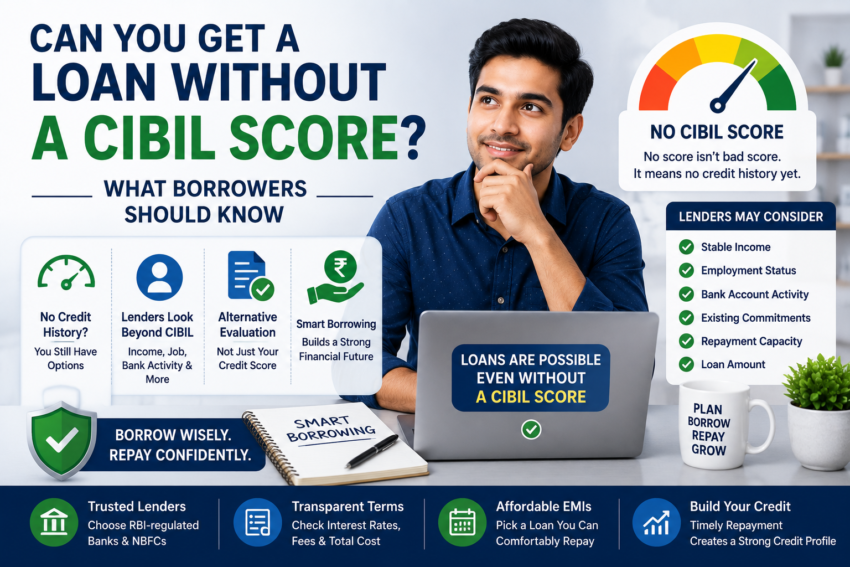
If you have never taken a loan or used a credit card, you may wonder whether you can get a loan without a CIBIL score. This is a common concern among first-time borrowers, students, young professionals, and people who have had limited access to formal credit.
The good news is that having no CIBIL score does not automatically mean you cannot get a loan. However, getting approved without an established credit history can be more difficult because lenders have less information about your previous borrowing and repayment behaviour.
A lender may consider other factors such as income, employment, bank account activity, existing financial obligations, loan amount, and repayment capacity.
Before applying, it is important to understand the difference between having no CIBIL score and having a low CIBIL score, what lenders may consider, and how to borrow safely.
What Is a CIBIL Score?
A CIBIL score is a three-digit number that represents information from your credit history. It is generated from the information available in your credit report.
Your credit profile can contain details about:
-
Previous loans
-
Credit cards
-
Repayment history
-
Outstanding balances
-
Credit enquiries
-
Account status
-
Credit utilisation
Lenders may use credit information as one part of their assessment when you apply for a loan or credit card.
A strong repayment history can help establish a positive credit profile. Missed or delayed repayments, on the other hand, can negatively affect your credit history.
But what if you have never borrowed?
You may simply have no established credit history.
No CIBIL Score vs Low CIBIL Score
These two situations are very different.
No CIBIL Score
If you have never used formal credit, there may not be enough information to generate a score.
You haven’t necessarily done anything wrong. You simply don’t have an established borrowing history.
Low CIBIL Score
A low score means there is credit history available, but the information may indicate higher credit risk based on the scoring model.
For example, a history of missed payments, high outstanding balances, or multiple credit applications can affect a credit profile.
Therefore, no CIBIL score does not mean bad credit.
It generally means the lender has limited information about your past credit behaviour.
Can You Get a Loan Without a CIBIL Score?
Yes, it may be possible.
However, approval is not guaranteed.
Some lenders may consider borrowers with limited or new credit histories, while others may have minimum credit-score or credit-history requirements.
When a CIBIL score is unavailable, a lender may consider other information to evaluate the application.
This can include:
-
Monthly income
-
Employment status
-
Employment duration
-
Business income
-
Bank account activity
-
Existing financial commitments
-
Age
-
Location
-
Loan amount
-
Repayment capacity
-
Internal lending criteria
The importance of each factor varies between lenders and loan products.
Why Is It Harder to Get a Loan Without Credit History?
A personal loan is usually unsecured. This means you generally do not pledge an asset as security for the borrowing.
Because the lender does not have collateral to rely on, it needs to assess whether you are likely to repay the loan.
A credit history provides useful information about how you handled previous borrowing.
If there is no credit history, the lender has less evidence.
As a result, some lenders may:
-
Reject the application
-
Offer a smaller loan amount
-
Ask for additional documentation
-
Require a co-borrower
-
Offer different interest rates
-
Apply stricter eligibility criteria
These outcomes are not universal. Every lender has its own underwriting process.
Can Salaried Employees Get a Loan Without a CIBIL Score?
A salaried employee with no established credit history may still be eligible for certain loans, depending on the lender.
Stable employment and regular salary income can provide useful information about repayment capacity.
For example, a lender may look at:
-
Monthly salary
-
Salary credits
-
Employment history
-
Employer profile
-
Bank statements
-
Existing EMIs
-
Requested loan amount
Suppose you earn ₹40,000 per month but have never used a credit card or taken a loan.
You may not have a CIBIL score, but your income and employment information can still be relevant to a lender’s assessment.
However, salary alone does not guarantee approval.
Can Self-Employed Borrowers Get a Loan Without a CIBIL Score?
Self-employed individuals may also be able to apply for loans without an established CIBIL score, depending on the lender and product.
Because they may not receive traditional salary slips, lenders can use other financial documents to understand income and repayment capacity.
These may include:
-
Bank statements
-
Income-tax returns
-
Business documents
-
Financial statements
-
Business vintage information
-
Existing liabilities
A self-employed borrower with consistent documented income may have a stronger application than someone whose income is difficult to verify.
Can Students Get a Loan Without a CIBIL Score?
Students commonly have limited or no credit history.
If you are a student, an education loan may be more appropriate than a standard personal loan when the purpose is to finance eligible education expenses.
Depending on the loan scheme, a parent or eligible co-borrower may be required.
The lender may consider the co-borrower’s income, credit history, and repayment capacity along with the student’s course and institution details.
Students should compare education loan options before choosing an expensive unsecured loan simply because the application appears easier.
What Types of Loans May Be Available?
Your options depend on your financial situation and the purpose of borrowing.
Personal Loan
A personal loan may be available to some applicants without an established credit history, although eligibility can be stricter.
Education Loan
Students may consider education loans for eligible tuition and related educational expenses.
Vehicle Loan
If you are purchasing a car or two-wheeler, a vehicle loan may be more appropriate than borrowing through an unsecured personal loan.
Secured Loan
Loans backed by eligible assets may have different eligibility requirements because the lender has security against the borrowing.
Small Personal Loan
Some lenders offer smaller loan amounts to borrowers with limited credit histories. However, borrowers should carefully compare the total cost.
The right option depends on your purpose and repayment capacity.
Can a Bank Give a Loan Without a CIBIL Score?
It depends on the bank, loan product, and applicant.
Banks may have specific eligibility requirements and may assess applications using multiple factors.
For example, a borrower with no credit history but stable income and a strong banking relationship may have a different application profile from someone with no credit history and irregular income.
There is no universal rule saying that every person without a CIBIL score will be rejected.
The same principle applies to NBFCs and other eligible lenders. Each institution may have its own credit assessment policies.
Does a No-CIBIL Loan Cost More?
It can, depending on the lender and your overall risk profile.
If a lender has limited information about your repayment history, it may compensate for the additional uncertainty through stricter terms, a lower loan amount, or different pricing.
For this reason, don’t compare loans based only on the advertised interest rate.
Look at:
-
Interest rate
-
APR
-
Processing fee
-
EMI
-
Tenure
-
Total repayment
-
Other applicable charges
For applicable regulated digital lending products, borrowers should review the Key Facts Statement and disclosed APR before accepting the loan.
What Is the Key Facts Statement?
The Key Facts Statement (KFS) is an important document for applicable regulated loans.
It provides key information about the credit facility in a standardized format.
Depending on the loan, it can include details such as:
-
Loan amount
-
Interest rate
-
APR
-
EMI
-
Tenure
-
Repayment schedule
-
Fees
-
Penal charges
-
Other applicable terms
If you are a first-time borrower, don’t skip this document.
It can help you understand the actual cost of borrowing before you agree to the loan.
Should You Take a Loan Just to Build a CIBIL Score?
Not necessarily.
Some people believe they should take any loan available simply to create a credit history.
Borrowing money you don’t need can create unnecessary financial pressure.
If you genuinely need a loan and can comfortably repay it, making payments on time can help establish a repayment history.
But don’t take a ₹50,000 loan just because someone tells you that you need a loan to build your CIBIL score.
Credit building should not become an excuse for unnecessary borrowing.
How Can You Build Credit History Responsibly?
If you have no credit history, focus on responsible financial behaviour.
You can:
-
Use credit only when you need it.
-
Pay EMIs on time.
-
Avoid taking multiple loans unnecessarily.
-
Keep credit card balances manageable.
-
Avoid repeatedly applying for credit.
-
Check your credit report periodically.
-
Review your report for incorrect information.
Building a credit history is a gradual process. There is no need to rush it.
Be Careful With “No CIBIL Guaranteed Loan” Offers
Searching for a loan without a CIBIL score can expose you to aggressive online advertisements.
You may see claims such as:
“Guaranteed loan without CIBIL!”
“100% approval!”
“No verification required!”
Treat such claims carefully.
A lender should still have an eligibility and risk-assessment process.
Before applying through a digital lending app, verify:
-
Actual lender
-
Official website
-
Regulatory status where applicable
-
Loan agreement
-
KFS
-
APR
-
Processing fees
-
Privacy policy
-
Customer-support details
Never share your OTP, UPI PIN, banking password, or debit-card PIN with anyone claiming to arrange a loan.
Avoid Borrowing More Than You Need
If you have limited credit history, don’t increase your loan amount simply because a lender offers a larger limit.
Suppose you need ₹30,000 and qualify for ₹1 lakh.
Borrowing the full ₹1 lakh creates a much larger repayment obligation.
Instead, calculate the amount you actually need and choose an EMI that fits your monthly budget.
Remember:
Loan eligibility is not the same as loan affordability.
What If Your Application Is Rejected?
A rejected loan application doesn’t mean you can never borrow.
First, understand why the application was unsuccessful.
Possible reasons may include:
-
Insufficient income
-
Limited employment history
-
High existing obligations
-
Internal lender criteria
-
Documentation issues
-
Loan amount being too high
-
Lack of established credit history
Instead of immediately applying to many lenders, review your financial situation and improve the weaker areas where possible.
Repeated applications in a short period can lead to multiple credit enquiries, so avoid applying everywhere without a plan.
Final Thoughts
Can you get a loan without a CIBIL score? Yes, it may be possible, but it depends on the lender, loan type, and your overall financial profile.
Having no CIBIL score generally means you have limited or no established credit history. It does not automatically mean that you have bad credit.
Lenders may consider other factors such as income, employment, bank activity, existing obligations, loan amount, and repayment capacity.
If you’re a first-time borrower, focus on choosing a loan you genuinely need and can comfortably repay.
Before accepting any offer, compare the interest rate, APR, EMI, tenure, processing fees, total repayment, and other applicable charges. Read the Key Facts Statement and loan agreement carefully where applicable.
Most importantly, don’t let advertisements promising “guaranteed loans without CIBIL” rush you into borrowing.
Your first credit decision can become an important part of your financial history.
Borrow only what you need, understand the complete cost, verify the lender, and make every repayment on time.