
One thing that a certified power cord does well is carry electricity from a power source to a device, safely and reliably. Buyers rely on that certification to confirm the cord has been tested against recognized electrical standards, not just built to look the part. Industrial equipment often needs more than power, though.
Sensors, actuators, and control modules also need to exchange data, and that job falls to a different kind of cable. This is where a custom M12 sensor cable comes in. Unlike a standard mains cord, it’s built around signal integrity, connector coding, and resistance to vibration, moisture, or chemical exposure on a factory floor. Deciding which one a project needs isn’t really an either/or question. Most systems end up using both, each sized and specified for its own role.
Certified Power Cord: What Should Buyers Check?
A certified power cord differs from a generic power cable in one key respect: documentation. Certification means the cord has been evaluated against standards such as UL, CSA, CE, or RoHS, and that evaluation is traceable to a test report. A generic cable might look identical on the outside while lacking any of that testing history.
Key Specifications to Verify
Buyers should check plug and connector configuration first, since mismatched interfaces cause more field failures than most people expect. Rated voltage and current need to match the equipment’s actual draw, not just a nominal figure on a spec sheet. In long distance applications, cable length and conductor structure also affect the voltage drop over distance. Jacket materials, whether PVC, rubber, or TPE, determine how the cord handles heat, flexing, and everyday wear.
Matching Certification to Application and Market
Certification only means something if it matches where the product will actually be sold or used. A cord rated for one region’s electrical system won’t necessarily meet another region’s requirements, even if the connector happens to fit. This is why cable length, gauge, color, voltage, current, and certification are usually treated as customizable variables rather than fixed defaults. A certified power cord built for a European market performs differently from one built for North America, even when both feed comparable equipment.
Industrial M12 Connectivity: How Does It Differ?
Where a power cord carries electricity, an M12 sensor cable carries data and control signals between sensors, actuators, and controllers. It’s built around a different set of priorities entirely.
Coding, Pin Counts, and Shielding
M12 A-coded connectors are common in sensor and actuator applications, available in 3-, 4-, 5-, 8-, and 12-pin configurations depending on signal complexity. Custom pinouts let engineers match a cable to a specific device rather than adapting the device to a generic cable. Shielded construction controls EMI and RFI interference, which matters in environments packed with motors, drives, and switching equipment. Getting the pinout wrong, even by one position, can stop a sensor from communicating at all.
Jacket Materials and Environmental Protection
PUR, TPE, and LSZH jackets each bring different trade-offs in flexibility, chemical resistance, and fire safety. IP67, IP68, and IP69K ratings define how well a cable resists dust, water immersion, and high-pressure washdown. High-flex, C-track-rated builds hold up under constant motion, while overmolding and strain relief keep the connector joint intact through repeated cycling. A custom M12 sensor cable is specified around the environment it will live in, not just the signal it carries.
How Do Certification, Testing, and Quality Control Affect Reliability?
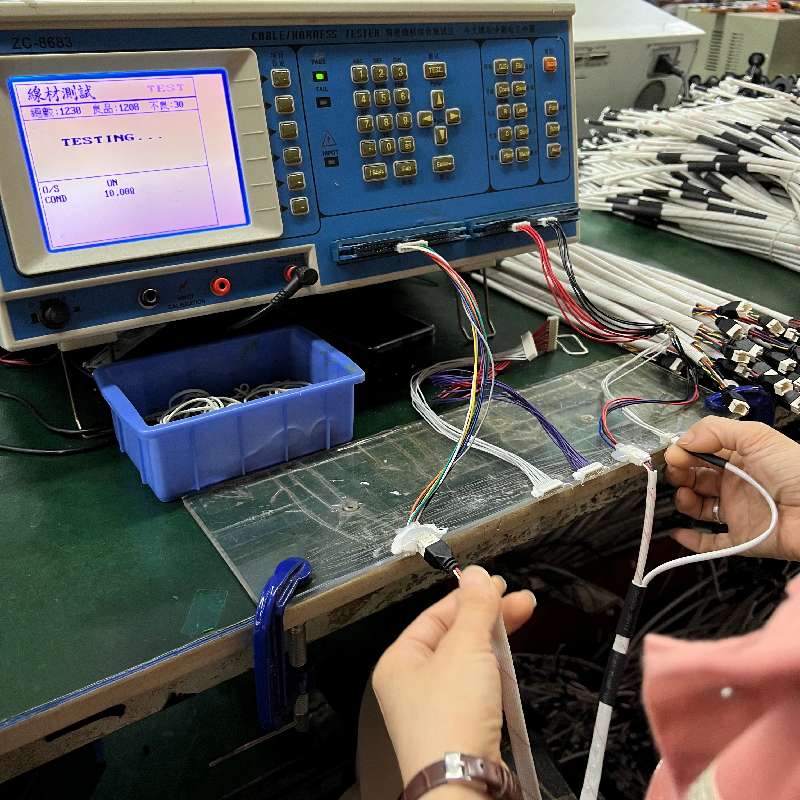
Documented certification on a certified power cord gives buyers something to check against, rather than trusting a connector by sight. Sensor cabling relies on the same logic, just through different benchmarks.
M12 assemblies are often built to standards like IPC-A-620 Class 3 which governs crimp and termination quality. Shielding performance determines how well a cable resists interference in electrically noisy environments.
IP67, IP68 and IP69K ratings are a way of confirming sealing in the field and not just in marketing materials. High flex cycles and good overmolding determine whether a cable will last for many years without breaking at the connector. It is better to compare tested results than just the look of the product.
How Can Custom Cable Manufacturing Meet Different Needs?
Flexibility in manufacturing is just as important as the specification itself. For a certified power cord, that means adjusting cable length, conductor gauge, jacket material, connector configuration, voltage and current rating and certification requirements to fit a specific product and market.
For a custom M12 sensor cable, the variables shift: pin configuration, connector angle, jacket type, shielding level, overmolding, environmental protection, and even serialization for traceability all come into play. SINNHONG ELECTRONICS CO., LIMITED works across both product types, adapting cable assemblies to equipment-specific requirements rather than offering a single fixed catalog design.
Conclusion
A certified power cord is chosen around safe power transmission and compliance with the standards that apply in its intended market. A custom M12 sensor cable is chosen around signal integrity, environmental protection, and how well it fits into a specific piece of equipment. Defining electrical, mechanical, environmental, and certification requirements upfront makes the selection process far more straightforward. SINNHONG ELECTRONICS CO., LIMITED builds power cords and sensor cable assemblies to match those application-specific specifications, whatever the certification calls for.