
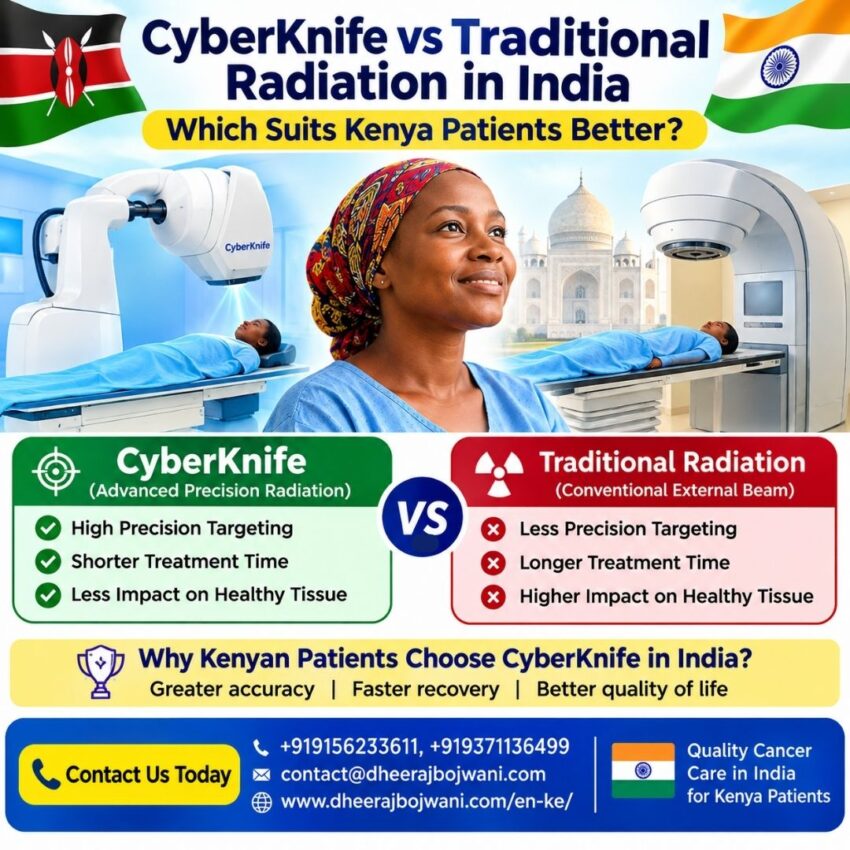
For Kenyan patients who need radiation treatment, choosing between CyberKnife and conventional external beam radiation can be confusing. Both approaches use high-energy radiation to target cancer cells, but they differ in how the radiation is delivered, how many treatment sessions may be required and how precisely the treatment can be focused. CyberKnife is a form of stereotactic radiation treatment that uses a robotic system to deliver highly focused radiation from different angles, while traditional radiation generally delivers treatment over a larger number of sessions.
The more advanced-looking technology is not automatically the better choice. The appropriate treatment depends on the type, size and location of the tumour, whether it has spread, previous treatments, the patient’s overall health and the radiation oncologist’s assessment. For a Kenyan patient travelling to India, these factors should be reviewed before deciding which treatment approach is suitable.
Read More Here: CyberKnife vs traditional radiation in India for Kenyan patients
What Is CyberKnife Treatment?
CyberKnife is a non-invasive radiation treatment system designed to deliver highly precise doses of radiation to selected tumours. It uses a robotic arm and image-guidance technology to direct radiation toward the target while allowing treatment to be delivered from multiple angles.
Because the radiation can be focused closely on the tumour, CyberKnife may be considered for selected small or well-defined tumours in areas where protecting nearby healthy tissue is particularly important. Depending on the condition, treatment may be delivered in only a few sessions rather than the many sessions sometimes required with conventional radiation.
However, CyberKnife is not suitable for every tumour. The size, shape, location and movement of the tumour all influence whether stereotactic treatment is appropriate.
What Is Traditional Radiation Therapy?
Traditional external beam radiation therapy delivers radiation from a machine outside the body. Modern radiation techniques can also be highly precise, using treatment planning and imaging to shape the radiation dose around the tumour while limiting exposure to surrounding organs.
Unlike the older concept of broad radiation fields, modern conventional radiation can use techniques such as intensity-modulated radiation therapy (IMRT) and image-guided radiation therapy (IGRT). These methods allow radiation oncologists to carefully plan and deliver treatment according to the patient’s anatomy.
Depending on the cancer, conventional radiation may require treatment over several weeks. This can be important for Kenyan patients because the number of treatment sessions may affect the length of their stay in India.
CyberKnife vs Traditional Radiation
|
Factor |
CyberKnife |
Traditional External Beam Radiation |
|
Radiation delivery |
Highly focused stereotactic treatment |
External radiation using planned treatment fields |
|
Treatment sessions |
Often fewer sessions for suitable cases |
May require more sessions depending on the cancer |
|
Precision |
Designed for highly targeted treatment |
Modern techniques can also provide high precision |
|
Suitable tumours |
Selected small or well-defined targets |
Used for a broad range of cancers |
|
Recovery |
Usually no surgical recovery |
Usually no surgical recovery |
|
Suitability |
Depends strongly on tumour characteristics |
Depends on cancer type, stage and treatment plan |
The important point for Kenyan patients is that CyberKnife and traditional radiation are not competing treatments for every cancer. In some situations, CyberKnife may be particularly useful, while conventional radiation may provide the more appropriate treatment.
When May CyberKnife Be Considered?
CyberKnife may be considered for selected tumours that are relatively small, well-defined and located where highly focused radiation can be delivered safely. It has been used for certain brain tumours, spinal tumours and selected cancers in other parts of the body.
For some patients, stereotactic radiation can also be used when surgery is not appropriate or when a previously treated tumour requires additional local treatment. However, this depends on the specific clinical situation and previous radiation exposure.
Kenyan patients should therefore have their scans reviewed by a radiation oncologist before assuming that CyberKnife is suitable. A specialist may recommend conventional radiation, surgery, systemic treatment or a combination instead.
When May Traditional Radiation Be More Suitable?
Traditional external beam radiation can be useful when the treatment area is larger, when surrounding lymph nodes also need treatment or when the cancer requires a radiation schedule that cannot be replaced by stereotactic treatment.
For example, some cancers require radiation to a wider area rather than only a small tumour. In such situations, conventional radiation techniques may provide better coverage of the areas at risk.
Modern radiation therapy can also be highly accurate, so patients should not assume that traditional radiation is outdated simply because CyberKnife uses newer technology.
What Should Kenya Patients Consider?
The first consideration should be the diagnosis rather than the machine. Kenyan patients should ask the Indian radiation oncologist what type of tumour they have, what area needs to be treated, why a particular radiation technique is being recommended and whether surgery or another treatment should also be considered.
Patients should also ask how many treatment sessions are expected, how long each session may take, what side effects are possible and whether follow-up imaging will be required. Understanding these details can help patients plan their stay in India more realistically.
Read More Here: CyberKnife treatment visa for Kenyan patients
Preparing for Radiation Treatment in India
Kenyan patients should carry their biopsy or pathology reports, MRI or CT scans, PET scans where applicable, previous treatment records and medication details. If the patient has already received radiation elsewhere, complete records of the previous radiation dose and treatment area are particularly important.
The Indian hospital may request additional imaging or tests before finalising the radiation plan. Patients should therefore avoid assuming that treatment can begin immediately after arrival.
Recovery and Returning to Kenya
Radiation treatment does not usually require the type of recovery associated with major surgery, but patients can still experience fatigue or treatment-specific side effects. The effects depend on the part of the body being treated and the radiation dose.
CyberKnife may allow some patients to complete treatment in fewer sessions, which can make international travel more convenient. However, the shorter schedule should never be the sole reason for choosing it. The treating specialist should determine whether the cancer can be safely and effectively treated with stereotactic radiation.
Before returning to Kenya, patients should receive a treatment summary, radiation details, medication instructions and follow-up recommendations. These records can help the patient’s doctors continue care after returning home.
Choosing a Radiation Centre in India
Kenyan patients should consider the experience of the radiation oncology team, treatment-planning facilities, imaging technology, quality-control systems and availability of other cancer specialists. A centre that can provide multidisciplinary care is particularly useful when treatment decisions involve surgery, chemotherapy, immunotherapy and radiation. Patients should also compare the proposed treatment plan rather than comparing CyberKnife and conventional radiation purely by price or number of sessions.
Final Thoughts
CyberKnife can be an excellent option for selected tumours because of its highly focused radiation delivery and potentially shorter treatment schedule, while traditional radiation remains an important treatment for many cancers and can also be highly precise. For Kenya patients, the better choice is the treatment that matches the tumour’s location, size, type and overall treatment plan, as determined by an experienced radiation oncology team.
Official Indian Government References
- Ministry of Health & Family Welfare (MoHFW), Government of India
The Ministry provides official information on India’s national health policies, healthcare programmes and health-system initiatives.
- National Cancer Grid (NCG), Government of India
Official National Cancer Grid Website
The National Cancer Grid connects cancer centres and institutions across India and works to support standardised, evidence-based cancer care and collaboration.
Our Commitment to Patients
“Our mission is to place patients at the centre of every healthcare decision by providing trustworthy, evidence-based, and unbiased medical information. We believe that informed patients make better decisions. Backed by personalised guidance from our experienced advisory team, we help patients understand their treatment options, compare them objectively, and confidently choose the path that best aligns with their medical needs, personal preferences, and long-term health goals.”
Disclaimer
This article is intended for educational and informational purposes only and should not be considered medical, legal, or visa advice. Medical recommendations, treatment plans, and procedures may vary from one patient to another based on individual health conditions and circumstances. Readers are strongly advised to consult qualified healthcare professionals before making any medical-related decisions.
Dr. Dheeraj Bojwani
Medical Travel Advisor for International Patients Seeking Treatment in India
📍 New Delhi, India
🏆 24+ Years of Experience | Assisted 5,000+ International Patients
🌐 Website: www.dheerajbojwani.com/en-ke/
📧 Email: contact@dheerajbojwani.com
📞 Phone: +91 9156233611
📞 Alternate Phone: +91 9371136499