
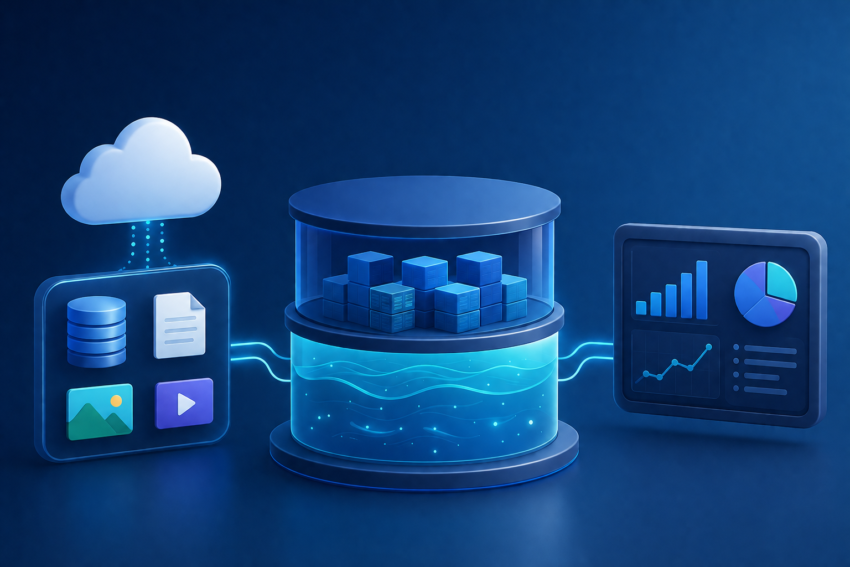
Data has become one of the most valuable assets for modern organizations, but managing it effectively has become increasingly complex. Businesses now collect structured, semi-structured, and unstructured data from countless sources, making it difficult for traditional storage systems to keep up. While data lakes offer flexibility for storing massive datasets and cloud data warehouses provide high-performance analytics, organizations often struggle to choose between the two. This challenge has led to the rise of the data lakehouse—a modern architecture that combines the best features of both approaches. Much of this transformation is driven by forward-thinking thought leadership in AI and innovation, which explores how intelligent technologies and cloud-native solutions are reshaping enterprise data strategies.
A data lakehouse eliminates the need to maintain separate environments for storage and analytics. Instead, it creates a unified platform capable of handling diverse data types while delivering fast analytical performance. In this comprehensive guide, we’ll explore what a data lakehouse is, why it’s becoming increasingly popular, and how it is bridging the gap between data lakes and cloud data warehouses.
Understanding Data Lakes
Before understanding a data lakehouse, it’s important to know what a data lake is.
A data lake is a centralized repository designed to store vast amounts of raw data in its original format. Unlike traditional databases, a data lake doesn’t require data to be structured before storage.
Organizations can store:
- Structured data from databases
- Semi-structured data like JSON and XML
- Unstructured data such as videos, images, documents, emails, and sensor data
Because data is stored without predefined schemas, businesses gain tremendous flexibility for future analysis.
Data lakes are particularly useful for machine learning, artificial intelligence, IoT applications, and big data analytics where preserving raw information is critical.
Understanding Cloud Data Warehouses
Cloud data warehouses serve a different purpose.
Instead of storing raw information, they are designed for structured, optimized analytics. Data is cleaned, transformed, and organized before being loaded into the warehouse.
Cloud data warehouses excel at:
- Business intelligence reporting
- Interactive dashboards
- SQL-based analytics
- High-speed query processing
- Enterprise reporting
Because the data is highly organized, queries execute much faster compared to raw data environments.
This makes cloud warehouses ideal for decision-makers who need reliable, consistent business insights.
Why Organizations Needed Something Better
Although both technologies are powerful, each has limitations.
Data lakes provide inexpensive storage but often struggle with governance, metadata management, and performance.
Cloud data warehouses offer exceptional performance but require data transformation before analysis, making them less flexible for handling diverse datasets.
As organizations began working with AI, streaming data, IoT, and advanced analytics, maintaining two separate environments became expensive and operationally complex.
This challenge led to the emergence of the data lakehouse.
What Is a Data Lakehouse?
A data lakehouse combines the flexibility of a data lake with the performance and management capabilities of a cloud data warehouse.
Instead of separating storage and analytics, organizations use one unified architecture capable of supporting multiple workloads.
A data lakehouse allows businesses to:
Store raw data
Process structured information
Run business intelligence queries
Support machine learning
Manage governance and security
Maintain high analytical performance
This hybrid approach simplifies modern data architecture significantly.
How a Data Lakehouse Works
A data lakehouse stores all data in a centralized cloud storage layer while adding advanced capabilities typically associated with data warehouses.
Instead of requiring separate storage systems, the platform introduces features such as:
Schema enforcement
ACID transactions
Metadata management
Data versioning
Indexing
Query optimization
These enhancements transform raw cloud storage into an analytics-ready environment.
Users from different departments can access the same data while performing entirely different workloads.
Key Components of a Modern Data Lakehouse
A successful lakehouse architecture includes several important components working together.
Unified Storage
The foundation consists of scalable cloud object storage capable of handling structured and unstructured data simultaneously.
This provides unlimited scalability while keeping storage costs relatively low.
Metadata Layer
Metadata helps organize and describe stored information.
Without proper metadata, locating valuable datasets becomes increasingly difficult.
The metadata layer enables:
Data discovery
Search capabilities
Governance
Access management
Version tracking
Transaction Layer
Unlike traditional data lakes, lakehouses support ACID transactions.
This ensures:
Reliable updates
Consistent data
Error recovery
Improved collaboration
Multiple users can safely work on datasets simultaneously.
Compute Engine
The compute layer processes analytical queries, machine learning workloads, and data transformations.
Because compute and storage remain separated, organizations can scale resources independently.
Why Data Lakehouses Are Becoming So Popular
Modern enterprises increasingly prefer lakehouses because they solve many long-standing challenges.
One major advantage is architectural simplicity.
Instead of managing multiple platforms, businesses operate a single unified environment.
This reduces infrastructure complexity while improving operational efficiency.
Supporting Both Analytics and AI
One of the strongest advantages of lakehouse architecture is its ability to support multiple use cases simultaneously.
Business analysts can generate dashboards while data scientists build machine learning models using the exact same datasets.
Previously, organizations often duplicated data across several platforms to accomplish this.
A lakehouse removes this duplication entirely.
Better Cost Efficiency
Maintaining separate data lakes and warehouses increases infrastructure costs.
Organizations pay for:
Storage
Data movement
Maintenance
Processing
Administrative overhead
A unified lakehouse significantly reduces these costs by eliminating redundant systems.
Since cloud object storage remains inexpensive, organizations can retain massive historical datasets without excessive spending.
Improved Data Governance
One criticism of traditional data lakes has always been weak governance.
Poorly managed lakes often become “data swamps” filled with inconsistent, undocumented information.
Lakehouses address this issue through:
Centralized metadata
Access controls
Data lineage
Audit capabilities
Schema enforcement
These features improve trust in organizational data.
Faster Analytics Performance
Although data lakes excel at storage, analytical performance has historically lagged behind warehouses.
Modern lakehouses introduce indexing, caching, and optimized query engines that dramatically improve performance.
Users can execute complex analytical queries without waiting extended periods.
This supports real-time dashboards and interactive business intelligence applications.
Enabling Real-Time Data Processing
Businesses increasingly require immediate access to information.
Whether monitoring financial transactions, website activity, or manufacturing equipment, waiting hours for reports is no longer acceptable.
Lakehouses support streaming data ingestion alongside traditional batch processing.
This allows organizations to combine historical and live information within one architecture.
The result is faster, more informed decision-making.
Cloud-Native Design Advantages
Most lakehouse platforms are designed specifically for cloud environments.
This brings several advantages.
Elastic scalability allows organizations to expand storage and computing resources instantly.
Automatic infrastructure management reduces operational effort.
High availability ensures continuous access to critical business data.
Pay-as-you-go pricing improves financial flexibility.
These characteristics align perfectly with modern enterprise requirements.
Industry Applications
Organizations across multiple industries are adopting lakehouse architectures.
Retail companies analyze customer purchasing behavior while simultaneously training recommendation engines.
Healthcare providers combine structured patient records with medical imaging and research data to improve clinical outcomes.
Financial institutions integrate transaction records with fraud detection models for real-time risk analysis.
Manufacturers merge production metrics, IoT sensor data, and maintenance records to optimize operations.
Each industry benefits from having one unified analytics platform.
Challenges Organizations Should Consider
Although lakehouses provide many advantages, implementation still requires careful planning.
Data governance policies must be clearly established.
Organizations need skilled data engineers familiar with cloud-native architectures.
Performance optimization remains important despite modern improvements.
Businesses should also select technologies that integrate well with existing analytics ecosystems.
Proper planning minimizes migration risks and ensures long-term success.
Best Practices for Implementing a Data Lakehouse
Successful adoption begins with defining business objectives.
Organizations should understand which workloads will benefit most from unified architecture.
Strong governance frameworks should be established early.
Metadata management should receive high priority to maintain data discoverability.
Automation can improve ingestion, transformation, and monitoring processes.
Regular performance reviews help optimize storage costs and query efficiency.
Training technical teams ensures organizations maximize the value of the new architecture.
The Future of Data Lakehouse Architecture
The lakehouse concept continues evolving rapidly.
Artificial intelligence will increasingly automate optimization tasks.
Machine learning models will become deeply integrated into daily analytics.
Serverless computing will simplify infrastructure management even further.
Organizations will gain access to faster query engines capable of analyzing petabytes of information within seconds.
Cross-cloud interoperability will improve, allowing businesses to operate seamlessly across multiple cloud providers.
As these technologies mature, lakehouses will become the default architecture for enterprise analytics.
Why Data Lakehouses Represent the Future
Organizations no longer want separate systems for storage, analytics, governance, and AI.
They want one intelligent platform capable of supporting every stage of the data lifecycle.
A data lakehouse delivers exactly that.
It combines affordability, scalability, flexibility, governance, and analytical performance into one architecture.
This makes it uniquely positioned to support modern digital transformation initiatives.
Businesses can reduce complexity while increasing innovation and operational efficiency.
The emergence of the data lakehouse marks one of the most significant advancements in modern data architecture. By bridging the gap between traditional data lakes and cloud data warehouses, lakehouses provide organizations with the flexibility to store diverse data types while delivering the speed and governance required for enterprise analytics.
Rather than forcing businesses to choose between storage flexibility and analytical performance, the lakehouse architecture offers the best of both worlds. It supports business intelligence, machine learning, artificial intelligence, and real-time analytics within a single unified platform.
As organizations continue generating larger volumes of data and demand faster insights, adopting a data lakehouse strategy can simplify infrastructure, reduce operational costs, improve governance, and accelerate innovation. For enterprises building future-ready data ecosystems, the data lakehouse is no longer just an emerging trend—it is quickly becoming the foundation of modern cloud data management.