

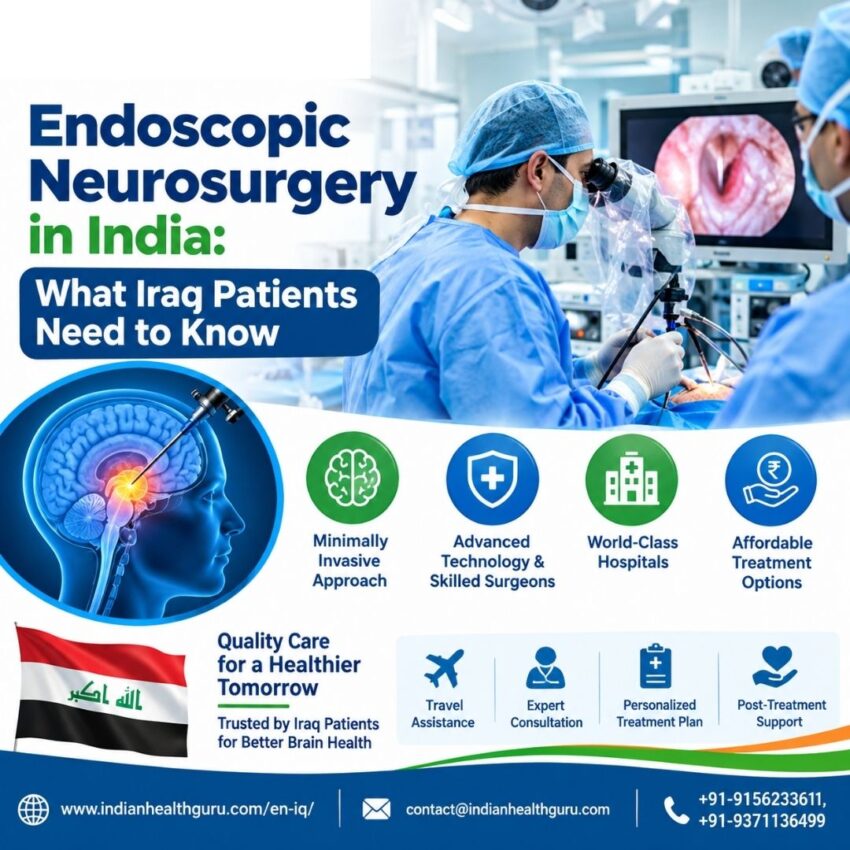
Endoscopic neurosurgery is a minimally invasive approach that uses a small camera called an endoscope to help surgeons access and treat selected conditions involving the brain, skull base or spinal region. The technique can provide a direct view of areas that may be difficult to reach through conventional approaches.
For patients from Iraq travelling to India, endoscopic neurosurgery may offer an alternative to traditional surgery in carefully selected cases. However, it is not appropriate for every neurological condition. The recommended approach depends on the diagnosis, location and size of the problem, the patient’s health and the surgeon’s assessment.
What Is Endoscopic Neurosurgery?
An endoscope is a thin instrument equipped with a camera and light. It allows the surgeon to view the operative area through a small opening or natural anatomical passage, depending on the procedure.
In neurosurgery, endoscopic techniques may be used for selected brain tumours, hydrocephalus, skull-base conditions and other neurological disorders. Some procedures may be performed through the nasal passages, while others require a small surgical opening.
The aim is to reach the affected area while limiting unnecessary disruption to surrounding tissues.
Which Conditions Can Be Treated?
Endoscopic techniques may be considered for selected patients with:
- Certain skull-base and pituitary tumours
- Hydrocephalus
- Some brain cysts
- Selected ventricular conditions
- Certain spinal or cranial conditions
The technique is particularly useful in some areas where a direct endoscopic route can provide good surgical access. However, a conventional craniotomy or another surgical technique may be safer for other conditions.
Potential Benefits
When appropriate, endoscopic neurosurgery may offer several potential advantages. Smaller surgical access can sometimes mean less disruption to surrounding tissues, reduced wound size and a potentially shorter recovery.
Some patients may experience less postoperative discomfort and earlier mobilisation. However, these benefits depend on the specific operation and individual patient.
A minimally invasive approach does not necessarily mean a minor operation. Neurosurgical procedures can carry significant risks, and safety should always take priority over incision size.
How Is Endoscopic Neurosurgery Performed?
The procedure begins with detailed imaging, usually MRI or CT, to understand the anatomy and plan the surgical route. During surgery, the endoscope provides magnified visualisation of the target area.
Specialised instruments are passed alongside or through the endoscope to perform the required treatment. Depending on the condition, the surgeon may remove tissue, drain fluid, take a biopsy or remove a tumour.
The exact procedure and duration vary considerably depending on the diagnosis.
Why Do Iraq Patients Consider India?
India has specialised neurosurgical centres with teams that may include neurosurgeons, neurologists, neuroradiologists, neuro-oncologists and rehabilitation specialists. Some centres also have advanced imaging, neuronavigation and endoscopic surgical facilities.
For Iraq patients, access to a multidisciplinary team can be particularly useful when the diagnosis is complex or when a second opinion is required before major brain surgery.
Patients should evaluate the surgeon’s experience with the specific endoscopic procedure, rather than selecting a hospital solely because it offers endoscopic surgery.
Cost Considerations
The cost of endoscopic neurosurgery in India varies according to the condition, procedure complexity, surgeon, hospital, technology and length of stay.
The overall expense may include diagnostic imaging, surgeon and anaesthesia fees, operating-room charges, ICU care, hospitalisation, medicines, pathology and rehabilitation.
Iraq patients should request a personalised treatment plan and itemised quotation before travelling. The quotation should clearly state what is included and whether additional investigations or treatment may change the final cost.
Read More:- Endoscopic Surgery Cost in India for Iraqi Patients
Recovery and Hospital Stay
Recovery depends on the condition treated and the type of endoscopic procedure. Some patients may recover relatively quickly, while complex brain surgery can require longer hospitalisation and rehabilitation.
After surgery, the medical team monitors neurological function, pain, wound or surgical access sites and other relevant parameters. Physiotherapy, occupational therapy or speech therapy may be recommended when neurological deficits are present.
Iraq patients should plan sufficient time in India for postoperative assessment before returning home.
Read More:- Endoscopic Neurosurgery Hospitals in India for Iraqi Patients
Preparing to Return to Iraq
The treating neurosurgeon should confirm when the patient is medically stable and fit to travel. Patients should not schedule an international flight solely according to a standard number of postoperative days.
Before leaving India, patients should collect their discharge summary, operative report, imaging, pathology results where applicable, medication list and follow-up instructions.
Continuing follow-up with a neurosurgeon or neurologist in Iraq is important, particularly when further treatment or surveillance scans are required.
Questions Iraq Patients Should Ask
Before choosing endoscopic neurosurgery, patients should ask:
- Is an endoscopic approach suitable for my condition?
- What conventional alternatives are available?
- How experienced is the surgeon with this exact procedure?
- What are the potential complications?
- What technology will be used?
- How long is the expected hospital stay?
- How much rehabilitation may be required?
- When can I safely return to Iraq?
These questions can help patients make a decision based on medical suitability rather than technology alone.
Final Thoughts
Endoscopic neurosurgery can provide a minimally invasive option for selected neurological conditions and may reduce surgical access in appropriately chosen cases. However, not every brain or spinal condition can or should be treated endoscopically.
For Iraq patients considering treatment in India, the priority should be an accurate diagnosis, experienced neurosurgical assessment and a clear explanation of all appropriate treatment options. Reviewing medical records and imaging before travelling can also help patients understand the likely procedure, recovery and costs.
Official Indian Government References
All India Institute of Medical Sciences (AIIMS)
AIIMS is a leading Government of India medical institution with specialised neurosurgery, neurology, neuroimaging and multidisciplinary neurological services.
Official Website: www.aiims.edu
National Medical Commission (NMC), Government of India
NMC is India’s statutory medical regulator responsible for standards relating to medical education and professional medical practice.
Official Website: www.nmc.org.in
Our Commitment to Patients
“Our mission is to place patients at the centre of every healthcare decision by providing trustworthy, evidence-based, and unbiased medical information. We believe that informed patients make better decisions. Backed by personalised guidance from our experienced advisory team, we help patients understand their treatment options, compare them objectively, and confidently choose the path that best aligns with their medical needs, personal preferences, and long-term health goals.”
Disclaimer
This article is intended for educational and informational purposes only and should not be considered medical, legal, or visa advice. Medical recommendations, treatment plans, and procedures may vary from one patient to another based on individual health conditions and circumstances. Readers are strongly advised to consult qualified healthcare professionals before making any medical-related decisions.
Dr. Dheeraj Bojwani
Medical Travel Advisor for International Patients Seeking Treatment in India
📍 New Delhi, India
🏆 24+ Years of Experience | Assisted 5,000+ International Patients
🌐 Website: www.indianhealthguru.com/en-iq/
📧 Email: contact@indianhealthguru.com
📞 Phone: +91 9156233611 | 📞 Alternate Phone: +91 9371136499