
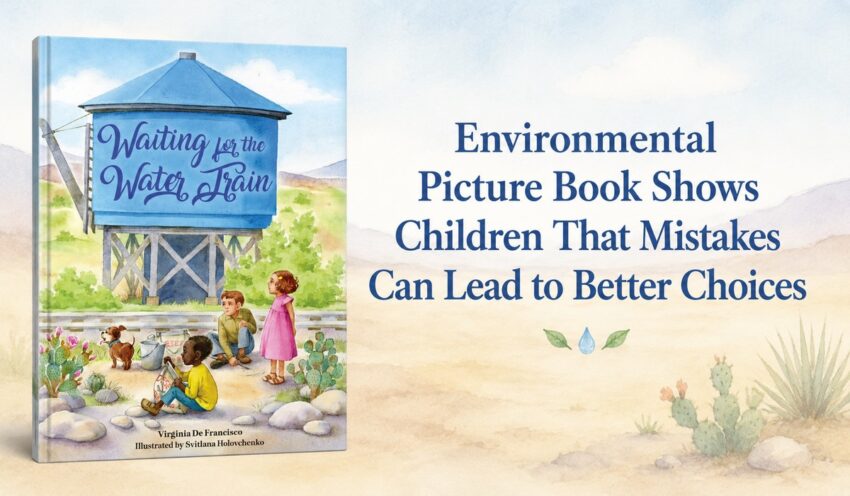
Emma’s journey combines conservation with accountability, forgiveness, and emotional growth.
A new children’s picture book is demonstrating that environmental education can also become a meaningful lesson in emotional growth, responsibility, and healthy relationships. Waiting for the Water Train, written by Virginia De Francisco and illustrated by Svitlana Holovchenko, blends water conservation with social-emotional learning by showing young readers that mistakes need not define a person’s future.
At the heart of the story is Emma, an energetic young girl living in a Mojave Desert community where water has always seemed plentiful. Like many children, she takes an everyday resource for granted. She wastes water despite gentle reminders that supplies are limited, believing there will always be enough tomorrow.
Then tomorrow changes everything.
The community’s underground well finally fails before the next scheduled water delivery. As families begin carefully rationing every remaining drop while waiting for the weekly water train, Emma realizes that her earlier choices carried real consequences. She experiences regret, disappointment, and guilt as she reflects on what happened.
Rather than using shame as a teaching tool, however, Waiting for the Water Train offers a healthier and more constructive approach.
Emma is never portrayed as a “bad child.” The story acknowledges that many people contributed to the community’s growing water problem. Adults, neighbors, and long-standing habits all played roles in creating the crisis. Emma accepts responsibility for her own actions without carrying responsibility for everything that happened.
This balanced perspective mirrors best practices in today’s social-emotional learning programs, which encourage accountability while protecting children’s developing sense of self-worth.
The book shows that regret becomes valuable only when it inspires change.
Instead of remaining trapped by guilt, Emma begins making wiser decisions. She learns to appreciate every bucket of water, helps her family care for limited supplies, and develops a deeper understanding of conservation. Her mistake becomes the beginning of personal growth rather than the end of her confidence.
Another important layer of the story comes through Emma’s relationship with her brother James.
Initially, James directs much of the blame toward Emma, believing she alone caused the family’s difficulties. His criticism reflects a common emotional response during stressful situations, particularly among children searching for someone to hold responsible.
As the story unfolds, however, James begins recognizing that the situation is more complicated than he first believed. He realizes that blaming one person oversimplifies a much larger problem.
Perhaps most importantly, James apologizes.
His apology demonstrates emotional maturity, humility, and the willingness to repair damaged relationships. Instead of continuing to criticize Emma, he offers practical support by encouraging her and helping carry heavy buckets of water once the long-awaited train finally arrives.
Emma’s response is equally significant.
She accepts James’s apology with grace. She forgives him. She also forgives herself, recognizing that genuine growth requires both accountability and self-compassion. Rather than remaining focused on past mistakes, she commits herself to making better choices in the future.
These interactions provide valuable examples for children learning how to navigate conflict, disappointment, and personal responsibility.
Educators increasingly recognize that environmental education and social-emotional learning complement one another. Caring for natural resources requires empathy, thoughtful decision-making, cooperation, and personal responsibility—the same qualities that strengthen relationships and emotional resilience.
Waiting for the Water Train naturally reinforces these shared competencies.
Young readers learn to recognize mistakes without becoming overwhelmed by guilt. They see sincere apologies modeled through actions as well as words. They observe relationships repaired through empathy, honesty, and forgiveness. Most importantly, they discover that positive change remains possible after poor decisions.
The book supports classroom discussions surrounding recognizing mistakes, managing difficult emotions, accepting shared responsibility, resolving conflicts respectfully, repairing trust, and transforming regret into meaningful action.
Counselors, teachers, parents, librarians, and SEL specialists may find the story especially useful during units on empathy, character education, emotional regulation, responsible decision-making, environmental stewardship, and healthy communication.
Svitlana Holovchenko’s expressive watercolor illustrations deepen the emotional impact of the story by capturing Emma’s changing expressions—from carefree confidence to quiet reflection and, ultimately, renewed hope. The illustrations help younger readers recognize emotional cues while remaining fully engaged with the unfolding narrative.
Rather than presenting environmental responsibility through fear or punishment, Waiting for the Water Train demonstrates that compassion, honesty, forgiveness, and learning can inspire lasting behavioral change.
By combining conservation with emotional intelligence, the book offers children practical life lessons they can carry far beyond the final page.
Review copies, educator guides, counseling resources, classroom presentation opportunities, parenting media interviews, author interviews, literacy events, and school partnership information are now available. Waiting for the Water Train is available through major booksellers and wherever children’s books are sold.
Contact:
Amazon: Waiting for the Water Train
Author: Virginia De Francisco
https://www.facebook.com/profile.php?id=61591557835010#