

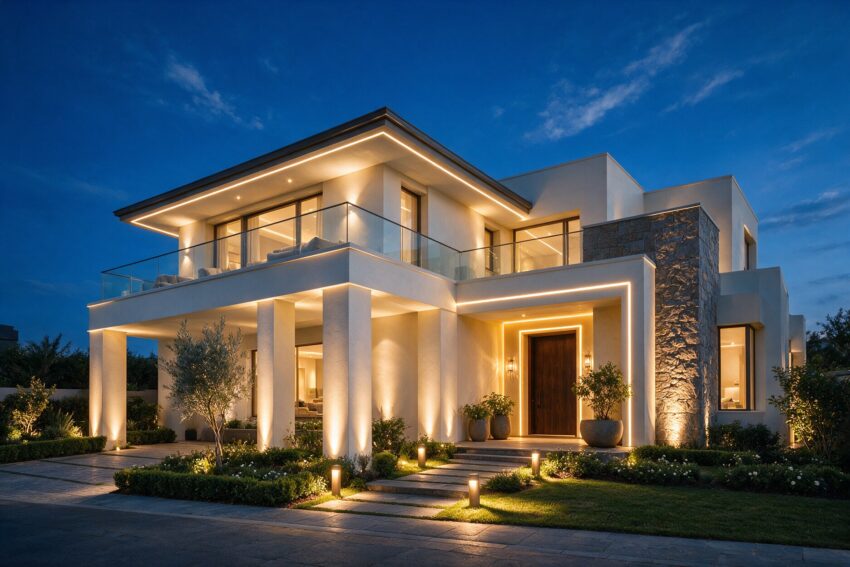
A building spends half its life in the dark, yet most facades are lit as an afterthought. This article explains what facade lighting is, the key techniques used by lighting designers, how to choose between static and dynamic lighting, why weatherproofing matters in Indian conditions, and how the right facade lighting adds character, security, and lasting value to homes, villas, and commercial buildings.
Every building lives two lives. By day, it’s shaped by sunlight: the sky, the shadows, and the changing angle of the sun. By night, it depends entirely on artificial light. Yet while enormous care goes into how a building looks during the day, its night-time appearance is often left to a few flood lights fixed wherever the electrician found a spare point.
That’s a missed opportunity. A building spends roughly half its life in the dark, and during those hours its facade is its identity. Facade lighting decides whether a home or commercial building looks elegant and welcoming after sunset, or flat, patchy, and forgettable.
What Is Facade Lighting?
Facade lighting is the design of light on a building’s exterior to reveal its architecture after dark. Good facade lighting doesn’t simply make a building bright. It picks out what makes the structure distinctive, such as columns, textures, cladding, and rooflines, and gives it depth, rhythm, and presence at night.
The difference between a well-lit facade and a badly lit one is rarely the amount of light. It’s where that light goes, and where it deliberately doesn’t.
The Techniques Lighting Designers Use
Professional facade lighting relies on a handful of proven techniques, often combined on the same building.
Uplighting places fixtures at ground level, aimed upwards to emphasise height and vertical elements such as pillars.
Wall washing spreads soft, even light across a wall surface, making the building feel calm and substantial.
Wall grazing places light close to a textured surface such as stone, brick, or fluted panels, so that every ridge casts a shadow and the material comes alive.
Accent lighting highlights specific features: an entrance, a signature element, or a name board.
Linear and outline lighting traces edges, balconies, and rooflines to give the building a crisp, defined silhouette.
The skill lies in choosing which features to light and leaving the rest in calm darkness. Contrast is what gives a facade its drama.
Static or Dynamic?
One of the first decisions is whether the facade should be static or dynamic.
Static lighting uses fixed white or warm light. It suits most homes, villas, and corporate buildings, where the aim is timeless elegance.
Dynamic lighting uses colour-changing fixtures controlled by a lighting system, allowing different scenes for festivals, events, or seasons. It is increasingly popular for hotels, retail, and landmark buildings.
For many homeowners, a combination works best: warm static lighting for everyday elegance, with the option of a festive scene for Diwali or special occasions.
Built for Indian Conditions
Exterior lighting in India faces heat, dust, heavy monsoon rain, and voltage fluctuations. Fixtures that aren’t built for these conditions fade, corrode, or fail within a season.
That’s why facade fixtures should carry an appropriate IP rating for water and dust resistance, use corrosion-resistant housings, and be installed with sealed connections and surge protection. Choosing cheaper fixtures often means replacing them within a year or two, while quality fixtures installed properly can perform reliably for many years.
More Than Just Looks
Facade lighting is often seen as purely decorative, but it delivers practical value too.
Security: A well-lit exterior removes dark corners and deters intruders.
Safety: Entrances, pathways, and steps become easier to navigate at night.
Brand and identity: For commercial buildings, the facade at night is a round-the-clock advertisement.
Property value: A beautifully lit exterior creates a strong first impression, which matters to guests, tenants, and buyers alike.
Plan It Early
The most common mistake is treating facade lighting as a last-minute addition. Fixture positions, cable routes, and power points are far easier and cheaper to plan while the building is under construction or renovation. Retrofitting later often means visible wiring, compromised fixture positions, and higher costs.
Involving a lighting designer at the design stage allows the lighting to be integrated into the architecture, with fixtures concealed and effects intentional, rather than added as an afterthought.
Choosing the Right Partner
When selecting a facade lighting partner, look for a company that designs as well as installs, can show completed exterior projects, specifies weather-rated fixtures, and can integrate the lighting with timers or smart control so the facade switches on at dusk and off at a set time automatically.
Brightmatic designs and installs facade and architectural lighting for homes, villas, and commercial buildings, serving Noida, Delhi NCR & across India. You can explore the service here: https://www.brightmatic.in/services/facade-lighting
A building’s night-time appearance deserves the same care as its daytime design. With the right lighting, a facade doesn’t just become visible after dark. It becomes memorable.
This article is contributed by Brightmatic, a premium architectural lighting and smart home company based in Noida, serving Noida, Delhi NCR & across India. Brightmatic designs and installs facade, architectural, and smart lighting for luxury homes and commercial spaces, guided by the philosophy of Crafting Brighter Lives. Book a free consultation at https://www.brightmatic.in