

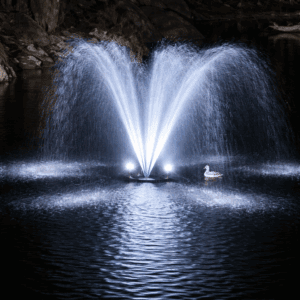
Ponds can provide an attractive feature for residential properties, farms, landscaped areas, and other outdoor spaces, but still water may require additional circulation. A fountain can help move water while creating a visible spray display across the pond surface. Understanding how a floating pond fountain works, what its horsepower rating means, and which features matter can make it easier to select an appropriate option for a particular water body.
How Does a Floating Pond Fountain Work?
A floating pond fountain rests on the surface of the pond while a submersible pump draws water through the system and pushes it upward through a spray nozzle. The water then falls back into the pond, creating continuous movement across the surface.
This circulation can contribute to water aeration by increasing contact between water and air. Moving water can also help reduce stagnant areas, although fountain performance depends on factors such as pond size, depth, shape, and overall water conditions.
The floating design also allows the fountain to remain on the water rather than requiring a permanent structure built into the pond.
Why Horsepower and Flow Rate Matter
Horsepower indicates the motor’s power, while gallons per hour (GPH) describes the amount of water the pump can move. These specifications work together when determining how a fountain will perform.
The floating pond fountain collection currently includes 1/3 HP, 1/2 HP, and 3/4 HP options. Their listed flow rates are approximately 4,000 GPH, 5,300 GPH, and 6,600 GPH, respectively.
A smaller fountain may be appropriate where moderate circulation is needed, while larger ponds can require greater pumping capacity. The fountain should therefore be selected according to the water body’s characteristics rather than horsepower alone.
Spray Patterns Add Visual Variety
A fountain does more than circulate water. Its nozzle determines the shape, height, and spread of the resulting display.
Friendly Fountains’ floating models include interchangeable spray nozzles, allowing users to change the appearance of the water pattern. Depending on the model and nozzle, displays can create different heights and widths, making this feature useful when appearance is an important consideration.
Changing the spray pattern can also help users create a display that better suits the available pond area.
Lighted and Non-Lighted Options
Floating fountains are available with or without lighting. A non-lighted model keeps the focus on daytime water movement and aeration, while a lighted model adds visibility after sunset.
The current collection includes 1/3 HP, 1/2 HP, and 3/4 HP lighted options. These models use three LED lights with white or color-changing options, depending on the selected product.
Lighting can be particularly useful for ponds located near outdoor gathering areas, landscaped properties, or spaces where the fountain is intended to remain visually prominent after dark.
What Should You Consider Before Choosing One?
Several practical details should be reviewed before selecting a fountain:
- Pond size: Larger water bodies generally require greater circulation capacity.
- Water depth: Confirm that the pond meets the minimum depth requirements of the selected model.
- Flow rate: Compare GPH ratings to understand the pump’s water-moving capacity.
- Spray pattern: Consider the desired height and width of the display.
- Lighting: Decide whether nighttime illumination is necessary.
- Power access: Check the available electrical connection and cord requirements.
- Placement: Consider where the fountain will sit and how its spray will interact with surrounding areas.
Maintenance and Long-Term Operation
Regular maintenance helps keep a floating fountain operating properly. Debris can interfere with the pump, so keeping the intake area clear is important. The products in this collection include debris protection for the pump, interchangeable nozzles, and a two-year warranty.
The fountain should also be positioned according to the manufacturer’s requirements, with sufficient water depth and appropriate electrical access. Routine inspection can help identify buildup, reduced spray performance, or other issues before they affect operation.
Conclusion
A floating fountain combines water movement with an attractive spray display, making it useful for ponds where circulation and visual appeal are both priorities. Choosing the appropriate horsepower, flow rate, spray pattern, lighting, and placement can help match the fountain to the pond’s requirements. The floating pond collection from Friendly Fountains offers multiple power levels and both lighted and non-lighted configurations, giving property owners several options to consider based on their water feature and intended use.