
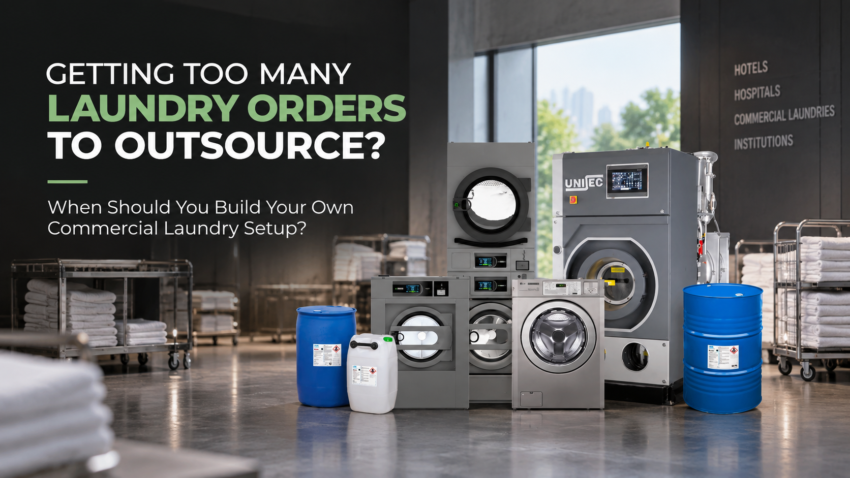
Outsourcing laundry can be a practical way to start or grow without investing heavily in equipment. But as orders increase, outsourcing costs, turnaround delays, limited process control, and dependency on another laundry can start affecting your business. At that stage, planning your own commercial laundry business setup may become a serious business decision rather than just an expansion idea.
The right time to move in-house depends on your actual laundry volume, customer commitments, operating costs, space, utilities, and future growth—not on one fixed KG number.
When Does Outsourcing Stop Making Sense for Your Commercial Laundry Business?
Outsourced laundry services can work well when volumes are small or inconsistent. You avoid a large initial investment and pay for processing based on the work you receive.
The situation changes when your commercial laundry business starts generating regular orders.
Watch for signs such as:
- Monthly outsourced laundry volume is consistently increasing.
- Outsourcing has become a major recurring operating expense.
- Customers are asking for faster turnaround.
- You have limited control over wash quality and finishing.
- Delays from the processing partner affect your commitments.
- You are turning down orders because your outsourcing partner cannot handle additional volume.
- You have secured or expect recurring B2B contracts.
For example, a growing B2B laundry business serving hotels, restaurants, gyms, spas, salons or institutions may need greater control over processing schedules as contract volume increases.
Instead of asking only, “How much am I paying my laundry partner?”, ask:
What would it cost to process this volume through my own operation, and would the additional control and capacity support future growth?
That comparison gives you a better starting point for deciding whether an in-house laundry setup makes business sense.
How Much Laundry Volume Do You Need Before Building Your Own Commercial Laundry Setup?
There is no universal laundry volume at which every business should stop outsourcing.
A business processing 300 KG per day under predictable contracts may have a very different case from another processing the same volume through irregular orders.
Start with your actual records.
A simple calculation is:
Expected Daily KG = Monthly Outsourced KG ÷ Operating Days
If you outsource 7,800 KG per month and operate for 26 days:
7,800 ÷ 26 = 300 KG per day
This gives you a starting volume for capacity planning. Next, examine how stable that 300 KG really is.
Look at:
- Average daily volume
- Peak-day volume
- Customer-wise KG
- Confirmed recurring contracts
- Seasonal fluctuations
- Expected new contracts
- Required turnaround time
- Textile and linen categories
Your laundry processing capacity should not be planned from average KG alone. A hotel linen contract, for example, may create different washing, drying, and finishing requirements from uniforms or mixed commercial garments.
Before investing, calculate both your current requirement and realistic future demand. Buying too little capacity can quickly recreate the same bottleneck, while buying far beyond actual demand can leave expensive equipment underused.
What Equipment Does an In-House Commercial Laundry Setup Actually Need?
A commercial laundry setup is more than buying a washing machine.
The equipment should support the complete processing flow:
Receiving → Sorting → Washing → Drying → Finishing → Quality Check → Packing → Dispatch
Your exact laundry business equipment will depend on the services and textiles you handle, but a typical setup may require:
- Commercial washing machine or washer extractor
- Commercial tumble dryer
- Suitable finishing equipment
- Sorting and handling equipment
- Trolleys and linen movement systems
- Folding or packing workstations
- Chemical handling or dosing arrangements
The washing section is normally planned around expected KG, textile categories and practical loads. A commercial washer extractor should then be matched with adequate downstream capacity.
For example, increasing washing capacity does little good if your commercial tumble dryer becomes the next bottleneck.
The same applies to finishing. If washed and dried linen spends hours waiting for finishing, the operation still cannot achieve the required turnaround.
That is why your commercial laundry equipment should be selected as a system rather than as individual machines.
Utilities also matter. Depending on the selected equipment, you may need to evaluate water supply, drainage, electrical load, heating requirements, ventilation, and other site conditions according to the machine specifications.
Outsourcing vs Your Own Laundry Setup—What Should You Compare Before Investing?
The decision should not be based only on outsourcing price versus machine price.
Outsourcing requires less capital investment and transfers much of the processing responsibility to another business. An in-house operation requires equipment, space, staff, utilities, maintenance, and day-to-day process management.
However, owning the processing operation can provide greater control over scheduling, capacity planning and workflow.
Compare the two options across these areas:
|
Factor |
Outsourcing |
In-House Setup |
|
Initial investment |
Lower |
Higher |
|
Equipment responsibility |
External processor |
Your business |
|
Processing control |
Limited |
Greater |
|
Staffing requirement |
Lower |
Requires operational staff |
|
Turnaround control |
Dependent on supplier |
Managed internally |
|
Expansion |
Depends on supplier capacity |
Can be planned around your operation |
|
Maintenance |
External |
Your responsibility |
The economics also depend heavily on utilization.
A machine sitting unused for much of the day may make the laundry business investment difficult to justify. On the other hand, regular outsourced volume combined with recurring contracts can create a stronger case for bringing processing in-house.
Also consider risk. If one large customer represents most of your current volume, investing purely on that contract may expose the business if the contract ends. A broader base of recurring customers can make capacity planning more predictable.
How Much Should You Budget to Bring Laundry Processing In-House?
One of the biggest mistakes when calculating commercial laundry setup cost is looking only at machine prices.
Your actual investment is broader:
Total Setup Investment = Machines + Installation + Utilities + Site Preparation + Supporting Equipment + Initial Operating Requirements
The machine component may include the washer extractor, tumble dryer and required finishing equipment. But your budget may also need to account for electrical work, plumbing, drainage, ventilation, equipment positioning, material handling and other requirements based on the site and selected models.
Instead of asking, “What is the cheapest setup I can build?”, ask:
“What setup can reliably process my expected daily volume within the required operating hours?”
Then compare your proposed investment with:
- Current monthly outsourcing expense
- Expected processing volume
- Available operating hours
- Staffing cost
- Utility requirements
- Maintenance requirements
- Customer pricing
- Confirmed and expected contract volume
- Planned business growth
This gives you a more useful picture of the laundry setup cost and whether bringing processing in-house is commercially sensible.
How Orgaearth Can Help
Planning a commercial laundry business setup starts with understanding what the business actually needs to process—not simply selecting the largest machines available.
OrgaEarth can help businesses evaluate their expected laundry volume, required machine capacity, available space, utility conditions and workflow before selecting Whether you are moving away from outsourced processing, commercial laundry equipment.
starting a new laundry operation or expanding an existing facility, the goal is to build a balanced setup where washing, drying and finishing capacity work together.
Frequently Asked Questions
How much does a commercial laundry setup cost?
The cost depends on processing capacity, machine selection, site preparation, utilities, installation, finishing requirements and supporting equipment. Calculate the complete project cost rather than comparing only machine prices.
When should a business stop outsourcing laundry?
Consider bringing processing in-house when outsourced volume becomes consistent, recurring costs increase, customer contracts become more predictable, or external processing starts limiting turnaround, quality control or growth.
What equipment is needed for a commercial laundry?
A typical laundry equipment list can include washer extractors, tumble dryers, finishing equipment, chemical handling systems, trolleys, sorting areas and packing workstations. The exact requirement depends on your services and daily processing volume.
How much space does a commercial laundry need?
There is no single space requirement for every laundry. It depends on machine dimensions, capacity, workflow, loading and unloading areas, utility access, material movement and service clearances. Final planning should follow the specifications of the selected equipment.
Is in-house laundry worth the investment?
It can be when the business has sufficient recurring volume and a clear operational reason to bring processing under its own control. Compare total investment and operating responsibility against outsourcing costs, contract stability, required turnaround, and future growth before deciding.
Contact Us
Orgaearth Laundry Solutions
Plot no. 774, Udyog Vihar, Phase 5, Gurugram, Haryana, India-122016
Email: marketing@orgaearth.com
Contact No.- +91 7042912777