

The fishway is one of the oldest engineering concepts in natural resource management. The idea is elegant: if a dam blocks fish, build a channel that fish can swim through around or over the barrier. Stepped pool ladders, nature-like bypass channels, vertical-slot fishways, pool-and-weir designs. Each is a variation on the same underlying premise: use water flow to create a passable gradient.
That premise has served the field for over a century. It has also, we’d argue at Whooshh Innovations, become a constraint on what passage infrastructure designers are willing to consider. The fishway concept is so established that alternatives to water-based passage are treated with skepticism simply because they’re different from what the field has known.
The evidence for that skepticism is worth looking at honestly. Conventional fishways have documented performance limitations. NOAA Fisheries has reported passage efficiency rates below 70% at some fish ladder installations on the U.S. West Coast for certain salmon populations. That means at some facilities, three fish in ten are not making it past a single structure that cost millions of dollars to build. A concept that has been in use for over a century and still achieves sub-70% efficiency at some facilities is not a concept that has earned immunity from scrutiny.
What Does the Fishway Concept Get Right and Where Does It Fall Short?
Conventional fishways get the entry attraction concept right. Fish do orient to flow. Creating an upstream attraction current that fish can locate and follow to a passage entry is sound biology, and well-designed conventional fishways leverage it. They also get the volitional movement concept right. Fish that move through a fishway do so under their own power, which is preferable to fish that are handled, netted, or mechanically elevated.
Where conventional fishways fall short is selectivity, data generation, and hydraulic cost. A water-gradient fishway passes every fish that reaches it without distinguishing species or origin. It generates no automated record of what passed and when. And it requires continuous water diversion from the headpond that reduces generation revenue for hydroelectric operators.
What Is the Fish Tube and Why Does It Work Differently?
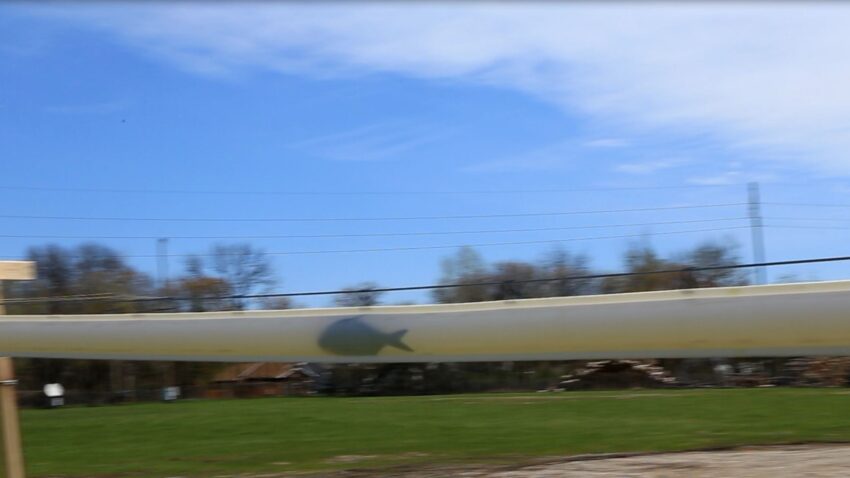
The fish tube, Whooshh’s MigratorTube, replaces the water-gradient passage channel with a flexible, misted, pressurized tube that moves fish using differential air pressure. Fish travel at 25 feet per second on a cushion of humidified air. The tube stays wetted through embedded misting ports that keep fish hydrated during what is, technically, an air transit.
Here’s what makes that difference operationally significant:
- No high-volume water diversion from the headpond, which preserves water for power generation
- Height-independent transport, since air pressure can move fish up any tube length regardless of dam height
- Selective routing through the GateKeeper gate, which acts on FishL Recognition classification to direct each fish to the appropriate destination
- Automated passage data logged for every fish, in real time, without requiring a monitoring crew on site
- Deployment in days rather than the years a conventional fishway civil structure requires
- Adjustable entry via the ASPFishway, which can be repositioned seasonally as water levels and fish behavior change
How Does This Address the Performance Limitations of Conventional Fishways?
The passage efficiency problem in conventional fishways is primarily an entry efficiency and throughput efficiency problem. Fish that don’t find the entry don’t pass. Fish that enter a ladder during low-flow periods when the gradient is compromised don’t pass efficiently.
The PassagePortal’s ASPFishway is positioned within the natural migration corridor using tailrace water. Fish locate it instinctively. The MigratorTube transit takes seconds, not hours. And the automated 24/7 operation means the system is working during the 3 AM peak migration hours that fall outside the staffed observation windows at conventional fishways.
Does Modernizing the Fishway Concept Require Abandoning What Works?
No. The volitional entry principle that makes a good conventional fishway better than a mechanical fish elevator still applies in Whooshh systems. Fish enter the ASPFishway because they choose to, attracted by a naturalistic current in the right location. The fish tube transit replaces the water channel as the transport mechanism, not the volitional entry principle.
Operators who have existing conventional fishways that perform adequately for native species but lack selectivity or data generation capability have another option: the Selector product, which retrofits an existing fish ladder with FishL Recognition scanning and GateKeeper sorting at the top of the ladder. It adds selectivity and monitoring capability without requiring a full replacement of the existing structure.
Final Thoughts
Whooshh Innovations has been refining the fishway concept since 2013. Visit our fish passage page for the full range of solutions. The published Whooshh blog A More Natural Way Forward covers the philosophy behind this design approach. For a site-specific conversation, contact our team.