
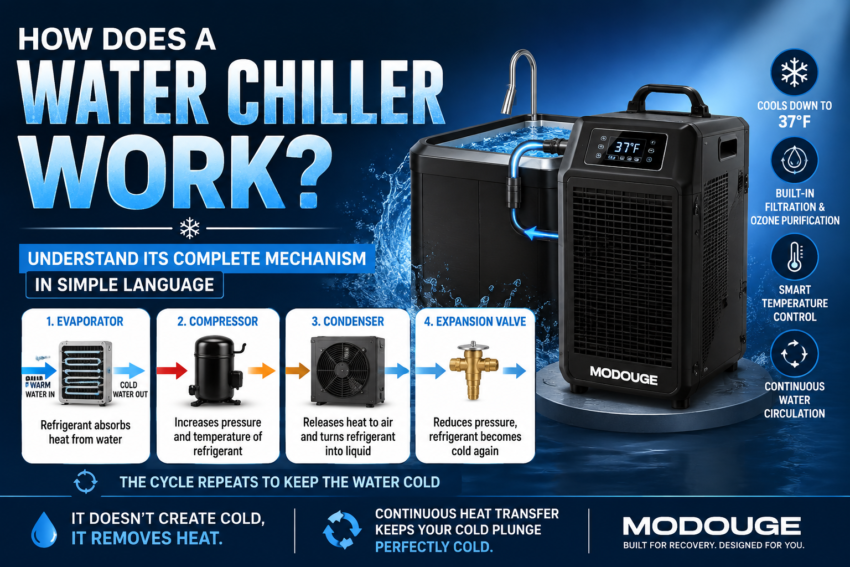
A water chiller works by removing heat from water and transferring it to a refrigerant, which then releases that heat outside the system. This same basic cooling principle is used in cold plunge chillers to continuously cool and maintain water at a desired temperature without relying on ice. A typical chiller works through four main components: the Evaporator, Compressor, Condenser and Expansion Valve.
The process begins when warm water enters the Evaporator or Heat Exchanger. The water flows through one side of the heat exchanger while a low-temperature refrigerant flows through the other side. The refrigerant absorbs heat from the water through the heat exchanger surface, lowering the water temperature. The chilled water can then be circulated back to a cold plunge tub, pool or other application through a water circulation system.
As the refrigerant absorbs heat it changes into a low-pressure gas and moves to the Compressor. The compressor increases the refrigerant’s pressure, which also raises its temperature. The hot, high-pressure refrigerant then enters the Condenser, where it releases the absorbed heat into the surrounding air or cooling water. As the heat is removed, the refrigerant condenses into a high-pressure liquid.
The liquid refrigerant then passes through the Expansion Valve, where its pressure drops sharply. This makes the refrigerant cold and ready to absorb heat again in the evaporator. The cycle then repeats continuously, allowing the chiller to maintain a stable water temperature.
In a modern cold plunge chiller this process can work together with built-in filtration, ozone purification, smart temperature control and a circulation system to keep the water cold and cleaner between sessions. For example Modouge’s portable chiller is designed to turn an existing tub into a cold plunge without complex plumbing or installation, while its 1 HP chiller can cool water down to 37°F.
In simple terms a water chiller does not create “cold” directly. It removes heat from the water, transfers that heat to the refrigerant and rejects the heat through the condenser. This continuous heat-transfer cycle is what allows a cold plunge chiller to keep water cold and ready for repeated use.