
Knowing English is one thing. Being able to use that English naturally, clearly and confidently when someone is sitting across from you and evaluating your performance is another.
This distinction is at the heart of how I approach IELTS Speaking at Chrysalides Tutorials. Over the years, I have seen learners who know the grammar rules, understand the vocabulary and can answer questions in practice—yet become hesitant, repetitive or unsure when they have to respond spontaneously.
That is why I do not see a mock Speaking test simply as a rehearsal for exam day. I see it as a window into the learner’s actual communication behaviour. A useful mock can show us what the learner knows, what they can use under pressure, and where the two are not yet connecting.
At Chrysalides, this fits into a larger belief: learning should go beyond books. Our approach has grown from empirical teaching experience, structured practice and what we observe in learners themselves. The aim is not merely to prepare a student for a test, but to help that student become a more capable and confident communicator.
What Is an IELTS Speaking Mock Test?
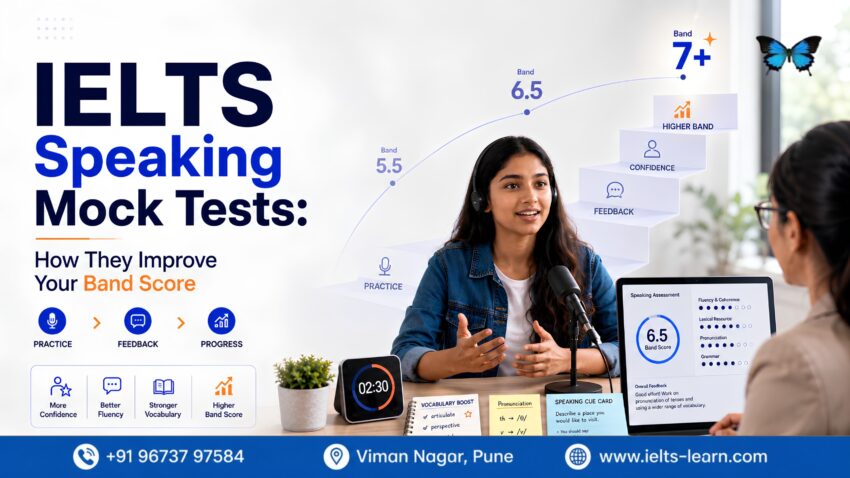
An IELTS Speaking mock test recreates the structure and timing of the actual Speaking test. It gives a learner an opportunity to practise all three parts while receiving feedback against the four IELTS Speaking assessment criteria.
- • Part 1: questions about familiar topics such as home, work, studies, interests and everyday life.
- • Part 2: a task card, one minute to prepare and up to two minutes of speaking.
- • Part 3: a deeper discussion related to the Part 2 topic, where the learner needs to explain and develop ideas.
But a good mock should do more than reproduce the format. It should help answer a more important question: What happens to this learner’s English when they have to think, organise an idea and speak in real time?
The Four IELTS Speaking Assessment Criteria
• Fluency and Coherence
how effectively the learner maintains speech, develops ideas and connects what they say.
• Lexical
the range, precision and appropriacy of vocabulary.
• Grammatical Range and Accuracy
the variety of grammatical structures and the accuracy with which they are used.
• Pronunciation
how clearly meaning is communicated through pronunciation, stress, rhythm and intonation.
What makes Speaking challenging is that these areas do not operate separately. A learner may know a grammatical structure perfectly in a written exercise but lose control of it while speaking. Another may know many words but continue to rely on the same few expressions because they cannot retrieve alternatives quickly enough.
Why I Use Mock Tests as Diagnostic Tools
One of the things I have learned through teaching is that a score alone rarely tells the whole story. If I tell a learner, “You are at Band 6.5,” the natural next question is, “What exactly is stopping me from getting a 7?”
That is where observation becomes important. During a mock, I look beyond the final band estimate and observe patterns: How does the learner begin an answer? Do they develop it? Where do they pause? Do they restart sentences? Do they reach for the same vocabulary repeatedly? Does grammatical accuracy change when the answer becomes longer? Does pronunciation remain clear when the learner becomes nervous?
These observations turn a mock test into a learning tool. Instead of simply collecting scores, the learner begins to understand the behaviour behind the score.
5 Ways IELTS Speaking Mock Tests Can Help
1. They Make the Speaking Situation Familiar
Many learners do not struggle because they have never studied English. They struggle because speaking to an evaluator creates a different kind of pressure. Repeated exposure to the format can make the situation less unfamiliar and allow the learner’s actual ability to come through more consistently.
2. They Reveal Habits You Cannot Hear While Speaking
When we speak, we are busy thinking about what to say next. That makes it difficult to notice our own fillers, repetition, sentence restarts or favourite words. A recorded or carefully evaluated mock can make these patterns visible. Once a learner can hear the habit, we can begin working on it.
3. They Show the Difference Between Knowing and Using
A learner may know several sophisticated words but not use them naturally. They may understand a tense but avoid it while speaking. They may know how to construct a complex sentence but fall back on short sentences under pressure. A mock exposes this gap between knowledge and real-time use.
4. They Help Learners Develop Ideas Rather Than Memorise Answers
I strongly prefer flexible preparation to memorised scripts. IELTS Speaking requires a candidate to respond to the question actually asked. The more useful skill is therefore learning how to take an idea, explain it, give a reason, add an example and move the thought forward naturally.
5. They Make Improvement Measurable
A mock gives us a starting point. Focused practice gives us something to change. A later mock allows us to see whether that change is becoming part of the learner’s natural performance. This makes progress more meaningful than simply taking test after test.
The Chrysalides Approach: Perform, Observe, Transform
At Chrysalides, the idea of transformation is not just part of the name. Chrysalides is built around the image of a chrysalis—the stage in which a developing butterfly changes before emerging in a new form. I use that idea as a way of thinking about education too.
A learner does not arrive as an empty vessel. They arrive with experiences, habits, beliefs about their own ability and often preconceived ideas about language. My role is not simply to add more information. It is to help them recognise what is already there, identify what is holding them back and develop new, more effective ways of learning and communicating.
For IELTS Speaking, that means a mock test should lead to transformation rather than merely a score.
- 1. Perform – experience the Speaking test realistically.
- 2. Observe – identify what actually happens during performance.
- 3. Understand – connect the observed behaviour to the IELTS criteria.
- 4. Practise – work on the specific language or communication behaviour that needs improvement.
- 5. Transform – return to speaking with greater control, flexibility and confidence.
What I Look for After a Speaking Mock
When I evaluate a learner, I want the feedback to be specific enough that the learner knows what to do next. For example, instead of saying “Improve fluency,” I would look for the behaviour behind the difficulty.
• If the learner hesitates frequently:
Is the hesitation caused by vocabulary retrieval, idea organisation, grammar or nervousness?
• If the learner gives short answers:
Do they need to practise extending an idea with reasons, examples or explanations?
• If vocabulary is repetitive:
Do they need a larger usable vocabulary, or simply more practice retrieving alternatives naturally?
• If grammar breaks down:
Which structures remain accurate while speaking, and which ones collapse when the learner speaks spontaneously?
• If pronunciation changes under pressure:
Which sounds, stress patterns, rhythm or intonation features need focused practice?
Why Personal Attention Matters
This is also why I believe a learner should not be reduced to a band score. At Chrysalides, personal attention is an important part of the learning experience. Student feedback repeatedly highlights individual attention, regular practice, confidence building, interactive sessions, clear explanations and a supportive learning environment.
The purpose of that personal attention is not to make learning comfortable at the expense of challenge. It is to create an environment where learners can ask questions, make mistakes, receive precise feedback and practise again without feeling that a mistake defines their ability.
Mock Tests Are Not a Substitute for Learning
I would also caution learners against taking mock after mock without changing what happens between them. A mock test is useful only when it leads to meaningful practice.
- • Take a baseline mock.
- • Identify the most important weaknesses.
- • Practise those weaknesses deliberately.
- • Use speaking activities that transfer the skill into real communication.
- • Take another mock and compare the performance.
In other words, do not ask only, “What score did I get?” Ask, “What did this performance teach me about the way I communicate?”
Common Mistakes to Avoid
- • Memorising complete answers instead of learning how to develop ideas flexibly.
- • Taking mocks without reviewing the performance.
- • Trying to correct every weakness at the same time.
- • Focusing only on vocabulary while ignoring fluency, grammar and pronunciation.
- • Practising without realistic timing.
- • Treating confidence as something you either have or do not have, rather than something that can grow through repeated successful practice.
Can Mock Tests Improve Confidence?
They can help, but confidence should not be treated as a magical feeling that appears before good performance. In many learners, confidence grows because they become more familiar with the task, understand their weaknesses and experience themselves improving.
This is one reason my teaching combines practice with feedback. When learners know what they are doing, understand why they are doing it and can see progress, they become more willing to communicate.
Final Thoughts from Najbun Shaikh
IELTS preparation should certainly help you achieve the score you need. But I believe the learning should not end when the test is over.
If you learn how to organise your thoughts, express an idea clearly, listen to a question, respond spontaneously, use language flexibly and communicate with greater confidence, you have gained something that belongs to you beyond the exam.
That is the kind of learning I want Chrysalides to represent: learning beyond the books, grounded in experience, practice and thoughtful mentorship.
So, when you take your next IELTS Speaking mock, do not look only at the number. Listen to yourself. Observe yourself. Ask what your performance is telling you. Then use that information to become a better communicator.
Ready to Take a Mock Speaking Test?
At Chrysalides Tutorials in Viman Nagar, Pune, IELTS preparation combines structured practice, mock tests, individual attention and communication-focused guidance. If you want to understand not just your estimated band but the habits behind your performance, a personalised Speaking mock can be a useful place to begin.
Book a mock Speaking session with Chrysalides and discover what your current performance is telling you.
FAQs
1. How can I improve my IELTS Speaking score?
Start by understanding what is affecting your current performance. Practise speaking regularly, take realistic mock tests, record yourself where possible, and work specifically on fluency, vocabulary, grammar and pronunciation rather than trying to improve everything at once.
2. How often should I take an IELTS Speaking mock test?
There is no fixed number that guarantees improvement. A more useful approach is to take a mock, diagnose the weaknesses, practise them and then re-test. The quality of the learning between mocks matters more than the number of mocks you collect.
3. Are IELTS Speaking mock tests useful?
Yes, especially when the mock is realistic and followed by detailed feedback. A good mock can reveal habits that are difficult to notice while you are speaking, including hesitation, repetition, weak idea development, grammatical breakdown and pronunciation changes.
4. Should I memorise IELTS Speaking answers?
It is better to prepare ideas, useful language and ways of developing answers than to memorise complete responses. Flexible speaking is more useful because you cannot know exactly how the examiner will phrase every question.
5. What should I do if my mock score is not improving?
Do not simply take more mocks. Compare the performances and identify the recurring difficulty. Then focus your next practice on that specific issue before taking another full mock.
6. Can IELTS Speaking practice improve my general communication skills?
It can, particularly when practice focuses on real communication rather than memorised exam answers. Developing ideas, explaining opinions, responding spontaneously and speaking clearly are useful skills beyond the IELTS test.
About the Author
Najbun Shaikh is the teacher and mentor behind Chrysalides Tutorials in Viman Nagar, Pune. Her work spans IELTS preparation, Spoken English, English grammar and vocabulary, communication skills and interview skills. Chrysalides also offers online learning and one-to-one as well as group formats.
Her teaching philosophy centres on learning beyond textbooks, individual attention, practice, confidence building and helping learners recognise and change the habits that affect their communication. The Chrysalides philosophy describes education as a process of growth and transformation: a learner arrives with existing beliefs and habits, and thoughtful, well-planned mentorship helps develop those into stronger, more creative and confident abilities.
Student feedback associated with Chrysalides highlights Najbun’s supportive and interactive teaching style, personal attention, regular practice and mock tests, and her ability to make difficult concepts easier to understand. The institute’s public profile also records learners reporting IELTS results such as Band 7.5 and Band 8.5 after training with Najbun.