

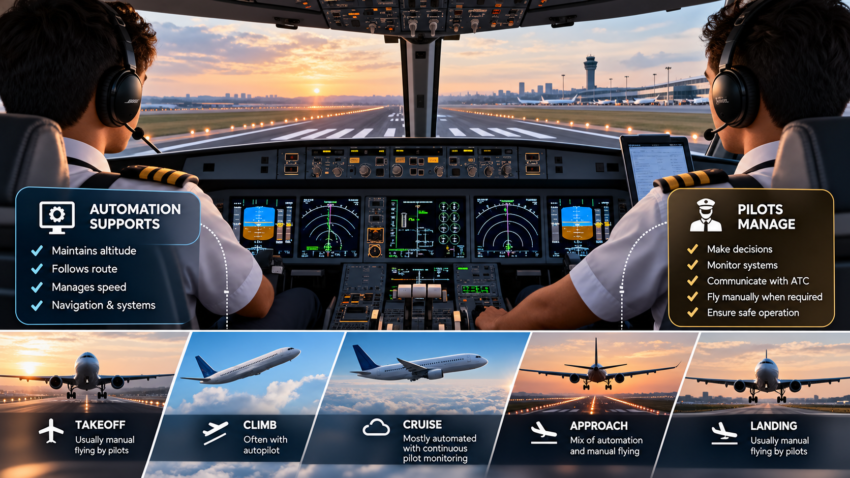
When passengers look into a modern airliner cockpit, they often see screens, flight computers, autopilot controls and automated systems. This naturally raises an interesting question:
Is the aircraft actually being flown by the pilots, or is the computer doing most of the work?
The answer is more interesting than simply saying “manual” or “automatic.”
Modern aircraft use a high level of automation, but pilots remain responsible for managing the flight, monitoring the aircraft, making decisions and taking manual control whenever required. The FAA describes autopilot as an automatic flight-control system that can maintain an aircraft’s flight path, while also noting that pilots can manually override it.
For anyone exploring aviation careers, understanding the relationship between pilots and automation is an important part of learning how modern aviation works. Resources from MH Cockpit can also help students explore aviation education and career pathways.
How Much Does Automation Actually Do?
Modern aircraft can automate many repetitive aspects of flight.
Depending on the aircraft and its systems, automation may assist with:
- Maintaining altitude
- Maintaining a selected heading
- Following a programmed route
- Managing speed
- Navigation
- Approach guidance
- Aircraft performance calculations
- Certain engine functions
For example, an autopilot can control the aircraft’s flight path after the pilots select the appropriate modes. More advanced systems can integrate with flight-management and navigation systems.
However, automation does not mean the pilots simply sit back and watch.
The pilots have to select appropriate modes, monitor what the aircraft is doing and verify that the automation is behaving as expected. The FAA specifically emphasises that pilots need to understand which automation modes are active and verify that the system performs as intended.
What Do Pilots Do When Autopilot Is On?
This is where the difference between flying the aircraft and managing the flight becomes important.
When the autopilot is engaged, pilots may spend less time physically moving the flight controls, but they remain actively involved in the operation.
They may be:
- Monitoring aircraft instruments
- Checking flight parameters
- Communicating with air traffic control
- Managing navigation systems
- Monitoring weather
- Reviewing fuel status
- Managing aircraft configuration
- Preparing for the next phase of flight
- Monitoring the autopilot and flight director
- Making operational decisions
The FAA’s guidance describes automation management as an active pilot responsibility rather than passive monitoring.
This is why professional pilot training involves much more than simply learning how to move the aircraft’s controls.
If you are interested in becoming a professional pilot, Commercial Pilot License training can help you understand the structured training involved in developing professional flying knowledge and skills.
Do Pilots Still Manually Fly Aircraft?
Yes.
Pilots are trained to manually control aircraft and maintain proficiency even when advanced automation is available.
The FAA specifically recommends maintaining manual flying skills and being capable of operating the aircraft without automation when necessary.
Manual flying may be used during different stages of a flight depending on the aircraft, airline procedures, operating conditions, pilot proficiency and workload.
For example, pilots may manually fly during:
- Certain departures
- Visual flight
- Portions of cruise
- Approach
- Landing
- Training exercises
- Situations requiring reduced automation
The exact use of manual flying varies between aircraft and operating procedures.
Why Don’t Pilots Just Let the Computer Do Everything?
Because automation has limitations.
A computer can follow programmed instructions, but pilots must understand whether those instructions are appropriate for the situation.
For example, if weather changes, ATC gives a new clearance, the aircraft encounters an abnormal condition or the flight plan needs to change, the pilots must evaluate the situation and determine the appropriate response.
The FAA’s current risk-management guidance notes that pilots should choose an appropriate level of automation and adjust it as circumstances change.
This means good pilots are not simply “manual pilots” or “automation pilots.”
They are automation managers who can also manually fly the aircraft when required.
What Happens If Automation Fails?
Pilots are trained to continue operating the aircraft if an automated system becomes unavailable.
Depending on the situation, they may:
- Disconnect the autopilot
- Fly the aircraft manually
- Use alternative navigation systems
- Reconfigure aircraft systems
- Follow abnormal procedures
- Communicate with ATC
- Reduce workload
- Reassess the flight plan
The FAA states that pilots should remain proficient in manual aircraft control and be prepared to fly manually if automation becomes unavailable or does not behave as expected.
This is one reason automation should be considered a tool, rather than a replacement for pilot knowledge and skill.
Students interested in professional flying can learn more about Commercial Pilot License training and the broader training pathway required to develop these abilities.
Why Is Pilot Training Still So Important?
If aircraft can automate so many tasks, why do pilots need extensive training?
Because flying an aircraft involves much more than controlling its physical movement.
Pilots need to understand:
- Aerodynamics
- Aircraft systems
- Weather
- Navigation
- Flight planning
- Aircraft performance
- Human factors
- Air traffic procedures
- Emergency procedures
- Decision-making
- Crew resource management
- Automation
The FAA’s aircraft handbooks continue to treat flight control, automation, emergency procedures and pilot knowledge as important components of flight training.
This foundation begins much earlier than airline training. Someone interested in learning to fly can explore Private Pilot License training to understand the starting point of pilot education.
Private Pilot vs Commercial Pilot
A Private Pilot License (PPL) is generally associated with learning to fly for private purposes, while a Commercial Pilot License (CPL) is part of the professional pilot pathway.
At the private-pilot level, students learn fundamental flying skills, aircraft handling, navigation, procedures and decision-making.
With Private Pilot License training, students begin developing the manual flying foundation that later professional training can build upon.
For those aiming toward professional airline flying, Commercial Pilot License training provides a more advanced pathway toward commercial aviation.
Both stages demonstrate an important principle:
Automation does not remove the need to know how to fly the aircraft manually.
Automation Can Actually Help Pilots
Automation is not designed simply to replace pilot workload.
When used appropriately, it can help pilots manage complex tasks and maintain accurate flight paths.
For example, during a busy instrument approach, automation may help maintain the selected flight path while the pilots concentrate on communication, checklists, navigation setup and monitoring.
The FAA’s risk-management guidance notes that using an appropriate level of automation can help manage workload while allowing pilots to maintain awareness of the aircraft’s state.
The important word is appropriate.
Too little automation can increase workload unnecessarily.
Too much automation, or poor understanding of automation, can also create risks.
The pilot has to manage that balance.
Who Is Really Flying the Aircraft?
So, is the aircraft flying itself?
Not exactly.
The aircraft may be controlling its flight path through automated systems, but the pilots remain responsible for deciding what the aircraft should do, monitoring whether it is doing it correctly and intervening when necessary.
Think of it like this:
Automation controls many actions. Pilots control the operation.
A pilot may tell the aircraft’s systems to maintain a particular altitude, follow a route or fly an approach. The automation then performs specific control functions, while the pilots continuously monitor the result.
The FAA describes the pilot-in-command as directly responsible for and the final authority over the safe operation of the aircraft.
Why Automation Knowledge Matters for Future Pilots
Future pilots need to be comfortable with both sides of modern flying.
They should develop:
- Strong manual flying skills
- Aircraft systems knowledge
- Automation awareness
- Situational awareness
- Decision-making
- Navigation skills
- Communication
- Emergency response
- Technical knowledge
A pilot who understands only manual flying may struggle with modern flight decks.
A pilot who understands only automation may struggle if automation becomes unavailable.
The goal is proficiency in both.
For students beginning their aviation journey, MH Cockpit provides aviation-focused education and career resources that can help them explore different aviation pathways.
Final Thoughts
Modern aircraft are highly automated, but that does not mean pilots have become unnecessary.
Automation can control many aspects of the aircraft’s flight path, but pilots remain responsible for monitoring, decision-making, managing the automation and manually flying when required.
The best way to think about modern airline flying is not:
“Pilot versus computer.”
It is:
“Pilot working with technology.”
For someone considering a flying career, developing strong manual flying skills while learning how modern automation works is essential.
You can explore Private Pilot License training to understand the foundations of flight training and Commercial Pilot License training for the professional pilot pathway.
For broader aviation education and career information, MH Cockpit offers resources for students interested in building a future in aviation.
The aircraft may be highly automated, but the pilot is still the person managing the flight.