
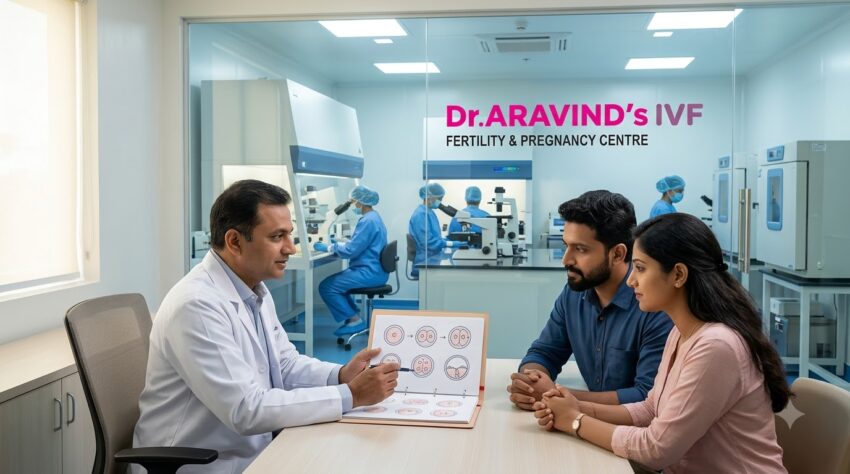
Male infertility can make natural conception difficult when sperm production, movement, or other reproductive factors are affected. For some couples, lifestyle changes or medical treatment may be enough. In more significant cases, assisted reproductive techniques such as IVF and ICSI may be considered.
Although IVF and ICSI are often discussed together, they are not exactly the same. Understanding how each approach works can help couples have a more informed discussion with their fertility specialist.
Why Can Male Factors Affect Conception?
For natural pregnancy, sperm needs to be produced in sufficient numbers, move effectively, and reach the egg.
Male-related fertility concerns may involve:
- Low sperm concentration
- Reduced motility
- Abnormal morphology
- Very low or absent sperm in semen
- Varicocele
- Hormonal problems
- Previous testicular injury
- Certain genetic conditions
- Ejaculation difficulties
Some men have no noticeable symptoms, making semen analysis an important part of fertility evaluation.
What Is IVF?
In vitro fertilization, commonly called IVF, involves fertilizing an egg with sperm in a laboratory.
The general process includes:
- Ovarian stimulation
- Egg retrieval
- Fertilization in the laboratory
- Embryo development
- Embryo transfer or freezing
Unlike natural conception, fertilization takes place outside the body.
Once an embryo is selected for transfer, it is placed into the uterus using a thin catheter.
Pregnancy still depends on successful implantation and continued development.
How Is ICSI Different?
ICSI stands for intracytoplasmic sperm injection.
It is a laboratory fertilization technique used as part of an IVF cycle.
During ICSI, an embryologist selects a sperm and injects it directly into a mature egg.
With conventional IVF, sperm and eggs are placed together under controlled laboratory conditions, allowing fertilization to occur without direct sperm injection.
ICSI therefore changes the way fertilization is attempted, but it does not replace the other stages of an IVF cycle.
When Might ICSI Be Considered?
ICSI may be considered when male-factor fertility problems are significant.
Possible situations include:
- Very low sperm concentration
- Poor sperm movement
- Previous fertilization failure
- Surgical sperm retrieval
- Certain severe sperm abnormalities
- Use of frozen or specially retrieved sperm in selected situations
The treatment decision is based on the overall fertility evaluation.
Having a mild semen abnormality does not automatically mean ICSI is necessary.
Can Sperm Be Used If None Is Seen in the Semen?
In some men, sperm may not appear in the ejaculate even though sperm production is occurring within the reproductive system.
Depending on the cause, a specialist may consider a surgical sperm-retrieval procedure.
If usable sperm are obtained, ICSI may be used to fertilize an egg.
The appropriate approach depends on why sperm are absent and whether sperm production is present.
What Happens Before IVF or ICSI?
A couple usually undergoes fertility evaluation before treatment begins.
The male partner may have a semen analysis and, when indicated, additional testing.
The female partner may undergo assessment of ovarian reserve, ovulation, the uterus, and other relevant reproductive factors.
Medical history, age, previous pregnancies, and previous fertility treatments are also considered.
This information helps determine whether IVF, ICSI, IUI, or another approach is appropriate.
Does ICSI Guarantee Fertilization?
No.
ICSI increases the opportunity for a sperm to interact directly with the egg, but fertilization is not guaranteed.
Egg maturity and quality, sperm characteristics, laboratory factors, and other biological processes still influence the outcome.
Even when fertilization occurs, not every embryo continues developing normally.
This is why couples should avoid viewing ICSI as a guarantee of pregnancy.
What Happens After Fertilization?
If fertilization occurs, the resulting embryos are monitored in the laboratory.
Some continue developing while others may stop at different stages.
An embryo that reaches an appropriate developmental stage may be selected for transfer.
Additional suitable embryos may sometimes be frozen for future treatment.
The number of embryos available depends on how many eggs were retrieved, how many fertilized, and how they developed.
Does Male Age Matter?
Male age can be one factor considered during fertility planning.
Although sperm production generally continues throughout adulthood, certain sperm characteristics and reproductive risks may change with age.
Age should not be viewed in isolation.
The health and reproductive profile of both partners are important when deciding whether IVF or ICSI is appropriate.
Can Lifestyle Changes Still Help?
Assisted reproduction does not make healthy habits irrelevant.
Men can support general reproductive health by:
- Avoiding tobacco
- Limiting alcohol
- Maintaining a healthy weight
- Exercising regularly
- Eating a balanced diet
- Getting adequate sleep
- Managing chronic health conditions
However, lifestyle improvements cannot correct every cause of severe sperm abnormality.
They should be viewed as supportive measures alongside appropriate medical care.
IVF vs ICSI: Which Is Better?
Neither option is necessarily the best choice for every couple.
The appropriate method depends on the reason for treatment.
|
IVF |
ICSI |
|
Sperm and eggs are brought together in a laboratory setting. |
A single selected sperm is directly injected into the egg. |
|
Fertilization occurs without direct sperm injection |
Uses direct sperm injection to assist fertilization |
|
May be suitable when sperm count and motility are adequate. |
Often considered for significant male-factor concerns |
|
A broader assisted reproductive treatment process |
A specialized fertilization method used as part of IVF |
A specialist should explain why one approach is being recommended rather than assuming that ICSI is always the preferred option.
What About Success Rates?
IVF and ICSI outcomes vary from person to person.
Factors such as female age, egg quality, sperm quality, embryo development, ovarian response, uterine health, and underlying fertility conditions can influence results.
Therefore, a clinic’s overall percentage cannot guarantee an individual outcome.
When comparing a Best fertility Centre in Palakkad, couples should ask how success statistics are calculated and whether the figures are separated by age and treatment type.
Questions to Ask Before Treatment
Before beginning IVF or ICSI, consider asking:
- What is causing our fertility difficulty?
- Why is IVF or ICSI being recommended?
- Would conventional IVF be suitable?
- Do I need additional sperm testing?
- What happens if fertilization does not occur?
- How will embryos be assessed?
- Can remaining embryos be frozen?
- What are the realistic expectations for our situation?
Clear answers can help couples make decisions without unnecessary pressure.
Conclusion
IVF and ICSI are established assisted reproductive techniques, but they serve slightly different purposes. IVF involves fertilization in a laboratory, while ICSI uses direct sperm injection to assist fertilization in selected cases, particularly when significant male-factor concerns are present.
If you are experiencing difficulty conceiving and want to understand whether IVF or ICSI is appropriate, Schedule an appointment with a qualified fertility specialist for a complete evaluation and personalized treatment guidance.