

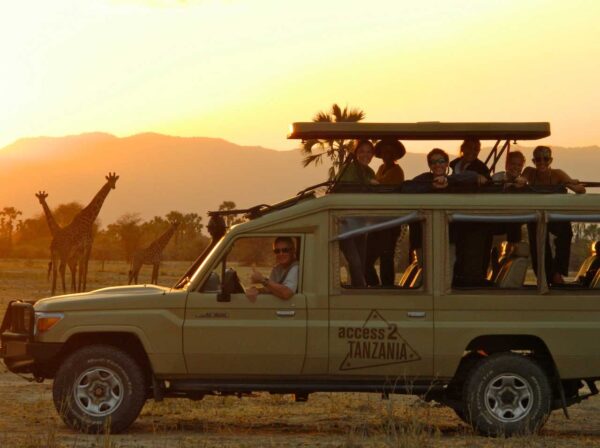
An Arusha National Park day tour can look modest on a map. Arusha National Park sits close to the city, yet within a short journey, the landscape changes from urban surroundings to forest, open grassland, volcanic terrain, and lakes. That proximity creates an unusual opportunity: travelers can experience a national park without committing several days to the road. For those building Tanzania Wildlife Safari Packages, it can also provide a different opening chapter, one based less on distance traveled and more on how closely the landscape is experienced.
The park is especially interesting for travelers who want to see Tanzania on foot. An Arusha National Park walking safari changes the rhythm completely. Instead of watching the landscape pass from a vehicle, visitors move through it slowly, with a guide drawing attention to tracks, plants, birds, terrain, and animal behavior. Tanzania National Parks identifies walking safaris, game drives, canoeing, cycling, and horseback riding among activities available in the park.
Why does Arusha National Park feel different from a typical safari?
The answer begins with its geography. Arusha National Park covers 322 square kilometers and is shaped by Mount Meru, volcanic craters, lakes, forests, and open areas. TANAPA describes Mount Meru as the second-highest mountain in Tanzania, rising to about 4,566 meters. The park is also close to Arusha city, making it accessible for a shorter visit.
That compact setting creates considerable variety. A visitor can move from forested slopes into open habitat and toward the Momella Lakes, where birdlife becomes an important part of the experience. Ngurdoto Crater adds another geological feature to the landscape.
The effect is less like ticking attractions off a list and more like watching several ecosystems unfold within one journey.
What can travelers actually see in the park?
Arusha National Park supports a wide range of wildlife despite its relatively compact size. TANAPA lists giraffe, elephant, buffalo, hippo, bushbuck, waterbuck, duiker, baboon, and several monkey species among the mammals found in the park. Leopards are present but rarely seen. The park also has more than 450 recorded bird species, according to Tanzania National Parks.
One of its notable wildlife experiences involves black-and-white colobus monkeys. The park’s forests provide habitat for these primates, and their calls can sometimes be heard before the animals become visible.
That possibility of discovery is part of what makes a smaller park compelling. A safari does not have to be defined by the scale of the animal encounter. Listening to birds in the forest or spotting movement between trees can become equally memorable when travelers have enough time to pay attention.
Why consider a walking safari instead of staying in a vehicle?
From a safari vehicle, visitors can cover substantial ground and search larger areas for wildlife. On foot, the focus becomes more immediate. The texture of the trail, the sound of birds, animal tracks, vegetation, and changes in elevation all become part of the experience.
This does not mean walking replaces conventional game viewing. It offers a different way to understand the environment. Tanzania National Parks specifically identifies walking as an activity in Arusha National Park, alongside canoeing, horse riding, and other experiences.
The presence of Mount Meru makes this particularly interesting. The mountain is not simply a backdrop. Its volcanic history has shaped the area’s craters, valleys, forests, waterfalls, and habitats. TANAPA’s Arusha-Meru Geopark information notes that the region contains geological features linked to volcanic activity, including craters, waterfalls, lava and ash deposits, and the dramatic structure of Mount Meru.
How does Arusha fit into a larger Tanzania safari?
For travelers assembling Tanzania Wildlife Safari Packages, Arusha National Park can provide contrast before or after longer wildlife routes.
Northern Tanzania is often associated with famous destinations such as Serengeti National Park and the Ngorongoro area. Those locations naturally attract attention, but a journey through Tanzania does not have to be built entirely around the country’s most recognizable names.
Arusha National Park can introduce travelers to another side of the northern circuit. Its combination of walking, mountain scenery, wildlife, lakes, and volcanic landscapes offers experiences that complement longer game-viewing itineraries.
It can also make practical sense for travelers arriving in Arusha and looking for an experience close to the city rather than immediately beginning a long transfer.
What does the growth of Tanzania tourism mean for smaller experiences?
Tanzania’s tourism sector has expanded substantially in recent years. The National Bureau of Statistics reported 2,141,895 international visitor arrivals in 2024, an 18.5% increase from 2023 and 40% above the country’s 2019 level. Tourism earnings reached approximately $3.9 billion that year.
As international interest grows, the appeal of less conventional experiences may become more apparent. Travelers increasingly have reasons to look beyond a checklist of famous destinations and consider how they want to spend their time within them.
A short visit can therefore have its own value. It does not have to compete with a multi-day safari. Instead, it can offer a change of pace and perspective.
Can a single day change how someone sees Tanzania?
Yes, particularly when the day is designed around observation rather than rushing from one landmark to another. An Arusha National Park day tour can introduce travelers to volcanic landscapes, wildlife, birdlife, forests, and lakes within a relatively accessible area. A walking experience can make those surroundings feel even more immediate. And for a broader safari itinerary, the park can add an active and varied dimension to time spent in northern Tanzania.
That is perhaps the most interesting lesson of Arusha National Park. Tanzania’s wildlife story is not confined to its biggest parks or most famous encounters. Sometimes it begins with a trail, a distant mountain, a call from the forest, or a quiet moment beside a lake.
For travelers considering Tanzania Wildlife Safari Packages that include different ways of experiencing the country, Access 2 Tanzania offers itinerary planning around Tanzania’s varied destinations and activities, including Arusha National Park experiences. The value of such planning is ultimately found in giving each part of the journey a reason to be there, rather than simply adding another stop to the map.