
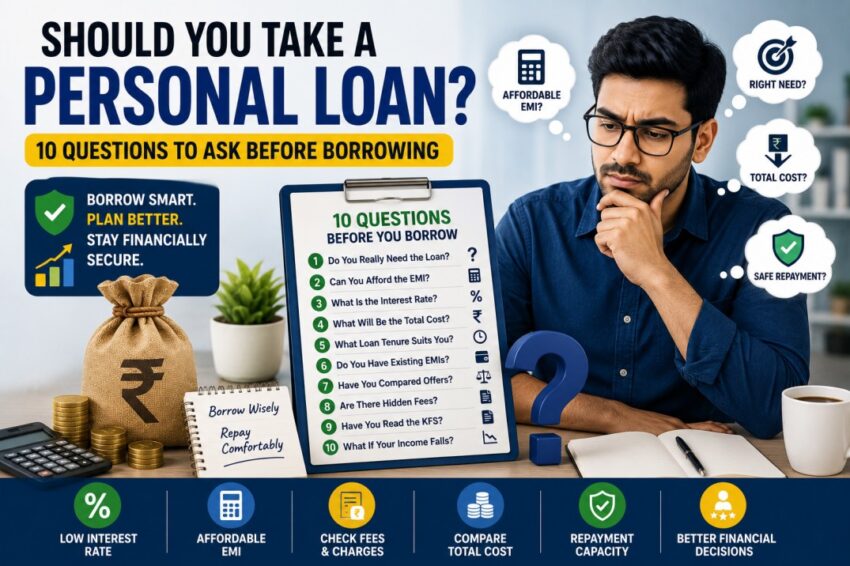
A personal loan can provide quick access to funds for medical expenses, education, weddings, home improvements, emergencies, or other major expenses. But convenient borrowing does not automatically mean that taking a loan is the right financial decision.
Before applying, ask yourself an important question: Should you take a personal loan?
The answer depends on your income, existing debt, purpose of borrowing, repayment capacity, interest rate, and overall financial situation.
If you are considering a personal loan, here are 10 important questions to ask before signing the agreement.
1. Do You Really Need the Personal Loan?
The first question is whether borrowing is necessary.
A personal loan may make sense for an essential expense that cannot reasonably be funded from your existing savings. However, borrowing for discretionary spending simply because credit is available can increase financial pressure.
Before applying, ask:
-
Is this expense necessary?
-
Can I postpone it?
-
Can I use existing savings instead?
-
Is there a cheaper financing option?
If the expense is not urgent, saving first may be preferable to paying interest on borrowed money.
2. What Will You Use the Loan For?
Your personal loan purpose should be clear before you borrow.
Common uses include:
-
Medical expenses
-
Education
-
Wedding expenses
-
Home renovation
-
Emergency expenses
-
Major purchases
-
Debt consolidation
Understanding the purpose helps you determine exactly how much you need.
Avoid borrowing significantly more than necessary simply because a lender offers a higher loan amount.
3. Can You Comfortably Afford the EMI?
Your personal loan EMI will become a fixed monthly financial obligation.
Before applying, calculate how much you can comfortably pay every month after accounting for:
-
Rent
-
Existing EMIs
-
Household expenses
-
Utilities
-
Insurance
-
Savings
-
Other financial commitments
Use a personal loan EMI calculator to compare different loan amounts, interest rates, and tenures.
A loan should not leave you struggling to meet essential expenses every month.
4. What Is the Total Cost of the Loan?
Don’t focus only on the EMI.
A personal loan can include:
-
Interest
-
Processing fees
-
Applicable taxes
-
Prepayment or foreclosure charges, where applicable
-
Late-payment charges
-
Other disclosed fees
For example, a longer tenure may reduce your monthly EMI but increase the total interest paid.
Always calculate:
Total repayment = Sum of scheduled EMIs + applicable costs
This gives you a clearer picture of the actual borrowing cost.
5. Can You Get a Better Interest Rate?
Before accepting a personal loan, compare available offers.
Your personal loan interest rate can depend on factors such as:
-
Credit score
-
Income
-
Employment history
-
Existing debt
-
Loan amount
-
Tenure
-
Lender’s internal policies
A strong credit profile may help you qualify for more competitive terms, although approval and pricing are always subject to the lender’s assessment.
Even a small difference in the interest rate can affect total interest over a longer repayment period.
6. How Much Existing Debt Do You Have?
If you already have EMIs, taking another loan could increase your monthly financial obligations.
Calculate your total debt burden before applying.
For example:
Existing EMI: ₹8,000
New EMI: ₹7,000
Total EMI: ₹15,000
Then compare that amount with your monthly take-home income.
Lenders may also assess repayment capacity using measures such as FOIR (Fixed Obligation to Income Ratio).
A good credit score does not necessarily mean you can comfortably afford another loan.
7. What Loan Tenure Should You Choose?
The personal loan tenure directly affects both EMI and total interest.
Generally:
Shorter tenure → Higher EMI → Lower total interest
Longer tenure → Lower EMI → Higher total interest
For example, you may find that a ₹5 lakh loan has a significantly lower EMI over five years than over three years. However, the longer repayment period can result in more interest being paid overall.
Choose the shortest tenure you can comfortably afford rather than automatically choosing the lowest EMI.
8. Have You Compared the APR and Fees?
When comparing personal loan offers, don’t look only at the advertised interest rate.
Consider the APR (Annual Percentage Rate) and applicable charges to understand the broader cost of borrowing.
Two lenders may advertise similar interest rates but have different processing fees or other costs.
Before choosing a loan, compare:
-
Interest rate
-
APR
-
Processing fee
-
Applicable taxes
-
EMI
-
Total repayment
-
Prepayment terms
-
Late-payment charges
The loan with the lowest advertised rate isn’t necessarily the cheapest overall.
9. Have You Read the Key Facts Statement?
Before accepting an applicable loan offer, carefully review the Key Facts Statement (KFS) provided by the lender.
The KFS is designed to present important information about the loan in a standardised format, helping borrowers understand key costs and terms before entering into the loan contract.
Check details such as:
-
Loan amount
-
Interest rate
-
APR
-
Repayment schedule
-
Applicable fees
-
Other important terms
Don’t rely solely on information shown in advertisements, SMS messages, or an app’s promotional screen.
Read the actual loan documentation before accepting the offer.
10. What Happens If Your Income Falls?
This is one of the most overlooked questions before taking a personal loan.
Your financial situation may change because of:
-
Job loss
-
Reduced income
-
Unexpected medical expenses
-
Family emergencies
-
Higher household costs
-
Business income fluctuations
Ask yourself:
“Could I still pay my EMI if my income temporarily decreased?”
Maintaining an emergency fund and avoiding an unnecessarily large loan can provide additional financial flexibility.
When Taking a Personal Loan May Make Sense
A personal loan can potentially be appropriate when:
-
You have a genuine financial requirement.
-
Your income is stable.
-
The EMI comfortably fits your budget.
-
You have compared multiple offers.
-
The total borrowing cost is reasonable.
-
You understand the repayment terms.
-
You have a clear repayment plan.
The decision should be based on affordability rather than simply whether you qualify.
When You Should Think Twice
You may want to reconsider borrowing if:
-
You are already struggling with existing EMIs.
-
You need a loan to pay another loan’s EMI.
-
Your income is unstable.
-
You are borrowing for unnecessary spending.
-
The new EMI would consume a large part of your disposable income.
-
You haven’t compared interest rates and fees.
-
You don’t understand the loan agreement.
Taking additional debt to cover existing debt without addressing the underlying cash-flow problem can create a cycle of borrowing.
Personal Loan vs Using Your Savings
If you already have sufficient savings, compare the cost of using those savings with the cost of borrowing.
For example, if your savings are earning a relatively low return while the personal loan carries a substantially higher cost, using some savings for a necessary expense could potentially be more economical.
However, don’t completely exhaust your emergency fund just to avoid borrowing.
The right decision depends on your financial circumstances and the purpose of the money.
How to Decide: A Simple Checklist
Before applying for a personal loan, answer these questions:
| Question | Your Answer |
|---|---|
| Do I genuinely need the money? | Yes / No |
| Is the expense necessary? | Yes / No |
| Can I afford the EMI? | Yes / No |
| Do I have existing EMIs? | Yes / No |
| Have I compared interest rates? | Yes / No |
| Have I checked APR and fees? | Yes / No |
| Have I calculated total repayment? | Yes / No |
| Have I selected an affordable tenure? | Yes / No |
| Have I reviewed the KFS? | Yes / No |
| Could I repay if my income temporarily falls? | Yes / No |
If several answers are “No,” consider delaying the application and reassessing your finances.
Final Thoughts
So, should you take a personal loan?
A personal loan can be a useful financial tool when you have a genuine need, stable income, and sufficient repayment capacity. But it can also become expensive if you borrow more than necessary or choose a loan without understanding its complete cost.
Before applying, evaluate your personal loan eligibility, existing EMIs, credit profile, interest rate, loan tenure, processing fees, APR, and total repayment.
Most importantly, calculate the EMI before borrowing and make sure it fits comfortably within your monthly budget.
Don’t choose a loan simply because the lender approves it. Choose a loan only when you understand the cost, have a clear purpose, and can comfortably manage the repayment.
A responsible borrowing decision is not about getting the maximum loan possible—it is about taking the amount you actually need and can realistically repay.