

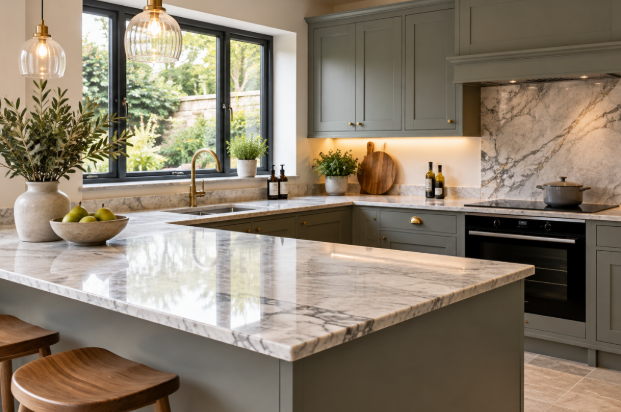
A worktop influences how a kitchen looks, functions, and withstands everyday use. Among engineered stone surfaces, quartz-based materials are widely used because they combine a consistent appearance with practical performance. Understanding how the material is made, how it responds to heat and stains, and what maintenance it requires can help homeowners make an informed choice. A Silestone worktop is an engineered mineral surface designed for interior applications, with properties that make it suitable for busy kitchens and other areas where durability and straightforward cleaning are important.
What Is Silestone?
Silestone is an engineered mineral surface developed for interior applications such as kitchen worktops, bathroom surfaces, and other areas requiring a durable, low-maintenance material. Its composition has evolved. Current Silestone worktop surfaces use a combination of premium minerals and recycled materials through Cosentino’s HybriQ+ technology, which is designed to reduce crystalline silica content. Unlike natural stone, which develops its appearance through geological processes, engineered surfaces are manufactured under controlled conditions. This allows manufacturers to produce consistent colours, textures and surface characteristics across different slabs.
What Makes Silestone Suitable for Kitchen Worktops?
Kitchen worktops are exposed to spills, food preparation, utensils, moisture and regular cleaning. Silestone worktops are designed to withstand many of these everyday demands.
Its compact, non-porous surface provides strong resistance to staining because liquids are less likely to penetrate the material. The manufacturer also identifies resistance to scratches, impacts, and common household substances among its performance characteristics.
Is Silestone Easy to Maintain?
The non-porous construction also means regular sealing is not required in the same way it is for some porous natural stone surfaces. This reduces the number of maintenance tasks involved in keeping the worktop clean.
One of the practical characteristics of Silestone worktops is their relatively simple daily maintenance. For routine cleaning, Cosentino recommends using neutral soap with a damp microfibre cloth, followed by removing any remaining residue and drying the surface.
Can Silestone Be Scratched or Chipped?
Edges can also be more vulnerable to accidental impact than the main surface. The manufacturer’s maintenance guidance notes that chipping can occur in frequently used areas, including around sinks and dishwashers. Professional repair may be possible for some small chips, while cracks can be considerably more difficult to address.
Silestone worktops are designed to provide high scratch and impact resistance, but no engineered stone surface should be considered completely scratch-proof. Sharp knives should therefore be used with a chopping board rather than directly on the worktop.
What Colours and Designs Are Available?
Engineered surfaces offer a broad design range because colours, textures and visual effects can be controlled during manufacturing. Silestone worktops collections include different tones and finishes intended to work with contemporary and traditional interior schemes.
This consistency can be useful when planning a kitchen because homeowners can select a surface according to the colour palette, cabinetry and overall layout rather than relying entirely on naturally occurring variations within a stone slab.
Is Silestone Suitable for Outdoor Use?
Silestone is primarily intended for interior applications. Cosentino specifically states that it is not recommended for outdoor use because prolonged exposure to ultraviolet radiation can affect the surface.
For an outdoor kitchen, terrace or other exposed installation, the suitability of the selected material should therefore be checked before specifying it.
Conclusion
A worktop combines engineered mineral construction with a non-porous surface, resistance to everyday staining and relatively straightforward maintenance. For anyone comparing materials, Quartz Supply can be considered alongside factors such as colour selection, fabrication requirements, maintenance needs, and the intended location of the worktop. Understanding these technical and practical considerations before installation makes it easier to select a surface that matches both the design and demands of the space.