
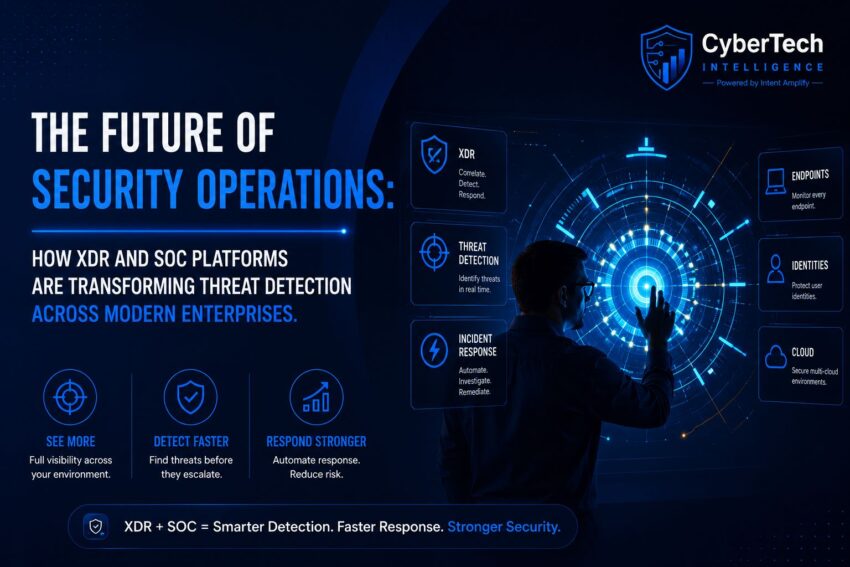
Cybersecurity operations have entered a new phase. Modern attacks move faster, exploit multiple attack vectors simultaneously, and often bypass traditional perimeter defenses before security teams can respond. As organizations expand their digital ecosystems through cloud adoption, remote work, connected devices, and AI-driven applications, maintaining complete visibility has become increasingly difficult.
This growing complexity has accelerated the adoption of Extended Detection and Response (XDR) and modern Security Operations Center (SOC) platforms. Instead of managing isolated security tools, organizations are embracing unified security operations that can detect, investigate, and respond to threats across the entire enterprise.
The goal is no longer simply identifying attacks – it is stopping them before they disrupt business operations.
Why Security Operations Need Modernization
Traditional SOCs often rely on disconnected technologies that generate thousands of alerts every day, creating a constant stream of work for analysts.
Security analysts frequently spend valuable time:
- Correlating alerts manually
- Investigating false positives
- Switching between multiple security consoles
- Searching for missing attack context
This fragmented workflow increases response times while placing additional pressure on already limited cybersecurity teams.
XDR solves this problem by correlating telemetry across endpoints, networks, cloud workloads, identities, email systems, and applications into a single investigation workflow.
The Core Capabilities of Modern XDR Platforms
Unlike traditional security tools, XDR provides:
Unified Threat Visibility
Analysts gain complete attack context by correlating information across multiple security domains instead of isolated alerts.
Automated Investigation
Artificial intelligence helps prioritize incidents, reduce false positives, and identify attack chains automatically.
Faster Incident Response
Integrated playbooks allow organizations to:
- Isolate compromised endpoints
- Disable suspicious user accounts
- Block malicious network activity.
- Contain ransomware before lateral movement.
Automation significantly reduces operational delays during security incidents.
Industry Focus: Government and Public Sector
Government agencies manage highly sensitive citizen information while protecting critical public services against increasingly sophisticated cyber threats.
Modern XDR platforms help public sector organizations:
- Improve national cyber resilience.
- Accelerate threat detection
- Protect digital citizen services.
- Strengthen incident response capabilities.
- Improve operational visibility across distributed infrastructure.
As government agencies continue modernizing digital services, unified security operations become increasingly important.
Industry Focus: Manufacturing
Manufacturing organizations increasingly connect operational technology (OT), industrial IoT devices, robotics, and cloud platforms.
This convergence creates expanded attack surfaces that require continuous monitoring.
Modern XDR and SOC platforms help manufacturers:
- Detect attacks targeting production systems.
- Monitor industrial networks
- Protect connected manufacturing equipment.
- Reduce operational downtime
- Improve cyber resilience across smart factories.
Real-time visibility becomes essential for maintaining production continuity.
Building an Intelligent Security Operations Strategy
Organizations adopting XDR should prioritize:
Threat Intelligence Integration
Combining internal telemetry with external threat intelligence improves detection accuracy while identifying emerging attacker techniques.
Security Automation
Automated workflows reduce repetitive manual investigations, allowing analysts to focus on complex threats requiring human expertise.
Continuous Visibility
Security teams should monitor identities, endpoints, cloud workloads, applications, and network traffic through a centralized operational platform.
Organizations investing in advanced XDR & SOC Platforms can significantly strengthen cyber resilience by improving visibility, accelerating threat response, and enabling proactive security operations across increasingly complex enterprise environments.
Final Thoughts
The future of cybersecurity depends on intelligent security operations capable of detecting sophisticated attacks before they escalate into business disruptions. XDR and modern SOC platforms provide organizations with the visibility, automation, and contextual intelligence required to defend increasingly distributed digital environments.
By modernizing security operations today, organizations can reduce operational risk, improve analyst efficiency, and build stronger resilience against tomorrow’s cyber threats.