
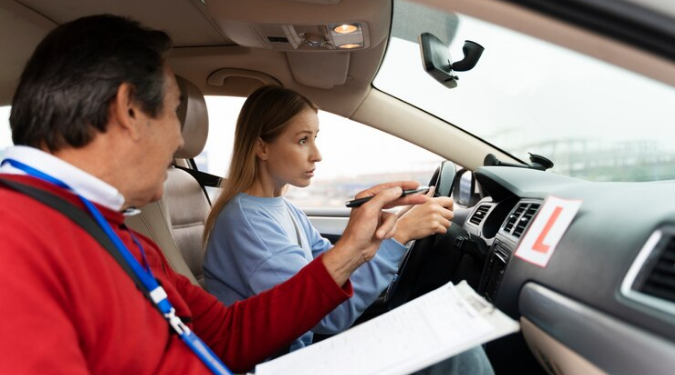
About to get behind the wheel in Dubbo for the first time?
Here’s what every new learner driver in NSW needs to know before their first lesson.
Get Your Learner Licence Sorted First
What You Need to Do Before You Drive a Single Metre
Before anything else, you need your learner licence. In NSW, that means being at least 16 years old, passing a Driver Knowledge Test (DKT), and clearing an eyesight test at a Service NSW Centre.
The DKT has 45 questions in total. To pass, you need to get at least 12 out of 15 general knowledge questions correct and 29 out of 30 road safety questions correct. The pass thresholds are tight, so study the NSW Road Users Handbook properly before you sit it.
You can complete the DKT online from home before visiting the centre to finalise your licence application.
The Dubbo Service NSW Centre is located at 258-260 Macquarie Street and offers driver testing by appointment on weekdays, plus Saturday mornings from 8:30 am to 12:30 pm.
The 120-Hour Log Book Requirement
Why the Hours Add Up Faster Than You Think
If you are under 25, NSW law requires you to log at least 120 hours of supervised driving before you can sit your practical driving test. That includes a minimum of 20 hours of night driving. You also need to have held your learner licence for at least 12 months.
That is a significant commitment, and it catches many learners off guard. If you are relying entirely on family members to supervise your practice, finishing in a few months is not realistic.
Here is where structured driving lessons in Dubbo with a qualified instructor make a difference. Every hour spent with a registered driving instructor counts as three log book hours, up to a maximum of 10 lessons. That means 10 professional lessons add 30 hours to your log book without requiring extra supervised drives.
Completing the NSW Safer Drivers Course, which is available once you have logged at least 50 on-road hours, adds another 20 bonus hours.
The official log book app is now Roundtrip, which replaced the old Licence Ready and L2P apps as of 29 June 2024. Make sure you use the right one so your hours are recorded correctly.
Dubbo Roads Are Not Easy
What You Will Face on Local Roads
- Residential streets in Dubbo typically run at 50 km/h unless signed otherwise. These are good starting routes for early lessons because traffic is lighter and intersections are more straightforward.
- School zones operate at 40 km/h during school drop-off and pick-up times, generally 8:00am to 9:30am and 2:30pm to 4:00pm on notified school days. These zones apply even on student-free days in NSW. Streets near Dubbo South Public School and Macquarie Anglican Grammar School see predictable congestion during these windows. Speeding in a school zone as a learner driver carries significant risk. All speeding offences attract at least 4 demerit points for learner and P1 drivers, and reaching that threshold triggers an automatic 3-month suspension.
- The Mitchell Highway and Newell Highway pass through Dubbo and connect to open rural roads where the posted limit is 100 or 110 km/h. As a learner, you are capped at 90 km/h regardless of what the sign says. On the Newell Highway south of Dubbo near the Zoo Town rest area, the southbound limit has been reduced to 80 km/h, so you may have traffic moving faster than you in the other lane. That can feel uncomfortable at first. It is normal.
- Open country roads around Dubbo heading towards Narromine or Wellington can have sections with limited signage, wildlife crossings, and long stretches without services. These roads are fine to practise on once you are past the basics, but not as a starting point.
What the Practical Driving Test Assesses
The Three Things That Fail Most Learners
According to data from Transport for NSW, around 44 to 50% of learner drivers across NSW do not pass their practical driving test on the first attempt. The most common reasons are the small, repeatable habits that either do or do not become automatic.
The three top failure categories are head checks, mirror use, and speed management.
- On head checks, examiners need to physically see your head turn. A subtle eye movement does not register. Practice this deliberately so it becomes a habit your supervisor can see.
- On mirror use, the expectation is to check your interior mirror roughly every 8 to 10 seconds, and to check the relevant exterior mirror before any change in speed or direction. That means before braking, turning, and changing lanes.
- On speed, the examiner assesses both exceeding the limit and driving unnecessarily slowly. In a Dubbo test route that includes school zones and arterial roads, you will likely encounter multiple speed limit changes in one test. Know your zones before the day.
To pass, you need to score at least 90% overall and have zero “fail items.” A fail item is any action that causes danger, including running a stop sign, failing to give way, or causing another driver to take evasive action.
What First-Time Drivers in Dubbo Get Wrong Early On
Specific Habits Worth Building From Lesson One
Transitioning between speed zones is one. Dubbo has multiple school zones, 50 km/h residential streets, and sections of arterial road at 60 and 70 km/h within close proximity of each other. New learners often carry speed from a faster zone into a slower one without noticing. Train yourself to read signs proactively, not reactively.
Open road nerves are another. Driving on a highway at 90 km/h for the first time with traffic coming the other way at 110 km/h can be unsettling. Instructors will prepare you for this progressively. Do not attempt open road driving before you are ready for it. It takes several lessons on quieter streets before highway speeds feel manageable.
One Thing Worth Doing Before Your First Lesson
Spend 10 minutes sitting in the driver’s seat of a parked car before you start your first lesson. Adjust the mirrors properly. Get used to the pedal positions.
It sounds simple. But arriving at your first lesson already familiar with the basic layout of a car means you can spend that lesson learning to drive, rather than working out where the brake is.
The driving test itself is bookable online through Service NSW or by calling 13 77 88. You cannot book until you are eligible, but it is worth knowing the process early so the pathway from L plates to a provisional licence feels like a clear sequence of steps rather than a distant goal.