
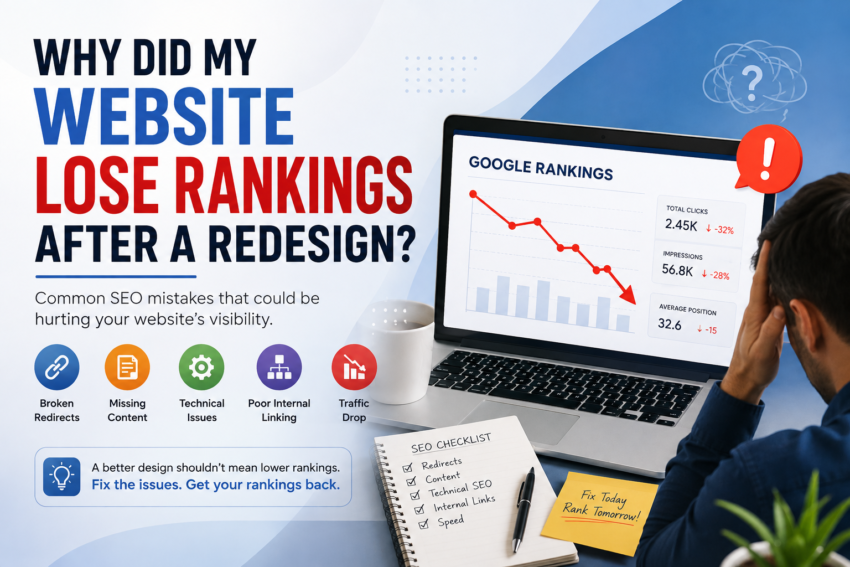
Why Did My Website Lose Rankings After a Redesign?
A website redesign is usually something to look forward to. You get a cleaner design, better navigation, faster pages, and hopefully more leads.
But then something unexpected happens.
Your new website goes live, and your Google rankings start dropping.
The pages that used to bring you enquiries are no longer appearing where they used to. Organic traffic falls. Some keywords disappear from the search results. And suddenly, you are wondering: “What went wrong?”
The good news is that a website redesign does not automatically mean you have to lose your SEO rankings. In most cases, rankings drop because important SEO signals were changed, removed, or overlooked during the redesign process.
For businesses working with SME Digital or any professional digital marketing team, understanding these issues early can help prevent a temporary ranking drop from becoming a long-term problem.
What Happens to SEO During a Website Redesign?
A website redesign is more than changing colours, images, fonts, and layouts.
Your website has an existing SEO history. Google already understands your pages, URLs, content, internal links, backlinks, and other signals.
When you redesign a website, some of these elements can change without anyone realising their SEO impact.
For example:
-
A high-ranking URL may be changed.
-
Important content may be shortened or removed.
-
Internal links may disappear.
-
Meta titles and descriptions may be replaced.
-
Pages may accidentally become noindex.
-
Redirects may not be implemented correctly.
-
Website structure may change completely.
Even if the new website looks much better, Google may see it as a significantly different website.
That is why SEO should be part of the redesign process from the beginning—not something added after launch.
1. Your URLs Were Changed Without Proper Redirects
This is one of the most common reasons for ranking losses after a redesign.
Imagine your old service page was:
yourwebsite.com/web-design-services
During the redesign, the URL becomes:
yourwebsite.com/website-design
To a visitor, this may not seem like a big issue. But search engines see two different URLs.
If the old page had backlinks, rankings, traffic, and SEO authority, simply deleting it can cause those signals to be lost.
This is where 301 redirects become important. A properly planned redirect can guide users and search engines from the old URL to the relevant new URL.
Before launching a redesigned website, businesses should create a list of important old URLs and map them to their new destinations.
2. Your High-Performing Content Was Removed
Designers and business owners often want a cleaner website.
That sometimes means removing paragraphs of content because the page looks “too crowded.”
The problem?
Some of that content may have been helping the page rank.
You may have removed:
-
Service-related keywords
-
Helpful FAQs
-
Location-specific information
-
Supporting content
-
Product details
-
Topic-specific sections
-
Content answering customer questions
A shorter page isn’t automatically better.
The goal should be to make content easier to read while keeping the information that satisfies search intent.
If a page was ranking for several valuable search terms before the redesign, check what content was removed before assuming Google simply changed its mind.
3. Your Internal Linking Structure Changed
Internal links help users move around your website, but they also help search engines understand how your pages are connected.
During a redesign, navigation menus, footer links, sidebar links, and contextual links can all change.
A service page that previously received links from several important pages might suddenly become isolated.
For example, your old website may have linked to a service page from:
Home → Services → Industry Page → Service Page
After redesigning, only the main Services page may link to it.
That change can affect how easily search engines discover and understand the importance of that page.
A proper redesign should therefore include an internal linking review—not just a navigation review.
4. Your Title Tags and Meta Information Changed
Your old pages may have had carefully optimised title tags that were helping them attract relevant searches.
During a redesign, these are sometimes replaced with generic titles such as:
Home | Company Name
or
Services | Company Name
That can weaken your page’s relevance for important searches.
For example, if a page previously targeted a specific service and location, removing those relevant terms from the title and page content can make it harder for search engines to understand the page’s purpose.
This is one area where experienced SEO Services in Chennai can be particularly valuable during a website migration or redesign.
The objective isn’t to stuff keywords into every title. It is to make the title accurately reflect what the page offers and what the customer is searching for.
5. Your New Website Has Technical SEO Problems
Sometimes the problem isn’t the content at all.
A new website can introduce technical issues such as:
-
Slow-loading pages
-
Poor mobile performance
-
Broken links
-
Incorrect canonical tags
-
Duplicate pages
-
Missing structured data
-
Crawlability problems
-
Incorrect robots.txt settings
-
Accidental noindex tags
One particularly serious mistake is launching a website with pages accidentally set to noindex.
If Google is being told not to index important pages, those pages may disappear from search results.
This is why a technical SEO audit should be completed immediately after launch—and ideally before the website goes live.
6. Your Website Structure Became Too Complicated
A redesign sometimes focuses heavily on creating a visually impressive experience.
But users and search engines still need a clear structure.
If important pages are buried several clicks deep, your website can become harder to navigate and crawl.
Your structure should make it obvious:
What does the business offer?
Which services are most important?
Which pages answer customer questions?
How are the different topics connected?
A simple, logical structure usually works better than an unnecessarily complicated one.
7. Your SEO Was Not Considered Before Launch
This is perhaps the biggest lesson.
SEO shouldn’t begin after the redesigned website is published.
Before launch, your team should document the existing website’s:
-
Organic traffic
-
Ranking keywords
-
Top landing pages
-
Backlinks
-
Indexed pages
-
Important URLs
-
Metadata
-
Internal links
-
Conversion-focused pages
This gives you a baseline for comparison.
After launch, you can monitor these elements and quickly identify what changed.
For businesses investing in Digital Marketing in Chennai, this is an important point to discuss with your digital marketing agency. Website development, content, SEO, and digital marketing should work together instead of operating as separate departments.
What Should You Do If Your Rankings Have Already Dropped?
Don’t immediately panic and start changing everything.
First, identify what actually changed.
Compare your old and new websites and check:
-
Which keywords lost rankings?
-
Which pages lost organic traffic?
-
Were the URLs changed?
-
Are the old URLs properly redirected?
-
Was important content removed?
-
Are the affected pages indexable?
-
Did internal links change?
-
Are there technical errors?
-
Did page speed or mobile performance change?
-
Are Google Search Console impressions and clicks declining?
The answer is usually hidden somewhere in these comparisons.
A Website Redesign Should Improve SEO—Not Destroy It
Your website redesign should be an opportunity to improve both user experience and search visibility.
A modern website can be faster, easier to navigate, more mobile-friendly, and better aligned with your customers’ needs. But those improvements should be made while protecting the SEO value your existing website has already built.
At SME Digital, the focus should not simply be on making a website look new. A successful redesign needs to consider the complete journey—from search engine visibility to website experience and, ultimately, enquiries and sales.
If your business is planning a website redesign, involve your SEO team before development begins. Protect your existing rankings first, then build on them.
Because the goal of a redesign isn’t just to launch a better-looking website.
It’s to build a better-performing business website without losing the visibility that was already bringing customers to you.