
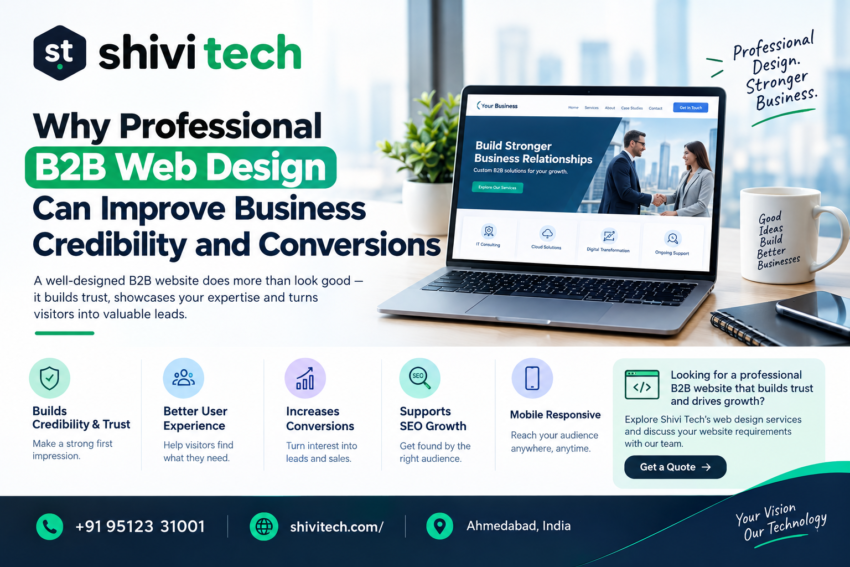
Before a potential B2B customer speaks to your sales team, there is a good chance they have already visited your website. They may be comparing vendors, checking your experience, or simply trying to understand whether your business can handle their requirements. If your website looks outdated, loads slowly, or makes it hard to understand what you do, that first impression can create doubt before a conversation even begins. This is where working with an experienced B2B web design company can make a real difference.
Many Indian B2B businesses have websites that list basic company information but fail to answer the questions buyers actually have. A website that only says “We provide these services” is rarely enough. A B2B website should quickly communicate:
- Who the company serves
- What problems it solves
- Why its services are relevant
- Why potential customers should trust it
- What the visitor should do next
Professional B2B web design brings these elements together into a structured, trustworthy online experience that supports business growth.
Need a professional B2B website that builds trust and supports business growth?
Explore Shivi Tech’s web design services and discuss your website requirements with the team.
Why Does Professional B2B Web Design Matter for Business Credibility?
For many B2B buyers, a company’s website is the first real interaction with its brand. Presentation influences perception. A clean, well-organised website suggests a business that pays attention to detail. A cluttered or outdated one can raise questions, even when the company delivers excellent work offline.
Professional B2B website design supports credibility through:
- Professional visual design that reflects the quality of your services
- Clear company information about who you are, where you operate and what you do
- Consistent branding across colours, typography, imagery and messaging
- Easy navigation so visitors can find information without effort
- Well-structured service pages that explain each offering properly
- Case studies and proof points that show real experience
- Testimonials from genuine clients
- Industry expertise communicated through relevant content
- Accessible contact details so buyers can reach you easily
- Mobile responsiveness for visitors browsing on phones and tablets
It is important to be realistic. Design alone does not guarantee conversions. Credibility also depends on your service quality, pricing, reputation, reviews and actual business experience. What professional design does is reduce friction and support trust, so that your real strengths are presented clearly instead of being hidden behind a poor website experience.
How Can B2B Web Design Improve Conversions?
A conversion in B2B usually is not an instant purchase. It may be a quote request, a consultation booking, a call, or a form submission. Conversion-focused web design guides visitors toward these meaningful actions.
Clear Calls to Action
Every important page should tell visitors what to do next. Relevant CTAs for B2B websites include:
- Request a Quote
- Schedule a Consultation
- Talk to an Expert
- Get a Project Estimate
- Contact Our Team
CTAs should be visible, specific and placed where a visitor is most likely to be ready to act.
Better Information Architecture
Information architecture is simply how your website content is organised. Visitors should be able to quickly find:
- Services
- Industries served
- About the company
- Case studies
- Contact information
- Resources
When information is logically grouped, visitors spend less time searching and more time evaluating your business.
Strong Service Pages
Each service page should work like a focused sales conversation. It should clearly explain:
- What the service is
- Who it is for
- The business benefits
- Your process
- Relevant expertise
- The next step
Trust Signals
Trust signals reassure visitors that your business is established and reliable. These include client testimonials, certifications, project experience, industry expertise, case studies and complete business information such as your address and registration details.
What Makes B2B Website Design Different?
B2B purchasing decisions are often more complex than consumer purchases. A single decision may involve several people, each looking for different information. A B2B website may need to support:
- Decision-makers looking for business outcomes
- Procurement teams comparing vendors and terms
- Technical teams checking capabilities and specifications
- Business owners assessing trust and value
- Department heads evaluating fit for their team’s needs
Because of this, B2B web design has to balance professional presentation with genuinely useful business information. This typically means:
- Detailed service information
- Industry-specific messaging
- Case studies that show real results
- Technical capabilities where relevant
- Clear business outcomes
- Multiple lead-generation paths
- Content at different levels of depth, from quick overviews to detailed resources
A regular business website might succeed with a few simple pages. A B2B website usually needs to support a longer, research-heavy buying journey.
What Should a Professional B2B Website Include?
Professional Homepage
Your homepage should answer the most important questions within seconds:
Who you are + What you offer + Who you serve + Why it matters + What to do next
Dedicated Service Pages
Build separate pages for individual services instead of putting everything on one page. This improves clarity for visitors and gives each service a better chance of appearing in search results.
Industry Pages
If your company serves different industries, dedicated industry sections make your website more relevant to each audience. A manufacturing buyer and a healthcare buyer often look for very different proof points.
Case Studies
Case studies show how your company has solved real business problems. They are among the most persuasive content types on a B2B website.
Testimonials
Use genuine customer feedback wherever available. Named testimonials with company details tend to carry more weight than anonymous quotes.
Simple Lead Forms
Keep forms short and ask only for information you need at that stage. Long forms can discourage enquiries, especially on mobile.
Mobile-Friendly Design
B2B decision-makers often research vendors on smartphones and tablets, during travel or between meetings. A responsive B2B website ensures they can read, compare and contact you comfortably on any device.
Fast and Usable Website
Visitors should not have to wait for pages to load or struggle with confusing menus. Performance, navigation and usability all shape how visitors experience your business online.
How Does Web Design Affect B2B User Experience?
User experience (UX) is about how easily visitors can use your website to get what they need. In simple business terms, a visitor should quickly be able to answer:
- What does this company do?
- Is this service relevant to my business?
- Can they handle my type of project?
- Why should I consider them?
- How can I contact them?
Good B2B web design supports these answers through:
- Logical navigation with clear menu labels
- Readable content with short paragraphs and clear headings
- Visual hierarchy that highlights what matters most
- Clear buttons that stand out and describe the action
- Consistent page layouts so visitors know where to look
- Search-friendly structure that helps both users and search engines
- Mobile usability with tap-friendly buttons and readable text
When the experience feels effortless, visitors are more likely to explore further and reach out.
How Do SEO and B2B Web Design Work Together?
Web design and SEO should not be treated as separate activities. A beautiful website that search engines cannot understand may struggle to attract visitors, while a search-optimised website with poor design may struggle to convert them.
A well-planned B2B website supports organic search visibility through:
- SEO-friendly page structure that organises content logically
- Proper heading hierarchy using H1, H2 and H3 tags correctly
- Search-focused service pages built around what buyers actually search for
- Internal linking that connects related pages and guides users deeper into the site
- Descriptive URLs that clearly reflect page content
- Mobile responsiveness, which matters for both users and search engines
- Website speed for a smoother experience
- Crawlable content that search engines can read and index
- Image optimisation with compressed files and descriptive alt text
- Schema markup where appropriate, to help search engines understand your business
When design and SEO are planned together from the start, your website is better positioned to attract the right visitors and turn them into enquiries.
What Should Indian B2B Businesses Consider When Designing a Website?
Indian B2B businesses often serve very different markets. Depending on the business, a website may need to speak to:
- Domestic customers
- Regional markets
- Clients across multiple Indian cities
- National enterprise clients
- International customers
Your website should clearly communicate your service capabilities and market coverage. A company serving clients across India and abroad needs to present itself differently from a business focused on one city or region.
Industries where professional B2B web design plays an important role include IT companies, SaaS businesses, manufacturing companies, professional services firms, engineering businesses, logistics companies, healthcare businesses, financial services, real estate companies and export-oriented businesses.
That said, not every B2B company needs the same website structure. A manufacturing company may need product catalogues and technical specifications, while a consulting firm may focus more on expertise, case studies and thought leadership. The right B2B website design company in India will shape the structure around your business model and audience rather than applying a one-size-fits-all template.
When Is It Time to Redesign a B2B Website?
A B2B website redesign may be worth considering if:
- The website looks outdated
- The site is not mobile-friendly
- Visitors struggle to find information
- Services are not clearly explained
- Website leads are low
- Your brand has changed
- Your business has added new services
- The site is difficult to update
- Website performance is poor
- The design no longer reflects your current positioning
- Competitors offer a significantly better online experience
If several of these points apply, a redesign can help your website catch up with how your business actually operates today.
What Is the B2B Web Design Process?
A structured process keeps the project focused on business goals. A typical B2B web design process looks like this:
Step 1: Discovery
Understand the company, its audience, competitors, services and goals.
Step 2: Website Strategy
Plan the sitemap, page structure, user journeys and conversion paths.
Step 3: UX and Wireframing
Decide how information will be organised before visual design begins.
Step 4: Visual Design
Create the visual interface around your brand identity and target audience.
Step 5: Development
Turn approved designs into a functional, responsive website.
Step 6: Content Integration
Add service content, industry information, case studies, testimonials and other assets.
Step 7: Testing
Check mobile responsiveness, forms, navigation, links, browser compatibility, page performance and basic SEO elements.
Step 8: Launch and Improvement
After launch, monitor user behaviour and make improvements based on real data.
How Much Does B2B Web Design Cost in India?
There is no single fixed price for B2B web design, because the scope can vary significantly from one project to another. The cost typically depends on:
- Number of pages
- Design complexity
- Custom UI/UX requirements
- Choice of CMS
- Custom functionality
- Third-party integrations
- Content requirements
- Ecommerce functionality
- CRM integration
- API integration
- SEO requirements
- Ongoing maintenance
A small corporate website and a complex B2B platform are fundamentally different projects. The best way to get an accurate estimate is to discuss your requirements with a B2B web design company and receive a quote based on your actual scope.
How to Choose a B2B Web Design Company
Choosing the right partner is just as important as the design itself. Here is what to look for:
Relevant Experience
Look for experience building websites for businesses with similar audiences and sales processes.
Understanding of B2B Buyers
The team should understand that B2B websites support research-heavy, multi-stakeholder buying decisions.
Design and Development Capability
Check whether the team can handle both design and implementation, so nothing gets lost between the two.
SEO Understanding
Your website should be structured with search visibility in mind from day one.
Conversion Thinking
Ask how the website will guide visitors toward enquiries or other business actions.
Clear Communication
Good communication throughout discovery, design, development and launch keeps the project on track.
Post-Launch Support
Ask what support is available after the website goes live, including updates, fixes and improvements.
Why Choose Shivi Tech for B2B Web Design?
Shivi Tech helps businesses create professional digital experiences designed around their brand, audience and business goals. Its web design approach combines user-focused design, responsive development, clear service structures and conversion-focused website elements to help B2B businesses build a stronger online presence.
Whether you need a new corporate website or a redesign of an existing one, Shivi Tech works through discovery, strategy, design, development and testing to create a website that presents your business clearly and supports your lead-generation goals.
Learn more about Shivi Tech’s approach on the web design company service page.
Frequently Asked Questions
Why does professional B2B web design matter for business credibility?
A professional website helps communicate your expertise, organisation, reliability and value clearly. It shapes the first impression many buyers form before contacting you. However, credibility also depends on service quality, reputation, reviews and real business experience. Good design helps these strengths come through instead of hiding them.
How can B2B web design improve conversions?
B2B web design supports conversions by guiding visitors toward actions such as requesting a quote or booking a consultation. Clear CTAs, well-structured service pages, trust signals and simple forms all reduce friction in the enquiry process.
What should a B2B website include?
A B2B website should include a clear homepage, dedicated service pages, industry pages where relevant, case studies, testimonials, simple lead forms, mobile-friendly design and fast, easy navigation.
How much does B2B web design cost in India?
The cost depends on factors such as the number of pages, design complexity, custom functionality, integrations, content needs and ongoing maintenance. A small corporate website and a complex B2B platform are priced very differently, so it is best to request a custom quote.
How long does it take to design a B2B website?
The timeline depends on the project scope, number of pages, custom features, content readiness and feedback cycles. A simple corporate website takes less time than a large website with integrations and custom functionality. Your web design partner should give you a timeline after the discovery stage.
What is the difference between B2B web design and regular website design?
B2B web design supports longer, research-heavy buying journeys that often involve multiple stakeholders. It usually needs more detailed service information, industry-specific content, case studies and clear lead-generation paths than a regular business website.
How important is mobile responsiveness for a B2B website?
Very important. B2B decision-makers often research vendors on smartphones and tablets. A responsive B2B website ensures they can read your content and contact you comfortably on any device, and it also supports search visibility.
How do I choose a B2B web design company in India?
Look for relevant experience, an understanding of B2B buyers, both design and development capability, SEO knowledge, conversion-focused thinking, clear communication and reliable post-launch support.
Can B2B web design help with SEO?
Yes. A well-designed B2B website with proper page structure, heading hierarchy, internal linking, fast performance, mobile responsiveness and optimised images creates a strong foundation for SEO. Ongoing content and optimisation are still needed for long-term search performance.
Conclusion
For B2B businesses, a website is often a key part of the buyer’s research process. A professional, well-structured website can help communicate credibility, improve user experience and guide visitors toward enquiries, while your service quality and reputation do the rest. Partnering with the right B2B web design company means building a website around your audience, your services and your business goals, rather than just filling pages with information.
Ready to build a stronger B2B online presence?
Talk to Shivi Tech about creating a professional, responsive and conversion-focused website designed around your business goals.