

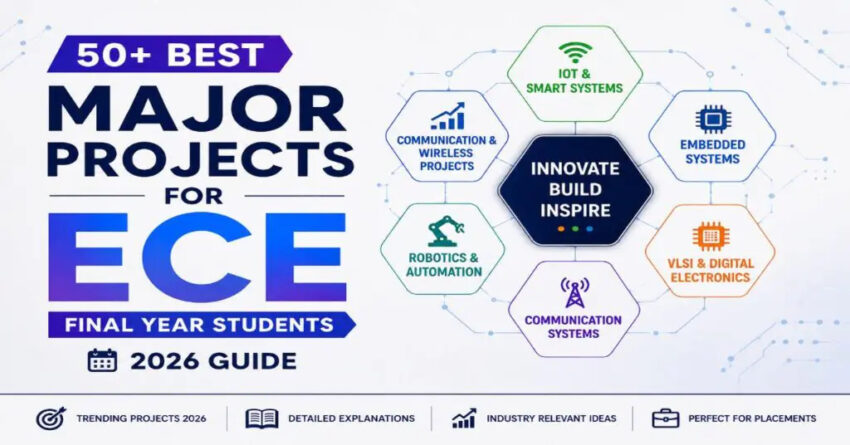
Picking a final year project is one of the more consequential decisions in an ECE student’s academic journey. It needs to survive a tough viva, hold up in a resume conversation, and be finished on time without burning out your last semester. With so many ideas circulating online, narrowing down the right pick among the many major projects for ECE final year students can feel overwhelming.
This guide compiles 40+ trending, practical project ideas spanning communication, embedded systems, IoT, VLSI, AI, robotics, and power electronics, with each one defined clearly so you know exactly what the build involves before committing your semester to it.
Why Project Selection Matters So Much in the Final Year
Final year projects carry more weight than earlier coursework. They get discussed in interviews, listed on resumes, and often become a student’s first real technical conversation with a recruiter. Choosing wisely among major projects for ECE final year students isn’t just about clearing evaluation, it’s about building something you can genuinely explain and defend under questioning, both from your evaluation panel and from a future interviewer who wants to know how it actually works.
Communication and Signal Processing Projects
GSM-Based Home Automation System: Uses the GSM mobile network to send control commands via SMS to a microcontroller, which then switches connected appliances on or off remotely.
DSP-Based Adaptive Noise Cancellation System: Applies digital signal processing techniques to analyze incoming audio and generate an inverse waveform that cancels background noise in real time.
FM Transmitter and Receiver Design: Builds a working transceiver pair capable of modulating and demodulating an FM signal, covering the full transmission chain from oscillator to receiver circuit.
Li-Fi Based Data Communication System: Transmits digital data using rapid variations in visible light intensity, received and decoded by a photodetector on the other end.
Software-Defined Radio for Multi-Band Reception: Uses software rather than fixed analog hardware to tune, demodulate, and decode signals across multiple frequency bands on a single platform.
Digital Modulation Technique Simulator: Builds a simulation environment that generates and compares ASK, FSK, and PSK waveforms, helping visualize how each modulation scheme encodes data.
Optical Fiber Communication Link Design: Sets up and tests a basic fiber-optic transmitter and receiver pair, measuring signal loss, attenuation, and achievable bandwidth over the link.
Cognitive Radio Spectrum Sensing System: Scans the radio spectrum to identify unused frequency bands and dynamically allocates them for opportunistic, interference-free communication.
Embedded Systems and IoT Projects
IoT-Based Smart Agriculture Monitoring System: Connects soil moisture, temperature, and humidity sensors to a microcontroller that uploads readings to a cloud dashboard for remote farm monitoring.
Wearable Health Monitoring Device: A compact, body-worn unit that continuously tracks heart rate, temperature, and activity level, sending the data to a paired mobile app.
Smart Parking System Using IoT: Uses sensors placed in parking spots to detect occupancy and relays real-time availability to a connected app or display board.
Home Security System with Facial Recognition: Pairs a camera module with facial recognition software to identify known individuals and trigger an alert when an unrecognized face is detected.
IoT-Based Air Quality Monitoring System: Uses gas and particulate sensors to continuously measure pollutant levels indoors or outdoors, streaming the data to a cloud-based dashboard.
Smart Irrigation System Using Arduino and IoT: Reads real-time soil moisture data and automatically triggers a water pump only when the soil actually needs it, reducing water waste.
Gesture-Controlled Robotic Arm: Uses an accelerometer worn on the operator’s hand to translate physical gestures into corresponding movements of a robotic arm.
Bluetooth-Controlled Home Automation System: Lets a smartphone app communicate with a microcontroller over Bluetooth to switch household appliances on and off within short range.
IoT-Based Smart Waste Management System: Places ultrasonic sensors inside waste bins to measure fill level and notifies collection staff only when a bin actually needs emptying.
Real-Time Vehicle Tracking System Using GPS and GSM: Combines a GPS module for location data with a GSM module to transmit that location via SMS or a live online map.
Smart Street Lighting System Using IoT: Automatically adjusts streetlight brightness based on ambient light levels and detected motion, reducing unnecessary energy consumption overnight.
IoT-Based Patient Health Monitoring System: Continuously records vital signs from a connected patient and sends alerts to caregivers automatically if any reading falls outside a safe range.
VLSI and Circuit Design Projects
Low-Power VLSI Design for Portable Devices: Designs digital circuit architectures specifically optimized to minimize power consumption, extending battery life in portable electronics.
FPGA-Based Traffic Light Controller: Implements the logic for a multi-way traffic signal sequence directly on an FPGA, demonstrating practical digital logic and hardware description language skills.
Design of a 4-Bit ALU Using VHDL: Designs and simulates an Arithmetic Logic Unit capable of performing basic operations like addition, subtraction, and logical comparisons on 4-bit inputs.
RFID-Based Attendance System: Uses an RFID reader to scan ID cards as individuals enter a room, automatically logging attendance in a digital record without manual entry.
Design of a Digital Clock Using FPGA: Builds a functioning digital clock circuit on FPGA hardware, reinforcing sequential logic concepts like counters and timing control.
UART Communication Protocol Design on FPGA: Implements a serial communication protocol entirely in hardware, enabling reliable data transfer between an FPGA and external devices.
AI and Machine Learning Integrated Projects
AI-Based Driver Drowsiness Detection System: Uses a camera feed and a trained machine learning model to monitor eye movement and facial cues, triggering an alert when signs of fatigue appear.
Machine Learning-Based Crop Disease Detection: Applies an image classification model trained on leaf photos to identify common plant diseases from a simple uploaded or captured image.
AI-Powered Voice-Controlled Home Assistant: Combines speech recognition with a command-processing system to let users control appliances or ask basic questions using only their voice.
Object Detection System for Autonomous Vehicles: Runs a trained object detection model on embedded hardware to identify obstacles, pedestrians, and other vehicles in real time from a camera feed.
AI-Based Handwritten Digit Recognition System: Trains a neural network on a labeled dataset of handwritten digits, allowing it to classify new handwritten input accurately.
AI-Based Face Mask Detection System: Uses an image classification model to determine whether a person in a camera frame is wearing a face mask, useful for public health compliance monitoring.
Robotics Projects
Line-Following Robot Using IR Sensors: Uses infrared sensors mounted beneath the robot to detect a marked path and adjust motor direction to stay on course automatically.
Obstacle-Avoiding Robot Using Ultrasonic Sensors: Continuously measures distance to nearby objects using ultrasonic sensors, redirecting the robot’s path whenever an obstacle is detected ahead.
Voice-Controlled Robotic Vehicle: Interprets spoken commands through a speech recognition module to control the robot’s forward, backward, left, and right movements.
Fire-Fighting Robot Using Flame Sensors: Detects the presence of fire using flame sensors and autonomously navigates toward the source to deploy a small extinguishing mechanism.
Renewable Energy and Power Electronics Projects
Solar Power Monitoring System Using IoT: Tracks a solar panel’s voltage, current, and output efficiency in real time, displaying the data on a connected dashboard for remote monitoring.
Automatic Solar Tracking System: Uses light sensors and a motorized mount to continuously reposition a solar panel toward the sun’s direction, increasing total energy capture.
Wireless Power Transfer System: Demonstrates how electrical power can be transmitted without physical wires using resonant inductive coupling between a transmitter and receiver coil.
Battery Management System for Small-Scale Applications: Monitors a battery pack’s charge level, temperature, and overall health, preventing overcharging and improving safety during use.
Smart Energy Meter with Theft Detection: Measures household power consumption in real time and flags unusual usage patterns that may indicate tampering or unauthorized connections.
Hybrid Solar-Wind Energy Harvesting System: Combines solar panels and a small wind turbine into a single energy system, maximizing power generation under varying weather conditions.
Why These Domains Are Trending for ECE Final Year Projects
The concentration of major projects for ECE final year students in IoT, embedded systems, and AI-integrated designs isn’t accidental. These domains reflect where actual hiring is happening in 2026, companies want candidates who can demonstrate hands-on experience with sensors, microcontrollers, wireless communication, and basic machine learning integration, not just theoretical coursework. Many of the strongest picks today combine at least two of these domains, such as pairing IoT connectivity with a basic AI model.
How to Choose the Right Project for Your Skill Level
Not every student should attempt the most ambitious build on this list. Consider your comfort with hardware versus software, your access to lab equipment and components, and how much time your guide’s schedule allows for troubleshooting. Students newer to hardware work often do better starting with Arduino or Raspberry Pi-based projects, like smart irrigation or line-following robots, while those with stronger programming backgrounds may find AI-integrated projects more rewarding despite the steeper learning curve.
Balancing Innovation with Feasibility
A common mistake is choosing something too ambitious for the available timeline. A project that looks impressive on paper but can’t be completed and debugged by submission time often performs worse in evaluation than a simpler project executed flawlessly. It’s worth discussing your shortlist honestly with your guide early, adjusting complexity based on realistic component availability, budget, and the weeks actually available for building and testing. A project with a smaller core feature set that works reliably will almost always outperform a longer wish list of features that only partially function by submission day.
Documentation and Presentation Matter Just as Much
Regardless of which project you choose, strong documentation and clear presentation significantly affect your final evaluation. This includes a well-organized report covering your problem statement, methodology, circuit diagrams, code, results, and future scope, alongside a working demonstration that runs reliably during your viva. Starting documentation alongside your build, rather than after, tends to produce a much stronger final submission, since screenshots, test results, and troubleshooting notes are far easier to capture while the project is fresh.
Budgeting and Sourcing Components
Cost is a real constraint for most students. Before committing to any of these projects, map out the full component list and check local availability, since some sensors and modules ship with long lead times from overseas suppliers. Building in a buffer of a few weeks for shipping delays and component swaps can save significant stress later in the semester, particularly for projects relying on specialized sensors or FPGA boards.
Working Effectively with Your Project Guide
Your guide’s feedback shapes both your project’s direction and how it’s evaluated. Schedule regular check-ins rather than only appearing before deadlines, and come prepared with specific questions about design choices rather than open-ended requests for direction. Guides who see steady progress are generally more willing to advocate for the student during final evaluation.
Final Thoughts on Choosing Your Project
With so many strong options to choose from in 2026, the right choice ultimately depends on your interests, available resources, and career direction. Whether you’re drawn to communication systems, embedded IoT builds, VLSI design, robotics, or AI-integrated projects, prioritizing something you can genuinely explain and defend in depth will serve you far better during evaluation and interviews than choosing the most complex-sounding topic on this list.
Content Details –
Mob -+91 7058787557
Email – info@eceprojectkart.com
Website – eceprojectkart.com