
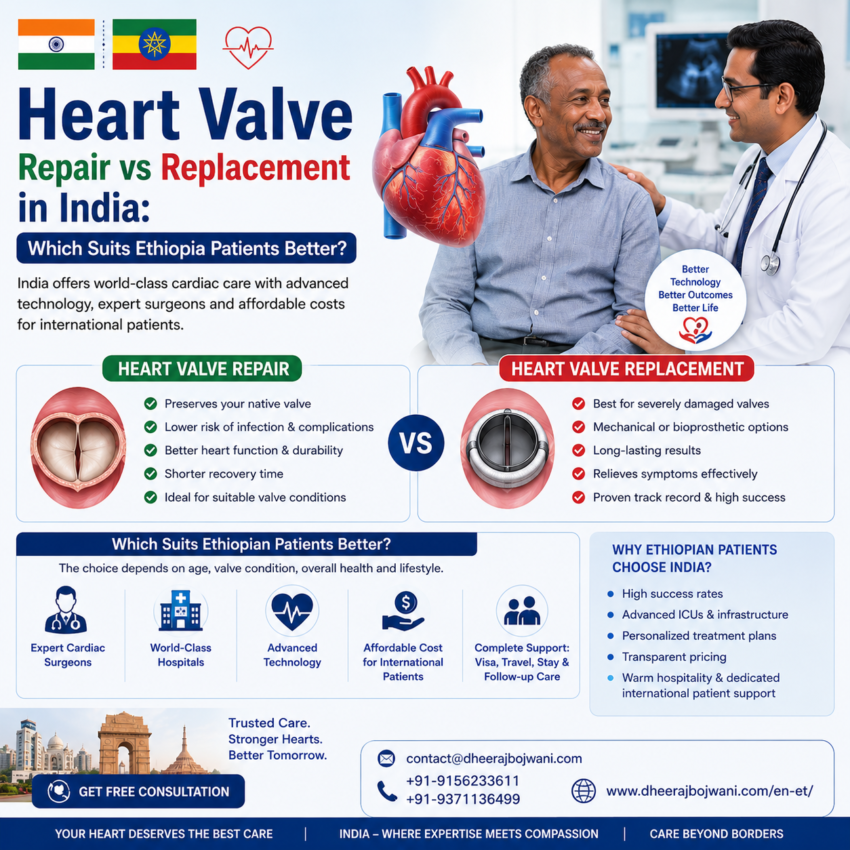
When a heart valve is badly damaged, many families hear two possible words from the cardiologist: repair or replacement. They can sound like similar options, but the long-term implications may be very different.
For patients from Ethiopia considering treatment in India, the decision depends on much more than cost or the availability of a particular hospital. Doctors look at which valve is affected, how severe the damage is, the patient’s age, heart function, other medical conditions and whether the valve can be repaired reliably.
In some cases, keeping the patient’s own valve is the best option. In others, replacing it provides a safer and more durable result.
Why Heart Valves Become Damaged
The heart has four valves that help blood move in the correct direction. When a valve becomes narrowed, leaky or structurally damaged, the heart has to work harder.
Common causes include:
- Rheumatic heart disease
- Degenerative valve disease
- Congenital valve abnormalities
- Previous infection of the heart valve
- Calcification
- Damage related to heart enlargement or other cardiac conditions
For patients from Ethiopia, rheumatic valve disease can be an important cause, particularly when the mitral or aortic valve is involved.
Symptoms may include breathlessness, fatigue, swelling in the legs, palpitations, chest discomfort or reduced ability to exercise.
Also Read: Best Heart Valve Treatment in India for Ethiopian Patients
What Is Heart Valve Repair?
Valve repair means the surgeon keeps the patient’s natural valve and corrects the problem where possible.
Depending on the valve and the type of damage, this may involve reshaping valve tissue, repairing supporting structures, removing excess tissue or placing a ring around the valve to improve its function.
Mitral valve disease is one of the areas where repair may be considered frequently, especially when the anatomy is suitable.
The main advantage is that the patient’s own valve remains in place.
What Is Heart Valve Replacement?
When a valve is too damaged to repair effectively, the surgeon may remove or bypass the diseased valve and implant an artificial one.
The two main replacement options are:
|
Valve type |
Key consideration |
|
Mechanical valve |
Very durable but usually requires long-term blood-thinning medication |
|
Tissue valve |
Often avoids lifelong anticoagulation solely because of the valve, but may wear out over time |
The choice between these valves is highly individual.
A younger patient may value durability, while another patient may have reasons to avoid long-term anticoagulation. Pregnancy plans, lifestyle, access to regular INR testing and other medical conditions can all influence the decision.
Repair vs Replacement: The Main Differences
|
Consideration |
Valve repair |
Valve replacement |
|
Natural valve retained |
Yes |
No |
|
Long-term anticoagulation |
Often not required solely because of repair |
Usually required with mechanical valves |
|
Durability |
Depends on quality of repair and disease |
Mechanical valves are highly durable; tissue valves may deteriorate |
|
Suitable for all valves? |
No |
More widely applicable when repair is not possible |
|
Future procedures |
Sometimes needed if repair fails |
May be needed if tissue valve degenerates |
The most important question is not simply which approach sounds better. It is whether the surgeon can achieve a durable and reliable repair.
When Is Repair Usually Preferred?
When technically possible and expected to last, valve repair can have important advantages.
Patients may avoid a prosthetic valve and, in some cases, avoid lifelong anticoagulation related specifically to valve replacement.
Repair may also preserve heart function more naturally in certain conditions.
However, not every diseased valve should be repaired.
If the valve is severely calcified, badly deformed or damaged by longstanding rheumatic disease, replacement may provide a more dependable result.
A repair that looks attractive initially but fails within a short period may not serve the patient’s long-term interests.
When Is Replacement the Better Choice?
Replacement may be recommended when:
- The valve is severely damaged
- Repair is unlikely to remain durable
- There is extensive calcification
- Rheumatic disease has caused major structural changes
- Previous valve repair has failed
- The anatomy is unsuitable for reconstruction
For Ethiopian patients travelling to India, surgeons should explain clearly why replacement is being recommended and which type of valve is most appropriate.
Mechanical or Tissue Valve?
This is often one of the biggest decisions for patients requiring replacement.
Mechanical Valves
Mechanical valves are designed for long-term durability.
The trade-off is that patients generally require lifelong anticoagulation, usually with regular monitoring. This makes dependable access to blood testing after returning to Ethiopia an important consideration.
Tissue Valves
Tissue valves are generally made from treated biological tissue.
They may be considered when avoiding lifelong anticoagulation is important, although they usually have a more limited lifespan than mechanical valves.
The choice should be made together with the cardiac surgeon and cardiologist, taking into account age, lifestyle, medical history and the practicality of long-term follow-up.
Can Valve Surgery Be Minimally Invasive?
Some valve repairs and replacements can be performed through minimally invasive surgical approaches in carefully selected patients.
There are also catheter-based procedures for certain valve conditions.
However, not everyone is suitable. Complex multivalve disease, previous surgery, severe calcification or other cardiac problems may make conventional open surgery more appropriate.
The safest technique matters more than the smallest incision.
Recovery After Valve Surgery
Recovery depends on the type of surgery and the patient’s overall condition.
Patients are usually monitored in a cardiac intensive care unit after the operation, followed by gradual mobilisation and breathing exercises.
Many patients remain in hospital for several days, but the exact duration varies.
After discharge, recovery focuses on wound healing, increasing physical activity gradually, medication management and cardiac follow-up.
Patients with mechanical valves will need clear anticoagulation instructions before leaving India.
What Ethiopia Patients Should Plan Before Returning Home
For international patients, treatment planning should include what happens after returning to Ethiopia.
Before travelling home, patients should have:
- A complete discharge summary
- Operative records
- Echocardiogram reports
- Medication instructions
- Anticoagulation guidance where relevant
- A follow-up schedule
- Clear advice on warning symptoms
Patients with a mechanical valve should confirm in advance where regular INR testing can be performed after returning home.
This practical point can influence the choice of valve just as much as age or surgical preference.
Choosing a Cardiac Centre in India
Ethiopian patients should look for hospitals with experienced cardiac surgeons, strong intensive-care support and expertise in both valve repair and replacement.
Established cardiac programmes are available at hospitals such as Medanta – The Medicity, Artemis Hospitals Gurugram, Fortis Memorial Research Institute, Kokilaben Dhirubhai Ambani Hospital Mumbai, and Manipal Hospitals Bengaluru.
The right hospital depends on the type of valve disease and the complexity of the operation.
Which Option Is Better?
There is no universal answer.
If the valve can be repaired safely and the result is expected to remain durable, repair may be an excellent option.
If the valve is too damaged, replacement may provide a more predictable long-term result.
For patients from Ethiopia, the best decision should consider not only what can be done in the operating theatre, but also what can be managed safely after returning home.
The right choice is the one that balances surgical success, durability, medication needs, lifestyle and long-term follow-up.
Official Indian Government References
All India Institute of Medical Sciences (AIIMS), New Delhi – A major public medical institution providing specialised cardiology and cardiothoracic surgical care.
https://www.aiims.edu/
National Medical Commission (NMC) – India’s statutory medical regulator and an official source of information related to medical professionals and medical education standards.
https://www.nmc.org.in/
Our Commitment to Patients
Our mission is to place patients at the centre of every healthcare decision by providing trustworthy, evidence-based, and unbiased medical information. We believe that informed patients make better decisions. Backed by personalised guidance from our experienced advisory team, we help patients understand their treatment options, compare them objectively, and confidently choose the path that best suits their medical needs and personal circumstances.
Dr. Dheeraj Bojwani
Medical Travel Advisor for International Patients Seeking Treatment in India
📍 New Delhi, India
🏆 24+ Years of Experience | Assisted 5,000+ International Patients
🌐 Website: www.dheerajbojwani.com/en-et/
📧 Primary Email: contact@dheerajbojwani.com
📞 Phone: +91 9156233611
📞 Alternate Phone: +91 9371136499
Disclaimer
This article is intended for educational and informational purposes only and should not be considered medical, legal, or visa advice. Medical recommendations, treatment plans, and procedures may vary from one patient to another based on individual health conditions and circumstances. Readers are strongly advised to consult qualified healthcare professionals before making any medical-related decisions.
Learn More: Best Hospitals in India for Heart Valve Replacement Surgery