
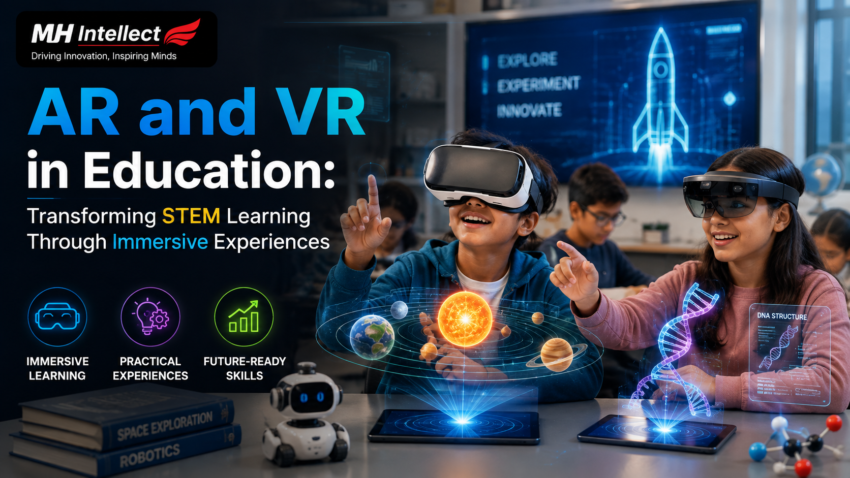
Technology is changing how students understand and interact with complex ideas, and immersive technologies are becoming an important part of this transformation. AR and VR in Education can turn abstract STEM concepts into interactive experiences, allowing students to explore 3D models, conduct virtual experiments, visualise invisible processes, and engage with digital environments. For schools, this creates opportunities to move beyond textbook-based instruction and develop more practical, engaging, and technology-driven learning experiences.
Why Immersive Technology Matters in STEM Education
Many STEM concepts are difficult to understand because students cannot directly see or experience them. Atoms, molecules, magnetic fields, biological systems, engineering structures, and complex scientific processes are often represented through diagrams or explanations. This can encourage memorisation without necessarily creating deep understanding.
Immersive Learning helps bridge this gap by allowing students to interact with concepts visually and spatially. Instead of simply reading about a molecule, learners can examine its structure from different angles. Instead of studying engineering principles through static diagrams, they can explore models and test how different components behave.
This shift from passive observation to active exploration can make STEM learning more meaningful and memorable.
How AR and VR Support Student Learning
AR and VR offer different but complementary approaches to classroom learning. Augmented reality overlays digital information onto the physical environment, making it easier to introduce interactive models into existing classrooms. Virtual reality creates an immersive digital environment where students can explore simulations and experiences that may be difficult, expensive, or impossible to recreate physically.
These technologies can support learning across multiple STEM disciplines. In chemistry, students can explore molecular structures and simulated reactions. In biology, they can investigate cells, organs, ecosystems, and biological systems in three dimensions. Physics learners can visualise forces, energy transfer, and other concepts that are difficult to observe directly. Engineering students can explore prototypes, test designs, and analyse virtual models before moving toward physical construction.
Key Benefits of AR and VR Learning
AR and VR Learning can support several important student outcomes:
- Higher engagement: Interactive environments encourage students to explore, participate, and ask questions rather than simply listen.
- Better visual understanding: Three-dimensional models can make complex and abstract concepts easier to understand.
- Stronger retention: Experiential learning can create memorable connections between theory and practical application.
- Improved problem-solving: Students can test ideas, investigate outcomes, and experiment with different solutions.
- Enhanced spatial reasoning: Manipulating three-dimensional objects can strengthen visualisation skills relevant to engineering, architecture, medicine, and robotics.
- Greater confidence: Making difficult concepts more accessible can help students become more comfortable with challenging STEM subjects.
Bringing Immersive Learning Into UAE Schools
Schools across Dubai, Abu Dhabi, Sharjah, and the wider UAE are increasingly exploring technology-enhanced learning environments. AR and VR can complement existing programmes in robotics, coding, engineering, artificial intelligence, and science while creating additional opportunities for practical exploration.
However, successful implementation requires more than purchasing devices. Schools need appropriate content, teacher training, curriculum alignment, technical support, and clear learning objectives. Starting with targeted science or mathematics projects can allow schools to evaluate outcomes before expanding immersive technology across additional subjects and grade levels.
AR, VR and the Future of STEM Education
The future of STEM learning is likely to become increasingly connected, immersive, and personalised. As AR and VR become more accessible, students may gain opportunities to participate in virtual laboratories, explore complex environments, collaborate digitally, and interact with simulations that respond to their learning needs.
Artificial intelligence can further enhance these experiences by adapting content, providing feedback, and creating personalised learning pathways. Together, AI, AR, and VR can help schools develop learning environments that encourage curiosity while strengthening technical and analytical skills.
How MH Intellect Supports Future-Ready STEM Learning
STEM Education for schools can become more engaging when emerging technologies are connected to meaningful curriculum objectives. MH Intellect supports schools with STEM education, robotics, coding, AI, IoT, engineering, and technology-driven learning solutions designed to help students develop practical future-ready skills.
The goal is not to use technology simply because it is innovative. The focus should be on using the right technology to improve understanding, encourage experimentation, and connect classroom learning with real-world applications.
Ready to Bring Immersive Learning to Your School?
AR and VR can help transform STEM classrooms into environments where students explore, experiment, visualise, and solve problems rather than simply memorise information. Book a consultation with MH Intellect to explore immersive learning, STEM, robotics, AI, and technology solutions tailored to your school’s educational objectives and future-ready learning goals.