

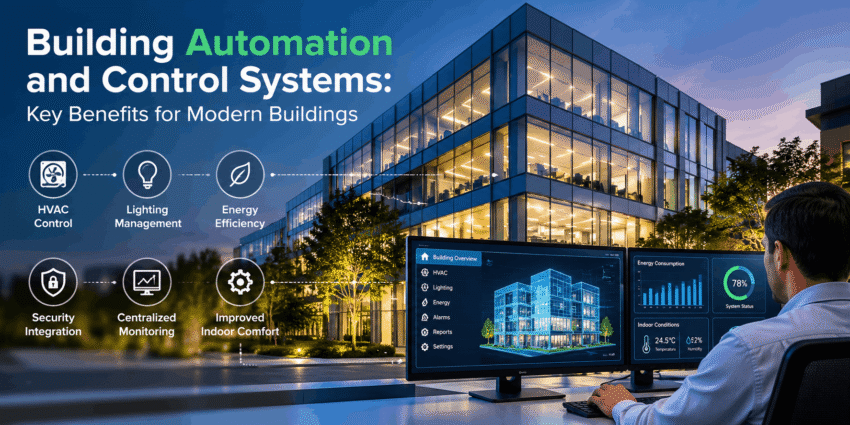
Building Automation and Control Systems: Key Benefits for Modern Buildings
Modern buildings depend on several systems to maintain comfortable indoor conditions, manage energy consumption, and support daily operations. Heating, ventilation, air conditioning (HVAC), lighting, access control, and other building services often operate through separate devices. Managing these systems individually can make monitoring and maintenance more complicated. Building automation and control systems help address this challenge by connecting building equipment and enabling more coordinated operations.
What Are Building Automation and Control Systems?
Building automation and control systems are technologies used to monitor, manage, and control equipment within commercial, industrial, and institutional buildings. Depending on the installation, these systems may include controllers, sensors, software platforms, communication networks, and operator interfaces.
For example, temperature sensors can provide room temperature readings to an HVAC controller. The controller can use this information to adjust heating or cooling according to configured requirements. Building operators can also monitor equipment status, review alarms, and identify operating conditions that need attention.
The specific functions depend on the equipment, system design, and level of integration.
1. Centralized Monitoring and Control
One important benefit of building automation is centralized visibility. Instead of checking every piece of equipment separately, facility teams can use a connected platform to monitor supported systems from a common interface.
Centralized monitoring can help operators review temperatures, equipment status, alarms, and other available data. This makes it easier to identify abnormal conditions and coordinate responses across different areas of a building.
2. More Efficient Energy Management
Energy consumption is a major consideration for commercial buildings. HVAC equipment and lighting can consume significant amounts of electricity, particularly when they operate without considering occupancy, schedules, or actual building requirements.
Building automation systems can support energy management through scheduling, temperature setpoints, occupancy-based control, and equipment coordination. For instance, an appropriately configured system can reduce unnecessary HVAC operation in selected areas when they are unoccupied.
Actual savings depend on the building, existing equipment, control strategy, maintenance practices, and operating conditions. Monitoring energy data helps facility teams identify opportunities for improvement.
3. Improved Indoor Comfort
Maintaining suitable indoor temperatures and ventilation conditions is important for occupants. Poorly coordinated HVAC equipment may contribute to uneven temperatures, unnecessary equipment operation, or recurring comfort complaints.
Building controllers can use information from sensors to support more responsive HVAC operation. When combined with proper commissioning and maintenance, automated control can help maintain conditions closer to configured comfort requirements.
4. Faster Fault Detection and Maintenance
Equipment problems are not always immediately visible. A sensor reading outside its expected range, repeated alarms, or an unexpected equipment status may indicate that an inspection is needed.
Depending on the system’s capabilities, building automation software can display alarms, trends, and operating information that help maintenance teams investigate potential problems. This can support more informed maintenance planning and reduce reliance on manual checks alone.
Automation does not eliminate the need for inspections, repairs, or preventive maintenance. Instead, it provides additional information that helps teams decide where attention may be required.
5. Integration Across Building Systems
Many facilities use equipment from different manufacturers. Integrating these devices requires attention to communication protocols, controller capabilities, network configuration, and compatibility.
Standards such as BACnet support communication between compatible building automation products. However, using the same protocol does not automatically guarantee that every device, data point, or function will work together without configuration.
A well-planned integration approach should include equipment assessment, point mapping, network planning, testing, and commissioning.
Choosing the Right Building Automation Solution
Before implementing a building automation system, facility owners and consultants should consider the building’s size, equipment requirements, operational goals, and future expansion plans.
Important questions include:
-
Which systems need to be monitored or controlled?
-
What communication protocols do existing devices support?
-
Is centralized monitoring required across multiple areas?
-
What information should operators see on the dashboard?
-
How will alarms, user access, and system maintenance be managed?
-
Can the solution accommodate future equipment and integration requirements?
Answering these questions early helps define the project’s scope and avoid unnecessary complexity.
Conclusion
Building automation and control systems help organizations coordinate building equipment, monitor operating conditions, manage energy use, and support maintenance activities. Their effectiveness depends on suitable equipment, reliable communication, careful configuration, and ongoing maintenance.
For organizations exploring building automation, HVAC control, and integrated building management, Messung BACD provides information about solutions for building control and automation applications. Reviewing the building’s operational requirements before selecting a solution can help ensure that the chosen system supports practical facility management goals.