
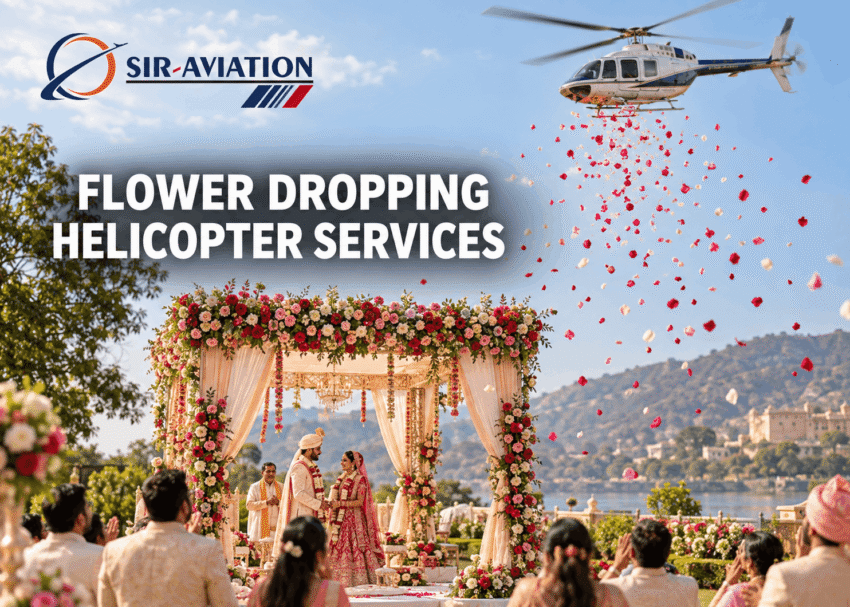
A shower of fresh petals descending from the sky can transform a wedding entrance, religious ceremony, corporate celebration, or public event into an unforgettable spectacle. Flower dropping helicopter services combine aviation planning, event coordination, safety management, and accurate timing to create this impressive aerial experience. SIR Aviation coordinates each stage carefully, from assessing the venue and arranging a suitable helicopter to planning the flight path and synchronising the drop with the event schedule.
What Is a Helicopter Flower Drop?
A helicopter flower drop involves releasing fresh or approved biodegradable petals from a helicopter over a designated outdoor location. The aircraft flies along a planned route while trained personnel release the petals at a calculated point. Wind and rotor movement then spread the petals across the selected area.
Although the final display may last only a few moments, the operation requires detailed preparation. Aviation professionals must consider airspace restrictions, weather, venue dimensions, crowd placement, flight altitude, nearby buildings, electrical lines, trees, and other potential obstacles.
The objective is to create an elegant floral shower while keeping guests, crew members, pilots, event staff, and surrounding properties safe.
Why Are Helicopter Flower Drops Popular at Weddings?
Indian weddings often feature memorable entrances, traditional rituals, music, decorations, and large guest gatherings. A helicopter flower drop can complement these elements by adding movement and visual drama to an important moment.
Couples and families may arrange an aerial petal shower for:
- The bride or groom’s entrance
- The arrival of the wedding procession
- The exchange of garlands
- The completion of wedding rituals
- A royal-themed wedding celebration
- A reception entrance
- A special photo or video sequence
- A family blessing ceremony
The effect works particularly well at palace venues, farmhouses, resorts, open lawns, heritage properties, sports grounds, and large wedding estates. An open setting gives the helicopter adequate operating space and allows petals to disperse naturally.
A flower drop also creates strong visual content for wedding films and photography. Aerial footage, slow-motion shots, and wide-angle recordings can capture the scale of the moment from several perspectives.
Which Events Can Include an Aerial Flower Shower?
Wedding ceremonies remain a popular choice, but organisers can use aerial flower drops for many other occasions.
Religious and Spiritual Gatherings
Petal showers may form part of temple celebrations, spiritual processions, religious anniversaries, consecration ceremonies, and community gatherings. Organisers must coordinate carefully because such occasions often attract large crowds.
Corporate Events
Companies can use a flower drop during a major inauguration, milestone celebration, product launch, foundation day, or award ceremony. The aerial display can mark a precise moment, such as a ribbon cutting or the arrival of a chief guest.
Political and Public Programmes
A helicopter petal shower may support a public reception, ceremonial welcome, commemorative programme, or major gathering. These events usually require extensive coordination because they may involve security agencies, local authorities, and controlled airspace.
Cultural Celebrations
Festival organisers can incorporate aerial petals into cultural programmes, community celebrations, parades, and heritage events. The display must match the approved event plan and local safety requirements.
Memorial and Tribute Ceremonies
Flowers can be released during a respectful tribute or remembrance programme. Organisers commonly choose a simple flight sequence and carefully selected petals to maintain the dignity of the occasion.
Sports and Institutional Events
Schools, colleges, clubs, and sports organisations may use a helicopter flower drop for opening ceremonies, victory celebrations, anniversaries, or stadium events. The venue must provide sufficient open space and safe access.
How Does the Planning Process Begin?
The process starts with a detailed enquiry. The organiser normally provides the event date, venue address, preferred drop time, event type, estimated attendance, and desired coverage area.
The aviation coordinator then evaluates whether the request appears operationally feasible. Early planning proves especially important for weddings held during busy seasons because helicopter availability may become limited.
SIR Aviation may request photographs, maps, venue coordinates, site videos, or a layout showing important areas. This information helps the operations team identify obstacles and determine whether the proposed location can support an aerial flower drop.
The initial review does not automatically confirm the operation. Final feasibility depends on the site assessment, aircraft availability, permissions, weather, security conditions, and operational requirements.
How Is the Event Venue Assessed?
A suitable venue needs adequate open space and a clearly defined drop zone. The operations team examines the proposed site and its surroundings before finalising the flight plan.
Important assessment factors include:
- The size and shape of the venue
- Expected crowd density
- Entry and exit routes
- Nearby airports or helipads
- Controlled or restricted airspace
- Buildings, towers, trees, and electrical cables
- Mobile towers and temporary structures
- Drone activity
- Open flames, decorative installations, or fireworks
- Parking areas and public roads
- Emergency access
- Prevailing wind direction
- Suitable alternate routes
The team may recommend changing the drop zone if the original area presents avoidable risks. For example, a location close to power lines, tall structures, loose decorations, or a congested road may not support the proposed operation.
Event organisers should share accurate information about temporary stages, lighting towers, tents, banners, cranes, and other installations. A venue can change considerably during final preparations, so late additions must reach the aviation coordinator promptly.
How Is a Suitable Helicopter Selected?
The helicopter must match the route, operating conditions, aircraft availability, payload, departure location, and required endurance. Aviation professionals consider performance rather than selecting an aircraft only for its appearance.
The proposed helicopter may depart from a nearby airport, approved helipad, or another authorised operating base. Its positioning requirements can affect the total flying time and cost.
The aircraft operator also considers:
- Distance to the venue
- Fuel requirements
- Local weather conditions
- Passenger and payload limits
- Crew duty restrictions
- Landing or refuelling needs
- Flight route limitations
- Airport operating hours
- Air traffic requirements
Organisers should avoid assuming that the helicopter will land at the wedding or event venue. Many flower-drop operations involve an aerial pass without landing. Any landing request requires a separate assessment and may involve additional approvals, site preparation, security arrangements, and ground support.
What Permissions May Be Required?
Helicopter operations must comply with applicable aviation rules and local administrative requirements. The necessary approvals can vary according to the venue, flight route, event type, airspace category, security conditions, and aircraft operator.
Depending on the operation, coordination may involve aviation authorities, airport authorities, air traffic control, district administration, police, venue management, local authorities, and security agencies. Events near defence areas, airports, government establishments, international borders, or restricted zones may require additional scrutiny.
The organiser may need to provide event-related documents, identity details, venue permissions, schedules, invitation information, or local approvals. The operator may handle aviation-specific submissions while the client or event organiser supports local documentation.
No organiser should treat a verbal discussion as final aviation approval. The flight can proceed only after the responsible authorities and operator complete the required processes.
How Are Flowers Prepared for the Flight?
Loose flower petals generally work better than whole flowers, garlands, stems, or heavy decorative materials. Petals disperse more evenly and reduce the chance of causing injury or property damage.
Common choices include rose petals, marigold petals, and other locally available varieties. The final selection depends on availability, visual preference, weight, freshness, and operational acceptance.
Petals should remain clean, fresh, and free from:
- Plastic pieces
- Metal clips
- Thread
- Wire
- Pins
- Packaging materials
- Stones or soil
- Excess water
- Chemical glitter
- Artificial decorations
Wet petals can clump together and fall unevenly. Extremely dry petals may blow away too quickly. The preparation team must therefore store and handle them properly before loading.
The operator determines the acceptable quantity after considering aircraft performance, route, release method, and coverage expectations. Adding more petals without approval can affect weight calculations and operational safety.
How Does the Flower Release Work?
The crew loads the approved petals according to the operator’s procedure. The helicopter then departs for the event venue and approaches along the planned route.
During the aerial pass, trained personnel release the petals over the designated drop zone. The pilot maintains the approved operating profile while considering wind, visibility, terrain, obstacles, and air traffic instructions.
The exact release point may sit slightly upwind of the target. This approach allows the wind and rotor wash to carry petals towards the intended area. The pilot and operations team may adjust the final approach when real-time conditions differ from earlier forecasts.
A flower drop may involve one pass or several passes, depending on the approved plan, petal quantity, venue dimensions, aircraft limitations, and client requirements. Additional passes require more flying time and careful coordination.
Why Does Timing Matter So Much?
Precise timing helps the aerial display support the main event rather than interrupt it. Wedding planners, photographers, presenters, security teams, and aviation coordinators must work from the same schedule.
The organiser should identify a clear trigger, such as:
- The couple reaching the main stage
- The groom’s procession entering the venue
- The chief guest arriving
- The completion of a ceremonial ritual
- A ribbon-cutting announcement
- The start of a musical cue
- A countdown from the event coordinator
A designated ground contact should communicate with the aviation team. Multiple callers can create confusion, especially when the schedule changes.
Helicopters cannot always remain airborne near a venue while waiting for an uncertain ceremony. Fuel limits, airport slots, daylight conditions, air traffic instructions, crew duty periods, and other commitments can restrict waiting time. Event managers should therefore build discipline into the programme.
How Do Weather Conditions Affect the Operation?
Weather can directly affect flight safety and petal distribution. Strong winds may carry petals outside the intended area, while rain can make them heavy and difficult to release. Poor visibility, thunderstorms, dust, low clouds, and adverse local conditions can also prevent the helicopter from operating.
The pilot holds final authority over the safety of the flight. Even when the event has progressed as planned, the operator may delay, alter, or cancel the sortie if conditions become unsuitable.
Organisers should discuss contingency arrangements in advance. A sensible event plan may include an alternate time window, a revised ceremonial sequence, or a ground-based floral option.
Weather-related decisions can occur close to the proposed flight time because conditions may change quickly. Clear contractual terms help all parties manage expectations regarding postponement, repositioning costs, approvals, and cancellation.
What Safety Measures Should Event Organisers Follow?
Aerial event work requires disciplined crowd and venue management. The organiser must keep guests within approved areas and follow every instruction issued by the operator or relevant authority.
Key precautions include:
- Keep the drop zone free from loose objects.
- Secure banners, fabrics, umbrellas, and temporary decorations.
- Prevent unauthorised drone flights near the venue.
- Keep guests away from any approved landing area.
- Maintain clear emergency access.
- Brief security personnel and event volunteers.
- Avoid fireworks during the helicopter’s operating window.
- Inform the aviation team about structural changes.
- Follow the agreed crowd-control plan.
- Appoint one responsible ground coordinator.
Rotor wash can move lightweight objects, dust, petals, fabrics, and unsecured decorations. Even when the aircraft does not land, organisers must keep the surrounding environment controlled.
If the helicopter will land, stricter measures apply. Guests must never approach the aircraft without direct crew instructions. The area must remain secure until the rotors stop and the crew confirms that movement is safe.
Can Drones Operate During the Flower Drop?
Uncoordinated drone activity can create a serious collision risk. Wedding photographers and videographers must not launch drones during the helicopter operation unless the responsible aviation team has reviewed and approved a coordinated plan.
The event manager should inform every photography vendor about the helicopter schedule. Security personnel should also watch for drones operated by guests or local content creators.
A drone should never approach the helicopter to capture close footage. Professional photographers can use ground cameras and approved positions to record the display safely.
How Much Do Helicopter Flower Drops Cost?
Pricing varies because each operation has different logistical and aviation requirements. The final quotation may reflect:
- Helicopter type and availability
- Aircraft positioning distance
- Total flying time
- Number of aerial passes
- Airport or helipad charges
- Ground handling
- Crew requirements
- Permission-related coordination
- Petal quantity and preparation
- Location accessibility
- Fuel planning
- Waiting requirements
- Applicable taxes
A venue close to an operating base may require less positioning than a remote destination. However, proximity alone does not determine the quotation. Airspace, airport procedures, helicopter availability, operating limitations, and event timing also influence costs.
Clients should request a detailed proposal instead of relying on a generic estimate. The proposal should clarify inclusions, exclusions, payment terms, postponement conditions, weather provisions, and client responsibilities.
What Information Should Clients Provide When Booking?
Complete information helps the aviation team evaluate the request efficiently. Clients should provide:
- Event type
- Exact venue address and coordinates
- Proposed date
- Preferred drop time
- Approximate guest count
- Size of the intended coverage area
- Number of requested passes
- Petal preference
- Venue photographs or videos
- Details of nearby obstacles
- Landing requirement, if any
- Event organiser’s contact information
- Backup timing options
Clients should also mention VIP attendance, large public gatherings, religious processions, political participation, nearby airports, and planned drone filming. These details can affect permissions, security coordination, and flight planning.
How Does SIR Aviation Coordinate the Service?
SIR Aviation supports clients through feasibility assessment, aircraft coordination, route planning, documentation requirements, operational communication, and event-day synchronisation.
The process generally includes enquiry review, venue assessment, aircraft availability checks, quotation preparation, document collection, permission coordination, weather monitoring, petal planning, and final operational confirmation.
The team also communicates practical limitations clearly. A visually impressive display must remain consistent with aviation safety, regulatory requirements, and actual site conditions.
Early enquiries give clients more time to complete documentation, reserve an appropriate aircraft, adjust the event schedule, and resolve venue-related concerns. Last-minute requests may face limited availability or insufficient time for coordination.
Creating a Memorable Aerial Celebration
A helicopter flower drop brings scale, movement, and ceremony to a special occasion. Its success depends on far more than simply flying over a venue and releasing petals. Site suitability, permissions, aircraft selection, weather, floral preparation, crowd control, and exact timing must work together.
SIR Aviation helps wedding families, event planners, institutions, and corporate organisers plan aerial flower showers with careful operational coordination. When every party follows the approved plan, guests can enjoy a graceful petal display that becomes one of the celebration’s most memorable moments.
Frequently Asked Questions
1. How early should flower dropping helicopter services be booked?
Clients should submit an enquiry as early as possible, especially during popular wedding periods. Advance planning allows time for aircraft availability checks, venue assessment, documentation, permissions, route planning, flower preparation, and coordination with event teams. Approval requirements and operational complexity vary according to the location and event.
2. Can a helicopter drop flowers over any wedding venue?
No. The venue must meet operational and safety requirements. The aviation team reviews available space, crowd placement, nearby buildings, power lines, trees, airports, restricted airspace, temporary structures, and local security conditions. Authorities or operators may reject or modify a request when the proposed location presents unacceptable risks.
3. What happens if bad weather affects the flower drop?
The pilot and operator assess wind, visibility, clouds, rain, thunderstorms, and other conditions before the flight. They may delay, alter, or cancel the operation when weather creates safety concerns. Clients should agree on postponement, cancellation, and alternate-timing terms before confirming the booking.
4. How many flowers are needed for a helicopter petal shower?
The required quantity depends on the coverage area, number of passes, desired visual density, flower type, aircraft limitations, and release plan. The operator must approve the final load. Clients should use clean, loose petals without stems, wires, plastic, glitter, pins, or other foreign materials.