
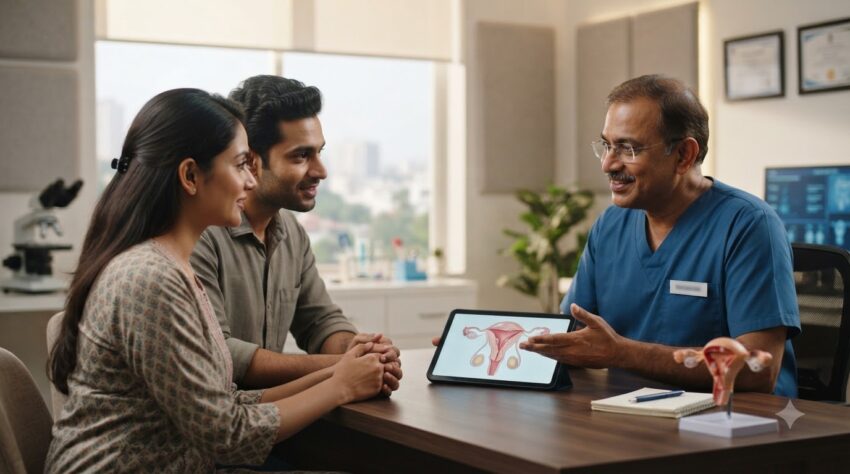
A semen report showing no sperm can leave couples with many questions. Does it mean the testes are not producing sperm? Could sperm be present somewhere else in the reproductive tract? What options might be available before or during IVF? At a fertility hospital in Konanakunte, doctors can investigate the underlying reason for azoospermia and determine whether sperm retrieval may be appropriate.
Why Sperm May Be Missing From Semen
Azoospermia means that sperm are not detected in the ejaculate. It is broadly associated with two different situations: sperm may be produced but unable to reach the semen because of an obstruction, or sperm production may be severely reduced.
With obstructive azoospermia, sperm can sometimes be found in the epididymis or testes even though none appear in the semen. Previous reproductive tract surgery, congenital conditions and other causes of blockage may contribute to this situation.
Non-obstructive azoospermia is different. Here, the testes may produce very few sperm, or sperm production may be severely impaired. Identifying the underlying cause is therefore an important part of male infertility evaluation.
How Doctors Investigate the Cause
The evaluation may include medical and reproductive history, physical examination and semen analysis. Depending on the clinical picture, doctors may also consider hormone testing, genetic assessment or other investigations.
The purpose is not simply to confirm that sperm are absent from semen. It is to understand where the problem occurs and whether sperm may still be available for assisted reproduction.
Where Can Sperm Be Retrieved?
When sperm are not present in an ejaculate, doctors may consider retrieving them from another location. The technique depends on the suspected cause and the expected availability of sperm.
PESA, or percutaneous epididymal sperm aspiration, involves using a needle to retrieve sperm from the epididymis. It may be considered in selected cases of obstructive azoospermia.
TESA, or testicular sperm aspiration, obtains sperm directly from testicular tissue. The procedure may be discussed when testicular sperm retrieval is considered suitable based on the patient’s diagnosis.
Neither procedure is automatically appropriate for every patient. The fertility specialist needs to assess the individual circumstances before recommending a particular approach.
When Micro-TESE May Be Discussed
Finding sperm can be more difficult when sperm production itself is impaired. For selected men with non-obstructive azoospermia, micro-TESE may be considered.
Microdissection testicular sperm extraction uses microsurgical techniques to examine testicular tissue and search for areas where sperm production may still be occurring. The AUA/ASRM guideline recommends micro-TESE for men with non-obstructive azoospermia undergoing surgical sperm retrieval, while noting limitations in the available evidence.
Importantly, a sperm retrieval procedure does not guarantee that viable sperm will be found. Doctors should explain the possible outcomes and alternatives before treatment.
What Happens After Sperm Is Found?
If viable sperm are identified, the embryology laboratory can assess and prepare the sample for assisted reproduction. In appropriate circumstances, ICSI may be used, with an individual sperm injected directly into an egg.
The timing of sperm retrieval may also be coordinated with the woman’s egg retrieval. Depending on the treatment plan, sperm can sometimes be used fresh or cryopreserved for future use.
This coordination between the fertility specialist and embryology laboratory is particularly important when only a small number of sperm may be available.
Why Individual Assessment Matters
A zero sperm result does not provide the complete picture of male fertility. The important questions are why sperm are absent from the semen, whether sperm production is occurring and where viable sperm might potentially be retrieved.
At a fertility hospital in Konanakunte, couples can discuss these questions before deciding on a treatment pathway. PESA, TESA and micro-TESE serve different clinical purposes, so selecting among them requires individualized medical assessment.
At Dr Aravind’s IVF Fertility & Pregnancy Centre, Konanakunte, Bangalore, couples can discuss male infertility evaluation, sperm retrieval options and IVF planning according to their specific circumstances. Understanding the reason behind a zero sperm result can help make the next steps in fertility treatment clearer and more informed.