
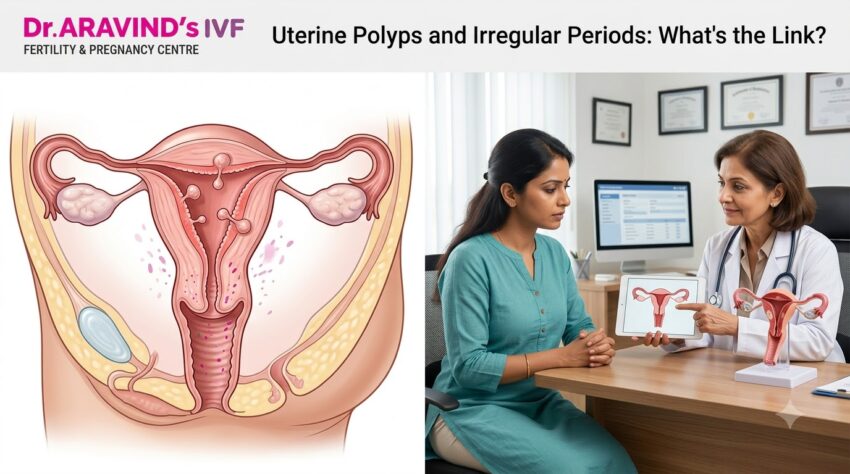
A period that arrives early one month, late the next, or suddenly becomes much heavier can leave you wondering what changed. Hormones are one possible reason, but they are not the only one. Small growths inside the uterus can also affect the way bleeding occurs. Uterine Polyps develop from the inner lining of the uterus and may cause changes in menstrual bleeding, although some women have no symptoms at all.
Understanding the possible link can help you know when irregular periods need a closer look.
What are uterine polyps?
A uterine polyp is a growth that forms from the endometrium, the tissue lining the inside of the uterus. It may be as small as a few millimetres or larger.
Most polyps are non-cancerous. Some remain small and cause no noticeable problems. Others can disturb the normal surface of the uterine lining and lead to unusual bleeding.
Polyps can occur at different ages, but they are more often found during the years around perimenopause and menopause. Hormonal changes, particularly the effect of estrogen on the uterine lining, may play a role in their development.
How can polyps affect periods?
The connection is mainly related to bleeding rather than simply changing the date of a menstrual cycle.
A polyp can make the uterine lining more likely to bleed irregularly. A woman may notice:
- Periods that become heavier than usual
- Bleeding that lasts longer
- Spotting between periods
- Bleeding after sexual intercourse
- Periods that seem unpredictable
- Bleeding after menopause
For example, someone may have regular periods for years and then begin noticing light spotting several days before menstruation. Another woman may experience a normal period followed by unexpected bleeding a week later.
These patterns can occur with polyps, but they can also happen for many other reasons. A bleeding pattern alone cannot confirm that a polyp is present.
Irregular periods do not always mean a polyp
This is where it is important not to jump to conclusions.
Changes in menstrual cycles may happen because of normal hormonal shifts, especially during adolescence, after pregnancy, or during the years leading up to menopause. Polycystic ovary syndrome, thyroid disorders, fibroids, adenomyosis, certain medicines, major weight changes, and other health conditions can also affect periods.
Stress may influence cycles too, but persistent or unusual bleeding should not automatically be blamed on stress.
A medical assessment helps separate a temporary cycle change from a problem that needs treatment.
When should irregular bleeding be checked?
Occasional variation may not be concerning, but repeated changes deserve attention.
Consider speaking with a gynecologist if your periods have suddenly become much heavier, you regularly bleed between periods, bleeding occurs after sex, or your periods continue to be irregular without a clear reason.
Bleeding after menopause should always be assessed by a healthcare professional.
This is particularly important for women who are trying to become pregnant. Abnormal bleeding may point to a uterine problem that needs to be identified before fertility treatment is planned.
How are polyps diagnosed?
The first step is usually a discussion about your menstrual history and symptoms. Your doctor may then recommend an ultrasound.
A transvaginal ultrasound uses a small probe to create images of the uterus and can sometimes identify a growth within the uterine cavity.
If the picture is unclear, saline infusion sonography may be recommended. A small amount of sterile fluid is placed inside the uterus during an ultrasound, helping the doctor see the shape of the cavity more clearly.
Another test is hysteroscopy. A thin camera is passed through the vagina and cervix to view the inside of the uterus directly. If a polyp is found, it may sometimes be removed during the same procedure.
The choice of test depends on the symptoms and the findings from the initial examination.
What about fertility and irregular periods?
Not every woman with a polyp will have difficulty becoming pregnant. However, a growth inside the uterine cavity can sometimes affect the environment where an embryo needs to implant.
For patients seeking advice from an IVF Hospital in Ariyalur, the uterine cavity may be assessed along with ovulation, ovarian reserve, fallopian tubes, sperm health, and other fertility factors.
If a polyp is found, the doctor may consider its size, position, symptoms, and the person’s pregnancy plans before deciding whether removal is appropriate.
Treatment is therefore not based only on the presence of a polyp. The wider picture matters.
Can irregular periods return to normal after treatment?
If a polyp is responsible for abnormal bleeding, removing it may help improve bleeding symptoms. However, the result depends on the actual cause of the irregular periods.
Hysteroscopic removal is commonly used when treatment is needed. The growth can be removed through the natural passage without an abdominal incision. The tissue is usually sent for laboratory examination so its cells can be checked carefully.
Some small polyps may be monitored instead of immediately removed, depending on symptoms and individual circumstances.
Know when a period change needs attention
An irregular cycle is not automatically a sign of something serious, but a new or persistent change should not be ignored. Uterine Polyps are one possible cause of unusual bleeding, and a simple evaluation can help identify whether they are actually responsible.
Dr.Aravind’s IVF Fertility & Pregnancy Centre can provide reproductive health assessment for women who are concerned about abnormal bleeding or fertility-related uterine problems. The right next step depends on the individual findings rather than the symptom alone.