
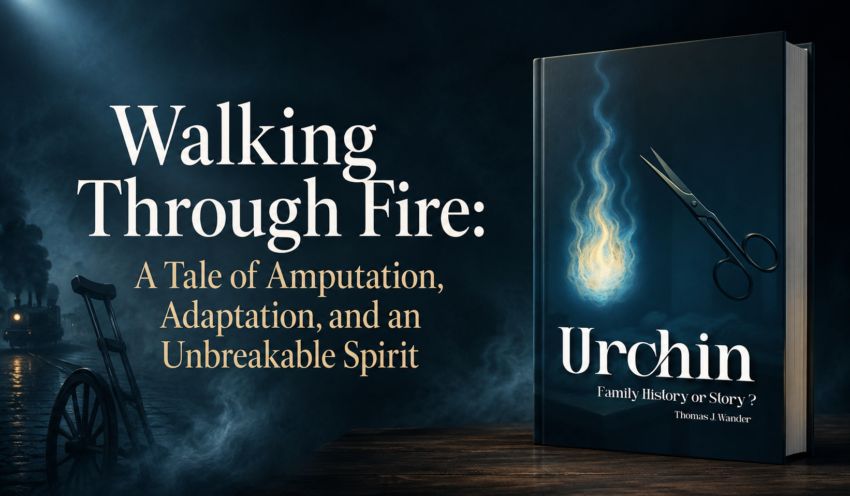
In the annals of nineteenth-century warfare, few words carried as much immediate, paralyzing terror as grapeshot. The battlefields of the Napoleonic era were butcher’s yards, and the medical tents were often places of last rites rather than recovery. To suffer a shattered limb in the mud of a foreign campaign was, almost without exception, a death sentence. Infection, shock, and the crude, unsterilized saws of exhausted field surgeons claimed those whom the artillery did not immediately kill.
Yet, in Thomas J. Wander’s masterful historical novel, Urchin: Family History or Story?, a catastrophic injury becomes the crucible for one of literature’s most compelling tales of human resilience. Through the harrowing physical and psychological journey of a ten-year-old Dutch boy, Wander offers a raw, unflinching look at disability and survival in an unforgiving century. The novel does not merely chronicle the loss of a limb; it meticulously charts the reclaiming of a life.
The Shattered Night
The violence of the nineteenth century rarely announced itself. For Johannes, the young captive who has come to be known as Urchin, the moment that divides his life into “before” and “after” occurs during a seemingly routine night watch.
Standing guard over the wagons of his surrogate family of Travelers, Urchin is suddenly thrust into the nightmare of a Russian Cossack ambush. The attack is swift and deafening. A cannon fires into the darkness, its payload ripping through the campsite. In a chaotic blur of concussive force and searing agony, Urchin is thrown violently backward. He awakens days later in a haze of fever and pain, peering down at the foot of his makeshift bed to discover a horrifying reality: his right leg, from the knee down, has been obliterated.
Wander’s depiction of this trauma is a triumph of empathetic storytelling. He does not gloss over the boy’s despair. Urchin’s immediate reaction is one of profound psychological devastation. Stranded hundreds of miles from his home in Gorinchem, entirely dependent on a ragtag group of camp followers, and suddenly rendered a “cripple” in a society that discards the weak, he wants nothing more than to succumb to the blackness. He weeps for his mother. He wishes to die.
It is in this abyss that the true narrative brilliance of Urchin takes hold. The author forces us to witness the agonizing, incremental steps of choosing to live when survival feels impossible.
The Medicine of the Earth
If the cannonball represents the indiscriminate cruelty of war, the aftermath highlights the desperate ingenuity of those who endure it. Urchin is not saved by a decorated military surgeon, but by the women of the Travelers’ camp, specifically Elayne and Annette, self-taught nurses who have learned their trade in the blood-soaked field hospitals of the Grande Armée.
Wander leans into fascinating historical details regarding alternative, grassroots medicine. Lacking sterile bandages or modern antibiotics, Elayne relies on a bitter tea and a specialized green paste made from rare forest mosses—likely a form of sphagnum moss, known historically for its natural antiseptic and absorbent properties. It is a grueling, touch-and-go recovery, fraught with the constant specter of lethal infection. The changing of the bandages is a daily agony, yet it is through this intimate, excruciating care that Urchin begins to understand the profound depths of the makeshift family that has adopted him.
They refuse to let him die. And eventually, Urchin refuses as well.
The Artisan’s Ultimate Masterpiece
The transition from a bedridden invalid to an active participant in his own survival marks a turning point in the novel. A lesser story might have simply handed the boy a pair of crutches and moved the plot along. Wander, however, remembers who his protagonist is: a deeply observant, incredibly gifted apprentice tailor and cobbler.
Urchin’s journey toward mobility is inextricably linked to his craftsmanship. When a crude branch serving as a crutch proves insufficient for the muddy, snow-covered roads of a Polish winter, Urchin takes matters into his own hands. Living temporarily in the cabin of an ancient village healer known as Grandmother Danuta, he is introduced to a Polish craftsman named Casimir.
What follows is one of the most conceptually beautiful sequences in the novel. Casimir does not simply build a leg for Urchin; he teaches the boy how to construct it himself. Using a small axe, raw timber from the forest, and his deep, pre-existing knowledge of leatherwork from his Uncle Bertus’s cobbler shop, Urchin carves his own salvation. He fashions a wooden stump, cuts the intricate grooves required for the leather straps, and even designs a webbed snowshoe attachment to prevent the peg from sinking into the winter mud.
He is no longer the passive victim of a Cossack cannon. He is the architect of his own mobility. By strapping that wooden leg to his body, Urchin physically integrates his artisan skills with his flesh and bone.
Walking With a New Cadence
The psychological impact of this adaptation is profound. The wooden leg alters his gait, introducing a literal and metaphorical limp, but it also alters his worldview. He learns to navigate wet, slippery leaves and the treacherous ruts of wagon trails. He is forced to confront the stares of strangers and the cruel taunts of older boys who see only a “half-man cripple.”
Yet, the disability ultimately becomes a source of unexpected power. Because he cannot rely on the speed of his legs to flee from danger, he must rely entirely on the sharpness of his mind and the quickness of his hands. The wooden leg necessitates a tactical brilliance that a whole-bodied boy might never have developed. It teaches him to stand his ground, a lesson that culminates in a jaw-dropping, visceral fight for his life against a murderous French soldier in an abandoned barn—a fight where the wooden leg itself becomes the instrument of his survival.
Thomas J. Wander’s Urchin is a masterclass in character development, but its most enduring legacy may be its depiction of trauma and adaptation. It reminds us that scars, whether visible or hidden, do not merely represent what we have lost. If we possess the courage to carve a path forward, our scars become the very foundation upon which we rebuild our lives. Through the rhythmic, determined thud of a wooden peg on a frozen road, Urchin offers a timeless anthem of survival.